



- Published on: 2026-10-16 01:31:50
Best Social Trading for Investors: How to Choose a Platform in 2026

A popular trader isn’t a risk plan. The best social trading for investors gives you room to assess the evidence, understand the risks, and decide how you want to participate. A polished profile or strong-looking track record may attract attention, but neither guarantees future results. Copying trades can also expose your capital to losses you didn’t expect.
Social trading can make it easier to follow markets and learn from other participants. But observing someone’s decisions and automatically copying them are different choices, with different levels of control and risk.
This guide compares social trading platforms using practical criteria: performance transparency, risk information, copying controls, and account fit. You’ll learn what to examine in a trader’s history and how to choose a measured next step that suits your experience and risk tolerance. We’ll also put TradingPRO’s social and copy trading ecosystem in context alongside its Rookie, Micro, Pro, and Scalp accounts. For newer traders, a Rookie Account may be a relevant starting point, but account choice doesn’t remove market risk. Trading through a brokerage also isn’t the same as owning physical shares.
Key Takeaways
- The best social trading for investors is a setup you can assess using consistent criteria, not a leaderboard you follow based on popularity alone.
- Compare how platforms present trader histories and strategies, and distinguish available information from promotional claims.
- Set personal risk limits and review a strategy before copying, rather than letting another trader’s decisions determine your exposure.
- TradingPRO’s social and copy trading ecosystem is part of a brokerage offering Rookie, Micro, Pro, and Scalp accounts.
What makes social trading useful for investors, and where its limits begin
Choosing the best social trading for investors starts with separating access to ideas from decisions about capital. Social trading brings market participants and their activity into a shared environment. Users may observe strategies, exchange information, and, on some platforms, replicate another trader’s transactions. For a broad overview of the concept and how it relates to copy trading, see What is Social Trading?
That access can make different market perspectives easier to explore. A newer investor might use a trader’s stated approach as a prompt to research an asset or consider how a strategy responds to changing conditions. An experienced investor might compare several viewpoints with their own analysis. In either case, social information is a starting point for judgment, not a substitute for it. A confident post or popular profile doesn’t establish that a strategy is suitable or likely to perform well.
Keep the risk in view. Markets can move against a copied position, and past performance can’t promise future results. A headline return alone may not show how risky a strategy is: its trading history, approach, and potential losses also matter. If copying is automated, trades may be replicated without your reviewing each one individually. You still bear the financial consequences of participating. Social trading can support learning or convenience, but it can’t remove market risk or make another person accountable for your choices.
Social trading and copy trading are not interchangeable
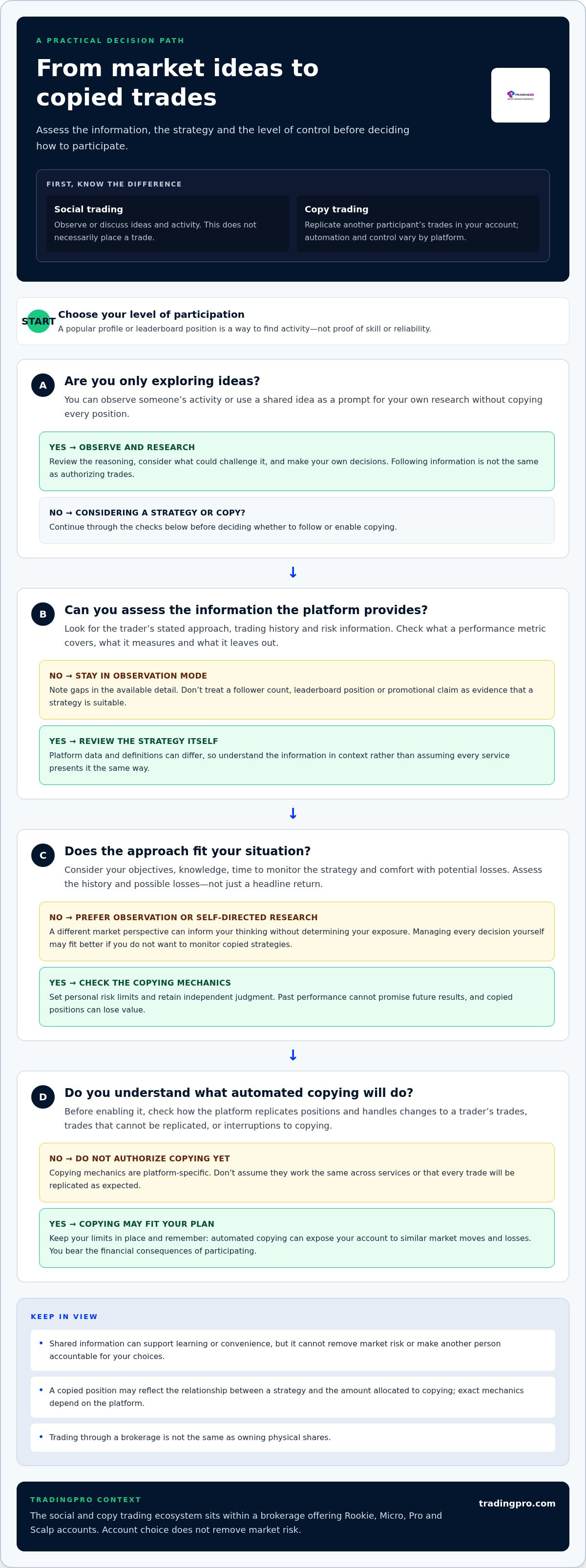
Social features let users observe or discuss trading ideas without necessarily placing a trade. Copy trading goes further by replicating another market participant’s trades in an investor’s account. The degree of automation and control depends on the platform. Some experiences focus on following information, while others enable automated replication. Before participating, understand whether you’re viewing a strategy or authorizing trades to be copied.
Who may benefit from a social trading approach?
Newer investors may value exposure to different market perspectives, provided they treat those perspectives as information to assess, not a shortcut to guaranteed results. Experienced investors can use shared ideas to challenge or supplement their own analysis while retaining independent judgment. Self-directed research may be a better fit if you prefer to make and manage every decision yourself, or don’t want to monitor copied strategies and accept the risks they carry. Choose a level of participation that matches your knowledge, time, and comfort with potential losses.
How social trading platforms connect investors, strategies, and trades
A social trading platform can bring several decision points into one process: discover a market participant, review the available information about their approach, decide whether to follow their activity, and choose whether to place trades yourself or use copying tools. Finding a trader is not the same as assessing a strategy, and following an account doesn’t necessarily mean authorizing trades.
What you can see depends on the platform. One may show a trader’s stated approach or trading history; another may present different risk indicators or less detail. Don’t assume that every platform defines or displays performance information in the same way. Before relying on a metric, check the period it covers, what it measures, and what it leaves out. A leaderboard position or follower count can help you find traders, but neither establishes skill or reliability on its own.
From observing market ideas to following a strategy
Use shared ideas as prompts for your own research. If a trader discusses a particular market, review the reasoning, consider what could challenge it, and decide whether it fits your objectives. You can follow someone’s activity for observation without copying every position. Keep a clear boundary between learning from another person’s decisions and giving a platform permission to replicate them.
Think of the process as a set of choices, not a single click:
- Discover: Find traders or strategies using the information the platform presents.
- Review: Examine available history, strategy details, and risk information, and note any gaps.
- Decide: Continue observing, use the ideas for independent analysis, or consider copying if it suits your plan.
What changes when trade copying is automated?
With manual participation, you review an idea and decide whether to place a trade yourself. Automated copying replicates another participant’s trades in your account according to the platform’s process. If the copied trader takes a position, your account may gain similar market exposure. If that position loses value, your account is exposed to losses too.
Replication may be proportional in concept: a copied position can reflect the relationship between the strategy and the amount allocated to copying, rather than simply matching the other trader’s trade size. The exact mechanics are platform-specific, so don’t assume they work the same everywhere. Before enabling copying, understand how the service handles changes to a trader’s positions, situations where trades can’t be replicated, and interruptions to the copying arrangement. These details shape what happens after your initial decision.
The best social trading for investors makes the process understandable before capital is exposed: what information is available, what actions are automated, and where you retain control. TradingPRO’s social trading ecosystem lets clients automate trades by copying other market participants. To explore its brokerage environment, you can review TradingPRO account access and keep the distinction between observing and copying in mind as you decide what suits you.
How to compare social trading platforms without chasing popularity
Compare platforms by what they let you assess and control, not by how crowded their leaderboards look. A large following or prominent ranking may help you discover traders, but it can’t tell you whether their approach suits your goals. The best social trading for investors makes it easier to examine the available information, understand the terms, and decide how much authority to give a copied strategy.
Assess the quality of trader and strategy information
Look beyond the headline return. Check what information is available about trading history, performance over time, market exposure, and drawdowns, meaning declines from a peak in account value. A short winning streak reveals little about how an approach may behave in different conditions. Rankings and follower counts are context, not proof of skill or a forecast of future results. If performance information is difficult to interpret, treat that as a limit on your assessment.
Use this framework to compare the information each platform makes available:
Transparency: Can you see how historical performance is presented, including the period covered and drawdowns?
Strategy information: Are the trader’s approach, activity, and exposure described clearly enough for you to understand what you’d be following?
Controls: Can you decide whether to copy, manage your participation, and stop copying? Understand what happens to existing positions when copying ends.
Costs and account terms: Review the disclosed charges and applicable account terms. Don’t assume fees or conditions are the same across platforms or account types.
Market access: Check whether the available instruments match your intended use and are offered under the relevant account arrangement.
Compare control, costs, and access before choosing
Look beyond the copy button. Understand how much of the process is automated, which decisions remain yours, and how you can change or end your participation. Then compare disclosed charges and account terms. A platform can offer appealing tools and still be a poor fit if its markets or terms don’t align with your plan.
Before committing, check which entity serves your jurisdiction, which terms apply to your account, and which instruments are available to you. A platform-wide description doesn’t establish that every feature or market applies in every region. For brokerage access, distinguish exposure to a market instrument from ownership of the underlying asset. The arrangement depends on the instrument and account terms.
Make a short comparison sheet. Record what you can confirm, what remains unclear, and which control matters most to you. This keeps your choice grounded in evidence and fit, rather than momentum or marketing language.
How investors can manage social trading risks before copying
Copied strategies can lose money. Past performance doesn’t guarantee future results, and automating a decision doesn’t reduce the market risk behind it. Treat copying as an investment choice that needs a plan, not a shortcut around one. Before following a trader, decide what you can afford to expose and what evidence would prompt you to reconsider.
A practical risk check before following a trader
Use this pre-copy routine to set your own boundaries before another participant’s trades enter your account:
- Set a personal exposure limit. Decide how much capital you’re willing to put at risk in copied strategies. Base the limit on your own finances and tolerance for losses, not the trader’s suggested allocation or popularity.
- Review the strategy, not just the return. Examine available history, drawdowns, typical holding patterns, and the market context behind the results. Consider whether you understand how the approach may behave when conditions change.
- Check how it fits your existing positions. Several traders can hold similar exposures, even if their profiles look different. Consider the combined effect instead of assuming that following more than one strategy automatically diversifies your risk.
- Set review and exit conditions. Decide in advance what would prompt you to reassess or stop participating, such as a change in strategy or a loss that reaches your personal limit. Write down your conditions so short-term market swings don’t dictate every decision.
- Monitor after you begin. Review your positions and the strategy’s activity at intervals that suit your plan. Automation can replicate trades, but it can’t decide whether the underlying approach still fits your goals.
Diversification may spread exposure across different strategies or markets, but it can’t eliminate losses. Positions that appear distinct may still respond to similar market conditions. A broader mix doesn’t guarantee a smoother result, so keep your total exposure within limits you can tolerate.
Verify safeguards and understand the service
Before participating, identify the legal entity that would serve your account and review the current terms and protections that apply in your jurisdiction. Regulatory requirements and investor protections can vary by entity and location. Read the relevant account information and understand the broker relationship and product structure, including what you’re trading and how copied positions are handled.
TradingPRO provides brokerage and trading access, not physical share ownership. Exposure through a brokerage product isn’t the same as owning the underlying shares. The best social trading for investors supports informed choices, but no platform removes market risk. If you’ve set your limits and are ready to explore TradingPRO’s brokerage environment, begin your TradingPRO account registration with your risk plan in place.
How TradingPRO social trading fits your next investing step
TradingPRO brings social and copy trading into a broader brokerage environment. Its social trading ecosystem lets clients automate trades by copying other market participants, connecting trader ideas with brokerage access. That can be a way to participate, but it doesn’t remove the need to understand the strategy, account terms, or potential losses. Social trading is a tool for informed decision-making, not a promise of income or performance.
Choose an account based on your experience, intended use, and comfort with market risk. Don’t select an account tier based on its name alone or assume one tier is right for every trader. Compare the relevant account information and terms, then decide whether the arrangement fits how you plan to trade or use copying.
Match your experience to a TradingPRO account tier
For newer traders, the Rookie Account is a relevant option to explore as a starting point. TradingPRO also offers Micro, Pro, and Scalp accounts. The names identify the available tiers, but they don’t replace a review of each account’s terms. Consider your experience and intended approach, then use the published Rookie Account details to inform your assessment rather than assuming specifications.
Before choosing a tier, clarify what you want from social trading. Are you mainly interested in observing other market participants, or do you intend to automate copied trades? How much time can you give to monitoring your activity? What level of loss could you tolerate? Your answers help you focus on the account terms that matter to your plan and keep the decision grounded in your needs, rather than a label or another trader’s results.
Take a measured first step into social trading
Review the applicable account terms and your risk tolerance before participating. If you choose to copy trades, set personal exposure limits and make time to review the strategy and your positions. Automation can replicate another participant’s activity, but it can’t judge whether their decisions remain suitable for you. Keep responsibility for your choices firmly in your hands.
The best social trading for investors supports informed participation while leaving room for deliberate decisions. TradingPRO’s Rookie, Micro, Pro, and Scalp accounts sit alongside its social and copy trading ecosystem, so you can consider account fit and participation together. TradingPRO provides brokerage and trading access, not physical share ownership. Keep that distinction in mind as you assess the products and markets available under the relevant account terms.
Ready to take a considered next step? Register with TradingPRO and review your account options before deciding how you want to participate.
Make your next move with a clear plan
Your next step doesn’t have to be an immediate decision to copy trades. Set a personal rule for how you’ll evaluate strategies, what would make you pause, and how often you’ll review your participation. That framework gives you a stronger basis for choosing the best social trading for investors who want access to market perspectives while retaining control over their decisions.
TradingPRO has operated since 2017, with social and copy trading as part of its brokerage environment. Use registration as a starting point to explore account options and applicable terms, then decide how they fit your experience and risk tolerance. There’s no need to rush into copying. Make each choice with a clear view of what you’re agreeing to and what you can afford to risk.
Register with TradingPRO to explore your account options and take your next step with purpose. A measured approach can help you engage thoughtfully while keeping your decisions your own.
Frequently Asked Questions
Is social trading suitable for beginner investors?
It can be useful for beginners who treat it as a way to observe market perspectives, not as a substitute for learning. For example, compare a trader’s reasoning with independent market information before deciding whether it makes sense to you. Before enabling copying, learn how the platform displays positions and how you can end participation. If you can’t explain a strategy’s risks in your own words, pause rather than copy it.
Can social trading guarantee profits?
No. A copied trade can lose money, and past performance can’t establish what will happen next. A trader may face new market conditions, change their approach, or experience losses after a strong period. Don’t treat rankings or recent gains as a promise of future results. Before participating, consider how a loss would affect your finances and whether the strategy’s potential downside fits your risk tolerance.
How much money should I put into copy trading?
There’s no single amount that suits every investor. Consider your financial commitments and whether you could withstand losing the amount you allocate. Don’t use money needed for essential expenses or borrow to copy trades. Review the relevant account terms and jurisdictional requirements before acting. If you need a decision tailored to your circumstances, speak with a qualified financial adviser rather than relying on a trader’s suggested allocation.
What happens if a trader I copy starts losing?
Your copied positions may lose value too. The effect depends on the positions, market movements, and how the platform handles copying. Review your positions and exposure instead of relying only on the trader’s overall performance figure. Decide in advance what would prompt you to reassess or stop following. Don’t assume copying will automatically stop at a loss limit unless the applicable platform terms explicitly describe that safeguard.
Is social trading the same as owning shares in a company?
No. Social trading doesn’t by itself mean you own the underlying asset. Your legal and financial exposure depends on the broker, product, account terms, and jurisdiction. TradingPRO provides brokerage and trading services, not physical share ownership. For example, access to a price movement through a brokerage product isn’t the same as holding company shares directly. Review the product structure so you understand what your account activity represents.
Do I need to copy trades to use social trading?
No. You can use social features to follow market commentary or compare ideas without authorizing trade replication. For instance, an investor might read how participants discuss a market, research it, and make an independent decision through their account. Copying is a separate choice, and functions vary by platform. The best social trading for investors is the approach that fits their goals, experience, and comfort with automation.


