




- Published on: 2026-09-04 10:22:25
Can Trading Be a Full Time Job? The 2026 Guide to Professional Market Mastery

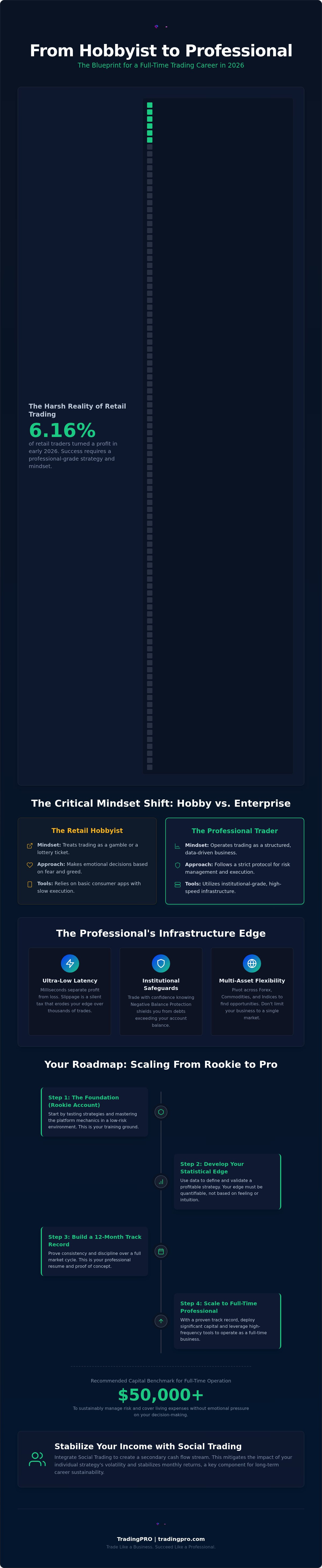
Only 6.16% of retail traders realized a profit in early 2026. This statistic reveals a harsh reality; most participants are bringing a knife to a high-speed digital gunfight. You're likely asking: can trading be a full time job in such a competitive landscape? The answer is a resounding yes, but only if you abandon the retail hobbyist mindset. Professional mastery requires institutional-grade infrastructure and a cold, calculated business strategy.
We understand the frustration of inconsistent monthly returns and the burnout that follows market volatility. You're ready to trade the 9-to-5 for total financial sovereignty. This guide provides the raw reality and the technical roadmap for that transition. We'll break down the $50,000 capital benchmark, essential risk ratios, and the high-performance tools needed to scale. From starting with a Rookie Account to mastering high-frequency Scalp execution, you'll learn how to operate with the precision of a global leader.
Key Takeaways
- Shift your mindset from gambling to enterprise management by mastering the professional discipline required for high-stakes market hours.
- Uncover the financial benchmarks and capital requirements that answer the ultimate question: can trading be a full time job in the 2026 market?
- Leverage institutional-grade infrastructure and high-speed execution to gain a decisive competitive edge over standard retail participants.
- Integrate Social Trading into your routine to stabilize monthly cash flow and mitigate the impact of individual strategy volatility.
- Map your professional progression from initial Rookie Account testing to a consistent, 12-month track record of risk-adjusted returns.
The Reality of Full-Time Trading: Freedom vs. Discipline
Stop treating the markets like a digital casino. If you want to know can trading be a full time job, you must first accept that it's a high-stakes business enterprise. It's not a hobby for your spare time. It's a rigorous profession that demands institutional-level commitment. Professional trading is the consistent extraction of edge over luck. While passive investors wait for long-term growth, full-time traders actively hunt for inefficiencies. To understand the foundational mechanics of this career, one should first grasp the basic structure of What is Day Trading? and how it differs from traditional stock picking. You're building a business, not just clicking buttons.
The "Freedom Myth" often lures retail hobbyists into the fray. They imagine trading from a beach with minimal effort. The "Discipline Reality" is far more demanding. You are the CEO, the risk manager, and the executioner. Market hours are your office hours. Success requires a psychological shift from a "salary mindset" to an "equity mindset." You no longer trade time for money. You trade precision and risk management for profit. This means your income isn't tied to your effort, but to the quality of your decisions under pressure.
The Mental Fortitude of Professional Market Access
Trading for a living means accepting that a paycheck isn't guaranteed. You'll face drawdowns. These periods of loss test your conviction and your strategy. Professional traders don't panic during a losing streak; they follow their protocol. The isolation of the solo trader can be a silent career-killer. Without a traditional team, you must regulate your own emotions during high-volatility sessions. You need to be your own high-performance coach. Mastery over your own psychology is just as important as your technical analysis. If you can't control your pulse when the candles turn red, you won't survive the year.
Why 2026 is the Best Year to Turn Professional
The barriers to entry have collapsed. In 2026, the democratization of institutional-grade tools has reached its peak. Retail users now access the same high-speed execution and deep liquidity once reserved for hedge funds. Global markets are more connected than ever. This connectivity offers endless multi-asset opportunities across different time zones. You aren't limited to a single exchange or asset class. The TradingPRO blog provides the educational foundation for this shift, offering the technical insights needed to transition from a retail mindset to a professional one. This is the era of the empowered trader. Take advantage of the infrastructure available to you and start treating your terminal like the corporate asset it is.
Institutional Infrastructure: Why Your Broker Is Your Business Partner
Your choice of broker defines your ceiling. Many retail hobbyists treat their platform like a simple app on their phone; professionals treat it like a mission-critical server. If you are asking can trading be a full time job, you must evaluate your infrastructure with the same scrutiny as a hedge fund. Execution speed isn't just a technical spec. It is the direct barrier between your projected profit and your realized equity. In the fast-moving 2026 markets, a delay of a few milliseconds can turn a winning entry into a break-even struggle.
Professional risk management demands more than just a stop-loss. It requires a partner that provides institutional safeguards like Negative Balance Protection. This ensures that extreme market gaps don't result in debts that exceed your account balance. This security allows you to trade with the confidence required for full-time status. You need a multi-tiered account structure that evolves with you. The TradingPRO ScalpX account represents the pinnacle of this evolution, offering the raw, unfiltered market access necessary for high-frequency success.
Execution Speed and the Scalper’s Edge
Milliseconds determine your monthly income. When you transition from a retail hobbyist to a pro, you move from standard execution to ultra-low latency environments. Slippage is a silent tax that erodes your edge. Even a half-pip difference on every trade can devastate your monthly equity curve over a high-volume sample. Moving from a Rookie-tier setup to high-performance infrastructure is a non-negotiable step for anyone serious about professional mastery. Precision execution is your greatest competitive advantage.
Multi-Asset Flexibility for Global Coverage
Stability comes from diversification. Full-time pros don't limit themselves to a single pair or index. They pivot across Forex, Commodities, and Indices as volatility shifts. This agility is why professionals avoid the clunky limitations of physical ownership. They prefer the speed and liquidity of elite brokerage services. Using the TradingPRO Trade Hub, you can monitor global correlations and sentiment in real-time. This high-level overview allows you to deploy capital where the momentum is strongest. To secure your place in this elite environment, open your professional account and begin your transition today.
The Math of Full-Time Trading: Capital and Sustainability
Leverage is your most potent tool when applied with institutional precision. It allows professional-grade accounts to capture significant market movements without tying up massive amounts of personal equity. However, your Survival Ratio defines your longevity. The Survival Ratio is the total number of months your liquid reserves can sustain your lifestyle during a zero-profit period. If your ratio is less than six months, you aren't ready for a full-time transition. Real mastery is about staying in the game long enough for your edge to manifest.
Calculating Your Required Trading Capital
Market data from early 2026 suggests a minimum trading capital of $50,000 to generate a sustainable, livable income. A 5% monthly return on this amount yields $2,500, which serves as a baseline for many emerging professionals. Under-capitalization is the primary cause of retail failure. It forces traders to over-leverage and ignore risk protocols to meet basic needs. If you're still building your skills, Rookie Accounts provide the perfect environment for low-stakes professional practice. Use this stage to prove your strategy before committing your primary survival capital to the live market.
Risk Management: Protecting Your Primary Income
Pros never risk more than 1% of total equity on a single trade. This discipline ensures that even a 10-trade losing streak only results in a 10% drawdown, leaving your business intact. You must prepare for drawdown periods that can last weeks or months. Markets don't always provide opportunity. Using automated stop-losses is mandatory to remove human hesitation from the equation. High-performance trading is about protecting what you have so you can capitalize on what's coming. Control your downside, and the upside will take care of itself.
Social Trading as a Stability Engine: Diversifying Your Career
Active trading is exhausting. If you're asking can trading be a full time job, you've likely realized that staring at charts for 12 hours daily often leads to diminishing returns. Professional market mastery in 2026 involves a hybrid approach. You don't have to carry the entire weight of your equity curve on your own shoulders. By integrating Social Trading, you create a stability engine that generates income even when your primary strategy is out of sync with the current market cycle. It's about diversifying your career path through the proven expertise of others.
Vetting signal providers requires institutional-grade scrutiny. Don't be blinded by simple ROI. Analyze maximum drawdown, win rates, and consistency over a 12-month period to ensure your capital is in safe hands. For a deeper dive into these mechanics, consult our Social Trading vs Copy Trading Guide. This resource breaks down how to identify elite performers who maintain professional risk standards. With the global social trading market projected to reach $2.82 billion in 2026, the pool of talent is deeper than ever.
Replicating Success: The Mechanics of Copy Trading
Copy Trading automates portfolio growth by replicating the trades of institutional-grade signal providers in real time. This significantly reduces the emotional burden of 100% active trading. You're effectively hiring a team of specialists to work for you. Once you've established your own track record, you can scale your income further by becoming a provider yourself. This creates a secondary revenue stream, turning your unique edge into a scalable business product.
Building a Multi-Strategy Social Portfolio
A robust social portfolio mixes diverse strategies to handle any environment. Combine trend-following with mean-reversion and high-frequency scalping to ensure performance across all market conditions. Use the social feed to identify emerging leaders before they become mainstream. This allows you to balance active Rookie account growth with passive replication. It's a frictionless way to expand your market footprint. To start building your diversified trading business, register your professional profile and access our global network today.
The Roadmap: Scaling from Rookie to Professional
Transitioning to the markets is a surgical process. It requires a tiered strategy that moves you from a retail hobbyist to an institutional-grade operator. The question of can trading be a full time job is answered by your ability to follow a roadmap without skipping steps. You don't just "go pro" on a whim; you earn it through a sequence of calculated upgrades. Follow this five-step progression to ensure your business remains sustainable over the long term.
- Step 1: Master the fundamental mechanics on a Rookie or Micro account to protect your initial capital while learning.
- Step 2: Build a 12-month track record of consistent, risk-adjusted returns to prove your edge is statistically significant.
- Step 3: Gradually increase your position sizing while strictly maintaining a 1% risk-per-trade limit.
- Step 4: Transition to a Pro or Scalp account to benefit from tighter execution and higher-speed infrastructure.
- Step 5: Diversify your equity curve by integrating social trading replication into your broader business model.
The Transition Phase: Trading While Working
Don't burn your bridges before you've built the foundation. Successful pros often start by managing positions alongside their primary career. Use high-performance mobile tools to monitor the markets during your day job. You must establish clear "Exit Milestones," such as reaching your $50,000 capital goal or sustaining six months of profitable trading. To accelerate this capital growth, leverage the TradingPRO Deposit Bonus. This allows you to scale your buying power and reach your full-time benchmarks faster without increasing your personal risk exposure.
Your First 90 Days as a Full-Time Trader
The first three months of total sovereignty are the most dangerous. You must establish a professional routine immediately. This starts with a rigorous trading journal to track every execution and emotional state. Treat your trading office like a command center. Invest in high-speed tech and redundant internet connections to ensure you never stall during a high-volatility session. Your environment should reflect your status as a global market leader. If you're ready to leave the amateur ranks behind, start your professional journey today by registering your Rookie Account and take control of your financial destiny.
Take Command of Your Market Destiny
Professional mastery is a choice, not a lucky break. You've discovered that can trading be a full time job is a question answered by discipline, capital math, and institutional infrastructure. By shifting from a retail hobbyist to a business-first operator, you position yourself among the elite few who extract consistent value from global volatility. Whether you're scaling through active execution or diversifying with social trading, your roadmap to sovereignty is now clear.
TradingPRO acts as your high-performance partner in this journey. We offer a multi-asset brokerage environment equipped with institutional execution and the essential safety of Negative Balance Protection. Our dedicated Rookie to Pro career path ensures you have the right tools at every stage of your evolution. Don't let another market cycle pass you by while you remain on the sidelines.
Join the Global Elite: Register Your TradingPRO Account Now
The 2026 landscape is rich with opportunity for those ready to act. Step into your role as a professional trader and start building your legacy today.
Frequently Asked Questions
How much capital do I really need to trade full-time in 2026?
A capital base of $50,000 is the recommended benchmark for a sustainable transition. This figure allows for a conservative 5% monthly return to cover basic living expenses. While you can begin practicing on a Rookie Account with less, can trading be a full time job only when your capital supports both market drawdowns and your household burn rate. Professional longevity requires this specific financial foundation.
Is full-time trading more stressful than a 9-to-5 job?
Stress levels are often higher than a 9-to-5 due to the direct link between performance and survival. Unlike traditional employment, there is no guaranteed paycheck. However, using institutional-grade tools and risk management protocols reduces emotional volatility. Pros treat it as a business, shifting from a salary mindset to an equity mindset to manage the psychological burden. Mastery over your own pulse is a non-negotiable requirement.
Can I trade full-time while still working my current job?
You can manage a hybrid phase using mobile execution and automated tools while maintaining your current employment. This allows you to build a 12-month track record before resigning. Transitioning from a part-time interest to asking can trading be a full time job requires hitting specific exit milestones. You should secure at least three times your monthly expenses in liquid cash reserves before committing to the markets full-time.
What is the success rate for full-time retail traders?
Data from early 2026 indicates only 6.16% of retail participants are profitable. This low rate stems from a lack of discipline and professional infrastructure. Success requires moving beyond a hobbyist approach and utilizing multi-tiered accounts, such as the Scalp Account, to gain a competitive edge. You must operate with the precision of a global leader to join this elite minority of earners who extract consistent value.
How do I handle taxes and insurance as a self-employed trader?
Professional risk management dictates that you never risk more than 1% per trade. If a catastrophic event occurs, TradingPRO provides Negative Balance Protection to ensure your losses never exceed your account deposit. Maintaining separate living reserves outside your trading capital is the ultimate safeguard against total financial failure. Protecting your downside is the first rule of professional market mastery. Your survival is the highest priority.
How many hours a day do full-time traders actually work?
Active screen time typically ranges from 4 to 6 hours during peak liquidity sessions. However, the total business day includes pre-market analysis and post-trade journaling. Efficiency is prioritized over duration. Pros use high-speed execution tools to capture moves quickly, allowing them to exit the market once daily profit targets or risk limits are reached. It's about the quality of your decisions, not the clock.
Is copy trading a reliable source of full-time income?
Social trading is a reliable component of a professional income strategy. It functions as a stability engine by allowing you to replicate institutional-grade signal providers. This diversification helps flatten your equity curve during periods when your personal strategy is out of sync with market volatility. It is a scalable business product that empowers you to earn while you continue to master the markets. Use it to stabilize your career.


