




- Published on: 2026-08-29 10:11:55
Conflict of Interest with Brokers: The 2026 Guide to Trading Transparency

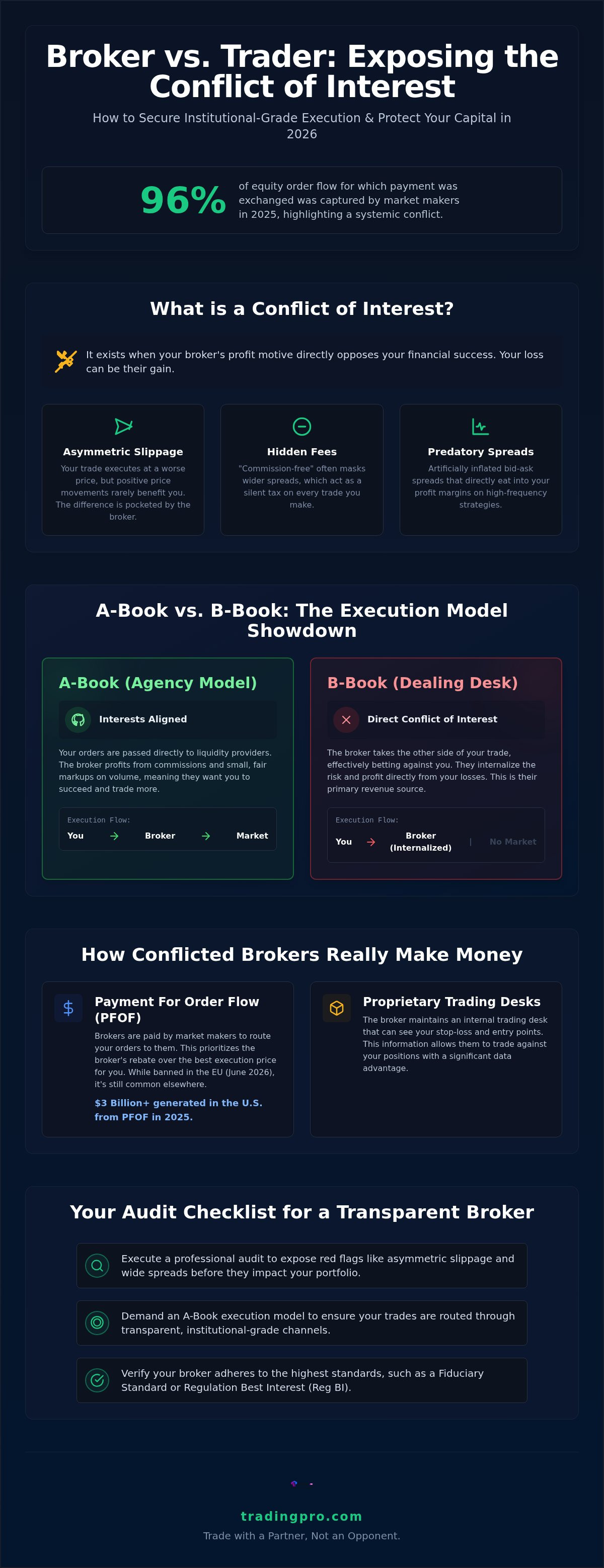
In 2025, market makers captured a massive 96% of equity order flow for which payment was exchanged. This staggering figure underscores the persistent conflict of interest with brokers that continues to challenge retail traders in 2026. You've likely felt the impact of slippage on high-frequency trades or watched hidden fees quietly eat into your profit margins. It's a common frustration to wonder if your broker is actually the one taking the other side of your trade through a B-Book model. You deserve better than predatory spreads that undermine your success.
This guide empowers you to master the mechanics of broker incentives to protect your capital and secure institutional-grade execution. We'll show you how to find a partner with aligned interests, whether you're managing a high-octane Scalp Account or protecting a diverse social trading portfolio. You'll gain the clarity needed to navigate the June 2026 EU ban on payment for order flow and other critical regulatory shifts. We're breaking down the complex world of A-Book versus B-Book models to ensure you trade with the confidence of a global leader. Prepare to elevate your strategy with total transparency and peak performance.
Key Takeaways
- Master the revenue mechanics of spreads and commissions to eliminate hidden costs and maximize your trading margins.
- Decipher the A-Book versus B-Book execution models to ensure your capital is routed through transparent, institutional-grade channels.
- Execute a professional audit to expose any conflict of interest with brokers, identifying red flags like asymmetric slippage before they impact your portfolio.
- Leverage specialized account infrastructure to secure the precision and speed required for elite-level market performance.
- Transition to a transparent trading environment where your success is the priority, utilizing tools designed for global-scale momentum.
Defining Conflict of Interest in Modern Brokerage
The global trading arena moves at breakneck speed. In this high-stakes environment, clarity is your most valuable asset. A What is a Conflict of Interest? exists when your service provider's profit motive directly opposes your financial success. This fundamental disconnect is the silent killer of retail portfolios. Historically, it appeared as hidden commissions. Today, it has evolved into sophisticated, predatory execution models designed to harvest your capital through artificial slippage and internalizing risk.
Elite performance requires a safe-haven approach to transparency. You cannot scale your strategy if your broker wins every time you lose. As of August 2026, the SEC continues to tighten the screws through Regulation Best Interest (Reg BI). This mandate forces firms to identify and mitigate any conflict of interest with brokers that could compromise retail recommendations. It's a necessary shift toward institutional stability in an era of unprecedented market volatility.
The Fiduciary Standard vs. Regulation Best Interest
A fiduciary standard is the gold standard of financial care. It demands that a broker acts solely in your best interest. While Reg BI provides a robust baseline for accountability in the US, other jurisdictions are taking even bolder steps. The European Union's full ban on payment for order flow, effective June 30, 2026, marks a global turning point. For serious traders, these regulations are just the starting point. Dominant brokers go beyond compliance. They build systems that eliminate the incentive to trade against the client. If you're entering the markets for the first time, the Rookie Account serves as a secure gateway, providing the transparency needed to build a foundation for long-term growth.
Why Transparency is Your Competitive Edge
Transparency is a functional tool for profit. When your broker's incentives align with yours, execution quality improves instantly. You'll see higher fill rates and a sharp reduction in predatory slippage. This alignment creates a frictionless trading experience where you can focus on strategy rather than skepticism. Trading with a partner instead of an opponent removes the psychological friction that often leads to hesitation. Execution integrity is the alignment of broker revenue and trader success. By choosing a partner that prioritizes your results, you secure the institutional-grade speed and precision required to dominate the 2026 market landscape.
Revenue Mechanics: How Brokers Actually Make Money
Brokers aren't charities. They are profit-seeking entities. Understanding how they extract value is critical to your capital preservation. Most traders focus on the obvious fees. They ignore the structural incentives that create a deep-seated conflict of interest with brokers. In 2025, U.S. brokers generated $3 billion from options-related Payment for Order Flow (PFOF) alone. This revenue model incentivizes brokers to route your trades to market makers who pay the highest rebates rather than those providing the best execution speed or price. While the EU ban on PFOF takes full effect on June 30, 2026, many global participants still operate in this grey area.
Proprietary trading desks present another layer of risk. When a broker maintains an internal desk, they effectively become your competitor. They see your stop-loss levels and your entry points. This data allows them to trade against your positions with mathematical precision. High-frequency traders must pivot to platforms that prioritize execution over internal profit-taking. It's about securing a partner, not a rival. Adhering to FINRA rules on conflicts of interest, transparent platforms disclose these revenue streams clearly to ensure you aren't trading in the dark.
The Spread Trap: Hidden Costs in 'Commission-Free' Trading
"Commission-free" is often a marketing mask for wider spreads. This wide gap acts as a silent tax on every position you open. For a high-frequency trader, even a fractional pip of spread markup can destroy the mathematical edge of a strategy. Identifying these markups is a primary step in auditing your provider. To achieve institutional-grade results, you need raw market access. The Scalp Account eliminates this friction by offering zero-spread potential, ensuring your profits stay in your pocket.
Copy Trading Incentives: Protecting the Follower
Social trading introduces a unique dynamic to the transparency debate. In traditional brokerage, the conflict is firm versus client. In social networks, it's often leader versus follower. Predatory platforms reward strategy leaders based on volume rather than performance. This encourages reckless trading to generate rebates at the follower's expense. Aligned networks use performance-based fees instead. This ensures the leader only profits when you do. For a deeper dive into these dynamics, explore our Social Trading Masterclass.
Securing your edge requires an environment where incentives are aligned. If you're ready to trade with a partner that values your execution speed, open your account today.
A-Book vs. B-Book: The Execution Model Showdown
Speed and transparency are the twin pillars of elite trading. Behind the sleek interfaces of 2026 platforms lies a critical engine: the execution model. This determines whether your provider is a facilitator or a competitor. Choosing the wrong model creates a structural conflict of interest with brokers that no amount of strategy can overcome. To dominate the markets, you must understand where your orders go after you hit the buy button.
Execution models generally fall into two categories: A-Book and B-Book. While both are legal under current regulations, their impact on your bottom line is vastly different. High-performance traders demand an environment where their success is celebrated, not hedged against. In 2026, the hybrid model has also emerged as a way for brokers to manage risk while maintaining institutional-grade standards for their most active participants.
The B-Book Conflict: Profiting from Trader Loss
B-Book execution, often called the "Casino Model," relies on internalizing risk. A Market Maker is a broker that acts as the counterparty to every trade. When you buy, they sell; when you lose, they profit. This creates a toxic incentive to manipulate prices or employ re-quotes during periods of high volatility. Professional traders avoid this trap. They require an environment where the broker's success is tied to volume, not client liquidation. If your broker wins when you lose, you aren't trading in a fair market; you're playing against the house.
A-Book Integrity: Aligned for Growth
A-Book execution utilizes Straight Through Processing (STP) to route orders directly to external liquidity providers. In this model, the broker acts as a pure intermediary. Your success doesn't hurt their bottom line. Instead, they focus on providing deep liquidity pools and institutional-grade routing to ensure frictionless trading. By removing themselves from the profit equation, A-Book brokers prioritize your fill rates and execution speed. This alignment is the only way to scale a high-frequency or high-volume strategy effectively. To see this infrastructure in action, leverage the Trade Hub for precision analysis and institutional tools.
Execution speed is the ultimate metric of a conflict-free environment. In a transparent setup, there is no incentive to delay your order or provide a sub-optimal fill. Every millisecond saved is a testament to the broker’s commitment to your success. By 2026, elite brokers have optimized their routing to ensure that "execution integrity" isn't just a buzzword, it's a functional reality. Choose a partner that invests in infrastructure, not one that bets against your potential.
Stop guessing and start auditing. Your trading performance isn't just about your strategy; it's about the environment where that strategy lives. Identifying a conflict of interest with brokers requires a proactive, data-driven approach. Predatory providers rely on retail traders who don't know what to look for. They hide behind complex terms while quietly harvesting your margins through five critical red flags.
- Asymmetric Slippage: This is a common warning sign. You'll notice that price movements against you are filled instantly, while movements in your favor suffer "slippage" that reduces your profit.
- Aggressive Leverage Pushing: Predatory brokers market extreme leverage to newcomers. This isn't about empowerment; it's about accelerating the path to a margin call.
- Opaque Liquidity Sources: If a broker cannot name their tier-1 liquidity providers, they're likely internalizing your risk in a B-Book model.
- Restrictive Withdrawal Policies: Watch for terms that link your own deposited capital to "bonus" trading volume requirements, effectively locking your funds.
- Frequent Re-quotes: If your platform freezes or rejects orders during high-impact news events, the broker is protecting their own interests at your expense.
Analyzing Execution Quality Reports
Data is the ultimate disinfectant. Monthly execution reports reveal the raw truth about your broker's integrity. Look beyond the surface levels. Analyze the variance between your requested price and the actual fill price across hundreds of trades. Third-party audits verify that "Average Fill Speed" isn't just a fabricated marketing metric. When a broker provides millisecond-level data, they signal institutional-grade transparency. If these reports are unavailable or overly simplified, the conflict is often baked into the system.
The Bonus Trap: Aligned or Entrapped?
Deposit bonuses are a double-edged sword. Some use them to entrap capital, while others use them to amplify your market reach. The difference lies in the clarity of the terms. Evaluate the TradingPRO Deposit Bonus for a model of transparency that supports your growth without hidden hurdles. Elite traders prioritize execution speed and capital mobility over "free" credit. Ensure your incentives are designed to accelerate your success, not hinder your withdrawals. Don't let hidden conflicts undermine your precision. Register for a transparent account and experience execution built for winners.
TradingPRO Infrastructure: Built for Execution Excellence
TradingPRO isn't just a service provider; it's your institutional-grade infrastructure partner. We've engineered our platform from the ground up to eliminate the structural conflict of interest with brokers that often drains retail capital. By offering a multi-tiered account structure, we ensure every trader finds an environment where their specific strategy can flourish without interference. Our commitment to transparency isn't a marketing slogan. It's a functional reality built into every server and routing protocol we operate. We provide the tools and the confidence for you to excel in the fast-moving landscape of 2026.
For those entering the market, the Rookie Account serves as a secure safe-haven. It's designed to protect new participants from the predatory execution models and hidden fees that often characterize entry-level brokerage. We've stripped away the complexity to offer a clear, reliable entry point. This allows you to focus on mastering market mechanics while enjoying the same security as our high-volume professionals. It's about building a foundation of success through consistent excellence and unshakeable reliability.
Tailored Environments for Every Strategy
Elite performance requires a setup that matches your specific trading DNA. We minimize friction by aligning our account types with your chosen style. If you're a high-frequency professional, our Scalp Account delivers the precision execution and raw market access you demand. It's built on institutional-grade infrastructure that prioritizes fill speed and eliminates the delays associated with B-Book desks. We also offer Micro, Pro, and Social Trading accounts to ensure a perfect fit for every level of ambition. For a deeper look at how to choose your path, explore our analysis of the Best Broker for Rookie Traders to dominate the markets this year.
The Future of Transparent Trading
We leverage tech-forward solutions to create a frictionless, elevated trading experience. Our global presence isn't just about scale; it's about providing you with access to a diverse and deep liquidity pool. This ensures competitive pricing and superior execution even during periods of extreme market volatility. We act as a proactive facilitator for your success, maintaining a cutting-edge image through constant innovation. The movement of our platform is always upward and outward, expanding your potential with every trade. Experience the power of a partner that values your time and efficiency above all else. Register now to experience institutional-grade transparency and secure your place at the top of the market.
Dominate the Markets with Absolute Transparency
Transparency is your ultimate high-performance tool. You've mastered the mechanics of broker incentives and learned to spot the red flags that undermine your capital. Now, the path to institutional-grade success is clear. Eliminating the conflict of interest with brokers isn't just about safety; it's about maximizing every pip of your potential. Trade with a partner that mirrors your ambition and provides the infrastructure for global-scale growth. It's time to leave predatory models behind and embrace an environment built for your expansion.
TradingPRO delivers the institutional-grade execution speed and multi-tiered account flexibility required to scale any strategy. Our commitment to global regulatory compliance ensures a safe-haven for your capital while you pursue peak performance. Don't settle for sub-optimal fills or hidden markups. Secure your competitive edge with a TradingPRO account today. Your journey toward frictionless, institutional-grade trading starts now. Step into the future of the markets with absolute confidence.
Frequently Asked Questions
What is the most common conflict of interest with brokers?
The most frequent conflict of interest with brokers occurs when a firm acts as a Market Maker, taking the opposite side of your trades. This B-Book model means the broker captures your losses as their own revenue. While common, this setup creates a structural incentive for the firm to manipulate execution or widen spreads during volatility. Professional traders pivot toward A-Book environments to ensure their provider acts as a facilitator, not a competitor.
Is it legal for a broker to trade against its own clients?
It's legal in most global markets, provided the broker discloses its role as a Market Maker. Regulatory bodies like the SEC and FINRA require firms to manage these conflicts through policies like Regulation Best Interest. However, the legal landscape is shifting rapidly. The European Union's full ban on payment for order flow in June 2026 demonstrates a global trend toward forcing brokers to prioritize client execution quality over internal profit-taking.
How can I tell if my broker is an A-Book or B-Book provider?
Identify the model by auditing your execution speed and the frequency of re-quotes. B-Book providers often experience asymmetric slippage where your losses are filled instantly but your profits suffer delays. A-Book providers typically offer Straight Through Processing (STP) and deep liquidity from tier-1 banks. Transparent firms will explicitly state their execution venues. If a broker is vague about where your orders are routed, they're likely internalizing the risk themselves.
Does a 'zero commission' account always mean there is a conflict of interest?
Zero commission often masks a significant conflict of interest with brokers because the firm must recoup costs elsewhere. This usually happens through spread markups or rebates from market makers. In these scenarios, the broker might prioritize routing your trade to the highest bidder rather than the fastest executor. For high-frequency strategies, accounts that offer raw spreads and clear commission structures provide a much more transparent and reliable trading environment.
What is Payment for Order Flow (PFOF) and should I be worried about it?
Payment for Order Flow is compensation a broker receives for routing client orders to specific market makers. This practice accounted for $3 billion in U.S. broker revenue in 2025. It's a major concern because it incentivizes routing to the most profitable venue for the broker, not the best price for you. Regulatory pressure is mounting; the EU's June 2026 ban marks a massive victory for retail transparency and execution integrity.
How do TradingPRO accounts handle execution transparency?
TradingPRO utilizes institutional-grade infrastructure across all account tiers to ensure maximum alignment with trader success. From the Rookie Account for newcomers to the high-performance Scalp Account, we prioritize execution speed and raw market access. Our multi-tiered structure allows you to select an environment that fits your specific volume and strategy. We focus on providing deep liquidity and clear execution paths, ensuring we act as your facilitator, never your opponent.
Can copy trading help mitigate broker conflicts for beginners?
Copy trading can align interests if the platform rewards leaders based on performance rather than trade volume. This ensures the strategy provider only profits when the followers do. Beginners should look for social ecosystems that emphasize quality signals and transparent performance metrics. By mirroring the trades of a successful veteran on a robust platform, you bypass many of the predatory execution traps that plague unguided retail participants in the open market.
What should I do if I suspect my broker is manipulating my trades?
Start by documenting every discrepancy with timestamps, order IDs, and screenshots. Compare your fill prices against a neutral third-party price feed to verify if the slippage was market-driven or artificial. If the data shows a pattern of manipulation, file a formal complaint with the broker's compliance department. If the issue remains unresolved, escalate the matter to relevant regulatory bodies like the SEC, FINRA, or your regional financial authority for an official audit.


