




- Published on: 2026-10-22 05:57:49
How to build a following as a trader with realistic goals

Building a following as a trader takes consistent, visible discipline, not a promised return. Set a 12-month goal to improve your strategy, then build a routine you can sustain while you trade and share your decisions. Treat return targets as aims, not forecasts.
It’s natural to focus on performance when you want others to trust your approach. But credibility also comes from explaining your process, managing risk consistently, and being open about both winning and losing trades. A strong track record takes time to build, and no trading plan can guarantee an outcome.
This article helps you assess how much time different trading styles demand and set realistic expectations for progress and returns. You’ll learn how to define measurable goals, document decisions, and present performance with meaningful context for potential followers. Build the process first, and let trust grow from evidence.
Key Takeaways
- Set a 12-month goal focused on improving your strategy, and choose a trading timeframe that fits your routine and mindset.
- Build a sustainable posting schedule around useful, consistent updates rather than chasing rapid audience growth.
- Choose social platforms based on the formats you can maintain and the trading conversations you want to join.
- Share your decision-making process, risk controls, and lessons from losing trades instead of implying profits are assured.
- Keep clear records of trade entries, exits, reasons, and outcomes to make your performance easier to understand.
Motivation and time commitment
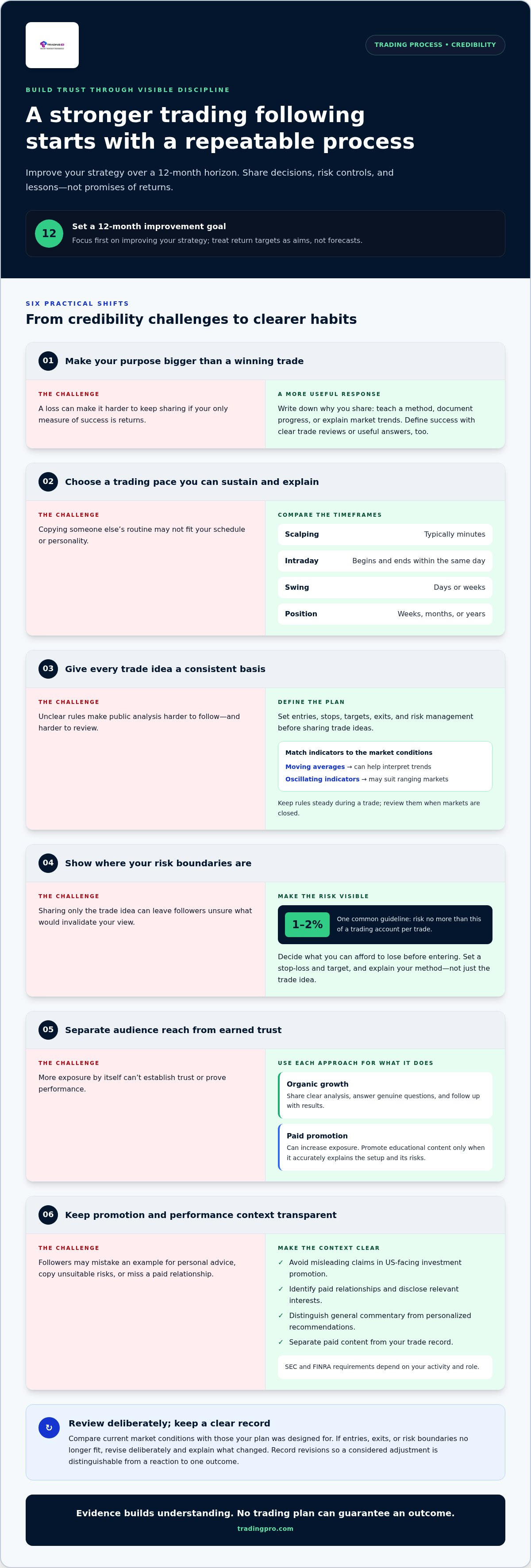
Set a 12-month goal for improving your strategy before measuring audience growth. Building a following as a trader takes steady effort across trading, reviewing decisions, and explaining what you learn.
- Choose a reason that can guide you through setbacks. Write down why you want to share your trading: to teach a method, document your progress, or explain market trends. Define success beyond returns, such as publishing clear trade reviews or answering useful questions. A specific purpose gives your posts direction when a trade closes at a loss.
- Match your trading timeframe to your personality and schedule. Scalping trades typically last minutes, while swing trades may stay open for days or weeks. Intraday trades begin and end within the same day; position trades can last weeks, months, or even years. Choose a pace you can explain consistently, rather than copying a trader whose routine doesn’t fit yours.
- Build a repeatable trading plan before sharing trade ideas. Define entries, stops, targets, exits, and risk management, then choose indicators suited to the market conditions you trade. Moving averages can help interpret trends, while oscillating indicators may suit ranging markets. Keep your rules steady during a trade and review them when markets are closed. This gives your public analysis a consistent basis.
- Set risk boundaries that protect your process. One common guideline is to risk no more than 1-2% of a trading account per trade. Decide what you can afford to lose before entering, and set a stop-loss and target. Explain your method, not just the trade idea. Followers should be able to see what would invalidate your view.
- Grow organically through useful posts; use paid promotion only for reach. Organic growth comes from sharing clear analysis, answering genuine questions, and following up with results. Paid promotion can increase exposure, but it can’t establish trust or prove performance. For example, promote an educational post only when it accurately explains the setup and its risks. Building a following as a trader depends on audience value, not ad spend alone.
- Keep promotion, monetization, and risk transparent. For US-facing investment promotion, avoid misleading claims, identify paid relationships, and distinguish general commentary from personalized recommendations. SEC and FINRA requirements depend on your activity and role. Sharing trades can lead followers to copy unsuitable risks or mistake an example for personal advice. If you monetize through sponsorships, subscriptions, or education, disclose relevant interests and separate paid content from your trade record.
Review your trading plan regularly and adjust it as market conditions change. Make this part of your routine instead of waiting for a difficult stretch to force a decision. Compare current conditions with those your plan was designed for, and consider whether its entries, exits, and risk boundaries still fit. If they don’t, revise the plan deliberately and explain what changed in your reasoning.
Keep a record of revisions so your approach remains understandable to you and anyone following your analysis. This helps distinguish a considered adjustment from a reaction to a single outcome. A sustainable review schedule matters more than frequent changes: review, decide whether conditions call for an update, and return to your rules with a clear rationale.
How can a trader build an audience on social media?
Building a following as a trader starts with a clear audience and a reason for people to return. Share what you know, make each post understandable on its own, and use responses to decide what deserves a deeper explanation. A practical process is more effective than trying to be everywhere at once.
- Choose the people you want to help. Decide whether you’re speaking to beginners learning chart basics or experienced traders comparing strategy ideas. Shape your examples for that group. A post explaining a stop-loss in plain language serves a different need from a detailed review of a swing-trading setup.
- Pick a clear editorial focus. Build your profile around a topic you can discuss in depth, such as market structure, trading psychology, or reviews of completed setups. A defined focus helps visitors understand why they should follow you. It also makes planning easier, because each new post can connect to a recognizable theme.
- Create a few recurring post formats. Try a chart annotation, a short lesson, and a weekly review. For example, use one post to explain a setup, then a later post to show how the market developed. Familiar formats give readers a reason to return without requiring you to invent a new approach every time.
- Set a schedule around your real routine. Choose posting days and formats you can maintain alongside trading and analysis. Draft educational posts after reviewing a completed session instead of interrupting a live decision to publish. A sustainable approach to building a following as a trader leaves time to think, trade, and respond thoughtfully.
- Make each post clear without extra context. Label chart timeframes, explain abbreviations, and state what the example demonstrates. If you share a chart showing resistance, add a sentence explaining how you identified the level. Readers should understand the point without guessing what the lines or labels mean.
- Invite discussion with focused prompts. Ask readers what market condition they see in a chart, or which part of a setup they’d like explained. Respond to good-faith questions with reasoning, not just a prediction. Useful conversations can show where your explanation needs clarification and inspire relevant follow-up posts.
- Review engagement for signs of learning. Notice which posts prompt thoughtful questions, saves, or requests for more detail. If a lesson about false breakouts sparks discussion, create a follow-up comparing chart examples. Use these signals to refine your content instead of changing direction whenever a post gets fewer reactions.
- Protect trust as your reach expands. Correct an outdated explanation when your view changes, and make the update easy to find. Keep trade examples contextual, and don’t imply that readers should copy your decisions. If you’re ready to put your own trading routine into practice, create a trading account as you continue sharing useful analysis.
Which platforms are best for growing a trading following?
Choose platforms whose formats suit your strengths. A chart walkthrough may suit YouTube; a concise market observation may fit X. Start with one primary platform, then adapt proven material elsewhere instead of creating separate content from scratch.
- Use YouTube for detailed explanations. Publish chart walkthroughs, trading journal reviews, or lessons on indicators. A longer video can show how an idea developed, where the setup failed, and what changed your view. Use clear titles that describe the lesson, such as “Reading a range before a breakout,” rather than promising results.
- Use X for timely market commentary. Post a concise observation about a trend, then add context in a thread. For example, explain which price level matters and what would invalidate your view. Avoid posting about every market fluctuation. Focus on analysis you can support and revisit later.
- Use Instagram for visual learning. Turn a chart into a carousel with one idea per slide: market context, setup, risk point, and lesson. Short Reels can introduce a concept, while captions add nuance. Keep chart labels readable on a phone and remove account details that could expose private information.
- Use TikTok for brief educational clips. Explain one trading term or chart concept in each video. For instance, contrast a breakout with a false breakout using a clearly labeled example. Keep the explanation accurate despite the short format, and direct viewers to fuller context on your profile.
- Use Reddit to contribute to focused discussions. Find communities where members discuss trading concepts, then answer specific questions with your reasoning. A post explaining why a setup failed can be more useful than a promotion. Read each community’s rules before sharing links, trade ideas, or account information.
- Use Discord for ongoing community conversation. Organize channels around topics such as market analysis, terminology, and trade reviews. Set clear expectations for discussion, including how members should label opinions and discuss risk. Moderation matters: remove spam and discourage claims that imply certain profits.
- Test platform fit with a content pilot. Choose one format you can produce repeatedly, such as a weekly YouTube review or several short X posts. Track substantive replies, saves, and follow-up questions. These signals show whether people understand and value the material better than raw views alone.
- Repurpose carefully instead of copying blindly. Turn a YouTube lesson into an Instagram carousel, then share its main takeaway on X. Adjust the level of detail for each audience and platform. Keep the original context intact, especially when discussing a trade’s outcome, so a short excerpt doesn’t distort your analysis.
What trading content attracts followers without promising profits?
- Explain the reasoning behind a trade idea. Show the chart context, the signal you noticed, and what would invalidate your view. For example, a 20-bar Donchian breakout can illustrate how a trader identifies a new high. Explain the method, not a predicted return. Readers gain a process they can examine rather than a promise to follow.
- Turn losing trades into practical reviews. Describe the original setup, your decision, and what the outcome taught you. For instance, explain how a breakout failed to hold, then identify which part of your plan guided your exit. Keep the review factual. A loss can demonstrate discipline without dressing a setback up as success.
- Teach one concept at a time. Create a short explainer on terms such as support, resistance, stop-loss, or volatility. Use one chart example and define unfamiliar language before applying it. A post about a false breakout, for example, can show why price moving above resistance doesn’t prove the move will continue.
- Show how you prepare, not just what you trade. Walk through a pre-market checklist, a watchlist, or a post-session review. Explain how a trend, range, or scheduled market event changes the questions you ask. This gives followers a repeatable learning framework and keeps the focus on decision-making rather than a single trade result.
- Publish scenario analysis with clear alternatives. Present a bullish case, a bearish case, and the condition that would weaken each view. For example, a price breakout may continue if buyers remain active, while a quick return into the range changes the setup. Scenarios show uncertainty honestly without claiming to know the next move.
- Make risk management visible in examples. Explain where a trade idea stops making sense and how position size relates to a predefined loss limit. Don’t present a risk figure as a universal prescription. Instead, show how changing the stop distance affects the amount exposed, using a hypothetical chart rather than urging followers to copy your position.
- Compare tools by their limits as well as their uses. Demonstrate how a moving average may help read a trend, then show a range where it gives confusing signals. Explain the market conditions in each chart. This balanced format helps readers understand that indicators are tools for analysis, not stand-alone forecasts.
- Keep claims grounded in complete context. If you discuss a winning setup, include the time period, decision rules, and relevant losing examples. Don’t present a selected result as proof of future performance. A clear caption can explain that the post is educational and that trading outcomes aren’t guaranteed, keeping expectations realistic.
How can traders demonstrate credibility and verify performance
- Keep a complete record for every trade. Log the entry and exit points, the reason for taking the trade, and its outcome. Add the date, market, setup, and any rule that guided your decision. A record that includes losing trades gives readers more context than a highlight reel of profitable positions.
- Use consistent rules throughout the record. Document your trading plan before presenting results, including entry criteria, exits, and risk controls. If you change a rule, mark when the change took place. This helps readers distinguish one version of a strategy from another instead of treating every result as part of a single, uninterrupted track record.
- Show the full sample, not selected screenshots. Share a chronological account history or trade log with winning and losing positions included. Explain what the sample covers and which markets or setups it contains. Testing a strategy over at least 100 trades gives a wider basis for evaluation than a few carefully chosen examples.
- Separate realized results from open positions. Label closed trades separately from positions that remain active. Explain whether a displayed figure includes fees and other transaction costs, and use the same method in each update. Readers can then understand what the result represents instead of mistaking an unrealized gain for a completed outcome.
- Explain performance with context. Pair any return figure with the period, strategy, and risk involved. Describe drawdowns, losing streaks, and changes in exposure alongside gains. A trader who reports only the best result leaves out information needed to assess the process. Don’t turn one period into a forecast of future performance.
- Preserve evidence that supports each update. Keep dated statements, screenshots, and journal entries that correspond to published trades. Remove sensitive account details before sharing. If a chart is edited for clarity, retain an unedited record. This creates a clear trail connecting the original decision, the final outcome, and the public explanation.
- Review the record on a fixed schedule. Review trades weekly to identify repeated errors, rule changes, or setups that need more analysis. Optimize a strategy only after a larger sample, such as 50 or more trades. Record what changed and why, so later readers can follow the development rather than see unexplained shifts.
- Make transparency part of your public profile. Pin a post explaining your method for recording trades, reporting results, and correcting mistakes. Then keep every update consistent with that standard. If you’re ready to apply a disciplined approach to trading, register for a trading account and put your process into practice.
Keep every update consistent with the method you’ve described, and correct omissions plainly when you find them. The author states that he has taken thousands of trades using the same rules and setups. That continuity gives readers a basis for considering whether reported results reflect a repeatable process, while the complete record and supporting evidence let them assess outcomes for themselves. Don’t imply that a long history guarantees future results. Credibility comes from making the method, its limits, and revisions visible, including when performance is disappointing. A transparent account helps readers distinguish documented experience from claims they cannot independently assess.
TradingPRO: Rookie Account
TradingPRO’s Rookie Account is a practical next step if you’re ready to put your trading routine into action while continuing to develop your audience. Apply the approach you’ve been documenting to make deliberate trading decisions and maintain a consistent record. Building credibility still depends on transparent communication, not account choice or promised returns.
If you want to explore how traders’ strategies can be followed, TradingPRO also offers Social Trading / Copy Trading. Consider how this option fits your own goals and approach to risk. Micro, Pro, and Scalp Accounts offer additional choices for different trading styles.
Visit TradingPRO to explore the Rookie Account and choose your next step.
Make Your Next Move Deliberately
Building a following as a trader is a long game. Let your next move strengthen the practice behind your public presence: choose an account that fits your trading approach, keep learning, and make each decision with care. TradingPRO offers Rookie, Micro, and Pro Accounts, giving you options to consider as your experience and goals develop.
Your audience can grow alongside your skills when you stay consistent, communicate honestly, and give people a clear view of how you think. Focus on progress you can demonstrate, not attention you can’t control. That mindset keeps your trading and public content grounded.
Ready to take your next step? Register with TradingPRO and choose a path that fits your goals. Build with discipline, share with purpose, and keep moving forward.
Frequently Asked Questions
How often should traders post to grow their audience?
Post on a consistent schedule you can maintain without compromising your trading decisions. For example, reserve a regular session to prepare educational posts, then share timely updates only when you have meaningful analysis. Track replies and saves to see whether your cadence gives readers enough value. If quality starts to slip, reduce the pace and focus on clearer, more useful posts instead of filling the feed.
What are the SEC and FINRA rules for traders promoting investments online?
For US-facing investment promotion, avoid misleading claims, disclose paid relationships, and distinguish general commentary from personalized recommendations. SEC and FINRA requirements depend on your activity and role.


