




- Published on: 2026-10-14 01:42:21
How to Calculate Margin Percentage in Trading: Formulas and Examples

A trading margin percentage isn’t a measure of profit. If you’re searching for how to calculate margin percentage, first identify which figure you need: the margin required to open a position or your account’s margin level after it’s open. Confusing either with business profit margin or markup can lead to a badly sized trade.
The calculation becomes clearer when you connect position exposure, leverage, required margin, and account equity. Leverage can reduce the funds required to open a position, but it doesn’t reduce the position’s exposure or the risk of a market move. Your equity and used margin also determine your margin level, a separate measure of how much headroom remains.
This guide breaks down the formulas, explains when to use each one, and walks through hypothetical calculations you can check before placing an order. The examples illustrate the arithmetic, not a universal requirement. Margin terms can vary by instrument and account, so use the calculation to understand the relationship, then apply the current terms for your trade.
Key Takeaways
- First decide whether you need the required margin percentage or your account’s margin level. They measure different things.
- Use the leverage ratio to calculate a generic margin percentage, then use the position’s notional value to estimate the required margin amount.
- Keep required margin, used margin, free margin, and equity distinct so you can interpret your account figures correctly.
- Before a trade, identify the instrument and position size, apply current relevant margin terms, calculate the requirement, and review the account impact.
- Use the result to assess collateral needs alongside downside exposure. A margin calculation can’t remove market risk.
What Does Margin Percentage Mean in Trading?
Trading margin is the portion of funds set aside as collateral to support a leveraged position. It isn’t a fee, a down payment that limits your exposure, or a measure of how profitable a trade is. The position’s market exposure can be larger than the funds allocated as margin, so even a relatively small price move may affect your account equity.
Trading margin percentage shows the share of a position’s value required as collateral, not the profit earned or lost. That distinction is central to understanding how to calculate margin percentage without confusing a trading requirement with a business performance measure. The Margin (finance) overview also describes how the term is used across financial markets.
Keep two trading figures separate. A required margin percentage describes the collateral needed in relation to a position. Account margin level compares your equity with the margin currently in use. Both are expressed as percentages, but they answer different questions.
Trading margin requirement versus margin level
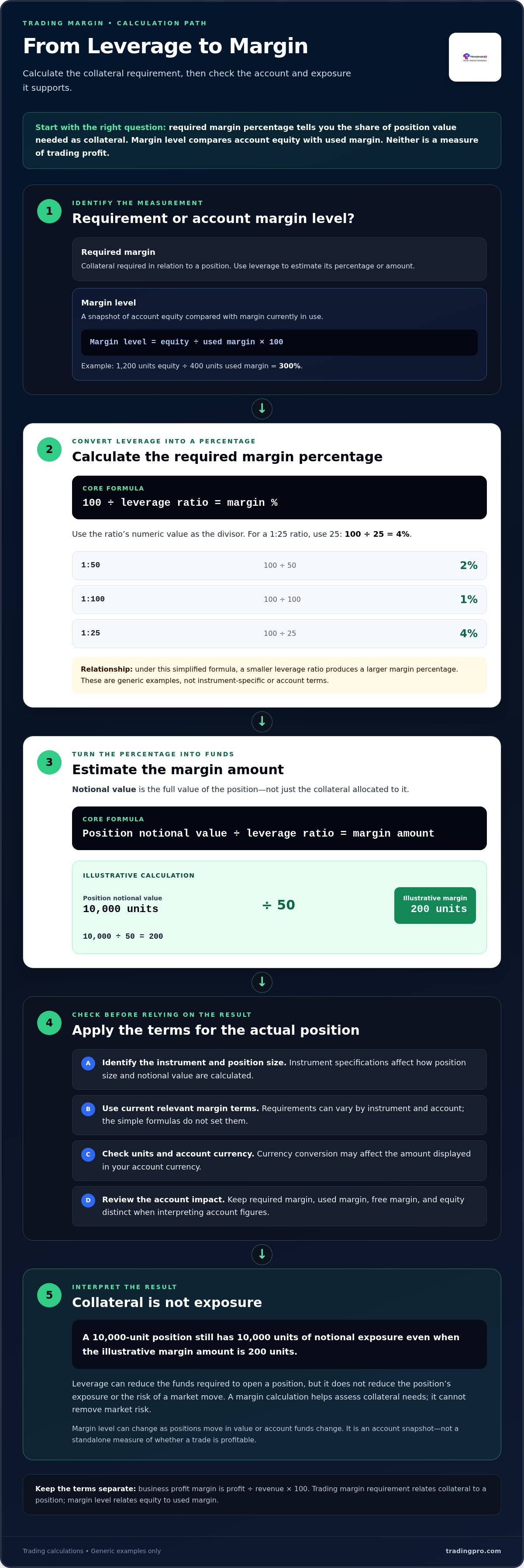
Required margin is collateral allocated to open or maintain a position. Margin level is equity divided by used margin, expressed as a percentage. For example, equity of 1,200 units and used margin of 400 units produce a margin level of 300%. The requirement relates to position support; the margin level reflects your account’s current condition.
A margin level is a snapshot based on account equity and used margin. It can change as positions move in value or account funds change. It doesn’t show whether a trade is profitable by itself, and a high margin level doesn’t eliminate the risk of loss.
Why profit margin is a different calculation
In business, profit margin is calculated as profit divided by revenue, multiplied by 100. A business earning 20 units in profit from 100 units in revenue has a 20% profit margin. That calculation compares sales revenue with business costs. Trading margin level compares account equity with used margin, while a margin requirement relates collateral to a position.
Before using any percentage, identify the question you’re answering: how much collateral supports the position, or how does your equity compare with margin already in use? Then choose the matching calculation. This keeps revenue, profit, exposure, equity, and collateral in their proper places as you prepare to assess a trade.
How to Calculate Trading Margin Percentage: The Core Formulas
Once you know you’re calculating a trading requirement, the leverage ratio gives you a straightforward starting point. For a simple leverage ratio, use required margin percentage = 100 ÷ leverage ratio. To estimate the funds needed for a position, use required margin amount = position notional value ÷ leverage ratio.
These formulas show the relationship between leverage and collateral. They aren’t a substitute for the current terms that apply to a specific instrument and account. The SEC Guidance on Margin Trading also explains that margin trading carries risks, so treat a calculation as one part of your pre-trade assessment.
Calculate required margin percentage from leverage
Use the leverage ratio’s numeric value, then express the result as a percentage. For a generic 1:50 ratio, divide 100 by 50 to get 2%. At 1:100, divide 100 by 100 to get 1%. These examples illustrate the formula only. They don’t represent TradingPRO account terms or the requirement for a particular instrument.
- Identify the leverage ratio that applies to your calculation.
- Divide 100 by the ratio’s numeric value.
- Express the result as a percentage.
For example, with a 1:25 ratio, calculate 100 ÷ 25 to get 4%. Keep the notation consistent: in a 1:25 ratio, 25 is the number used in the calculation. Under this generic formula, a smaller leverage ratio produces a larger margin percentage.
Calculate the margin amount for a position
Notional value is the full value of the position being opened, rather than just the collateral allocated to it. Divide that value by the numeric leverage ratio to estimate the margin amount. This converts the percentage-style requirement into an amount you can compare with available funds.
For a hypothetical position with a notional value of 10,000 units and a 1:50 leverage ratio, calculate 10,000 ÷ 50. The illustrative margin amount is 200 units. These figures are generic, not an account-specific requirement.
Leverage changes required collateral, not the position’s market exposure. In this simplified example, a position with 10,000 units of notional value still has that exposure, even if the calculated margin is 200 units. The effect of a market move depends on the position’s exposure, not just the collateral amount.
Actual calculations can involve more than simple division. Currency conversion may affect the amount shown in your account currency, while instrument specifications determine how position size and notional value are calculated. Use the correct units and current instrument-specific terms before relying on a result. The formula explains the relationship; it doesn’t set the applicable requirement.
Once you understand the calculation, you can create a TradingPRO account and explore the decisions involved in using a trading account.
Margin Requirement, Used Margin, and Margin Level: What Changes?
Once a position is open, account figures tell a different story from the leverage calculation alone. Required margin describes collateral needed for a position. Used margin tracks funds allocated to open positions, while equity and free margin show how your account stands as prices change. Margin level expresses the relationship between equity and used margin as a percentage.
Keep the units straight: some figures are amounts in your account currency, while margin level is a percentage. They aren’t interchangeable. Leverage is one part of understanding how a position uses margin. A forex trading beginner guide can help put the concept in context.
| Term | What it means | Typical form |
|---|---|---|
| Required margin | Collateral needed to open or maintain a position under applicable terms. | Amount or percentage, depending on the figure shown |
| Used margin | Funds currently allocated to support open positions. | Amount |
| Free margin | Equity remaining after used margin is accounted for. | Amount |
| Equity | Account balance adjusted for current unrealized profit or loss. | Amount |
| Margin level | Equity compared with used margin, expressed as a percentage. | Percentage |
How equity, used margin, and free margin relate
Equity moves with unrealized gains or losses in the account. Used margin is the portion allocated to open positions; free margin is the remaining equity after that allocation. In a simplified snapshot, a balance of 1,500 units and an unrealized loss of 100 units gives equity of 1,400 units. With 350 units of used margin, free margin is 1,050 units. This example assumes no other adjustments.
Free margin isn’t a separate pool of cash that guarantees you can open another position. The amount available for a new trade depends on the applicable requirements and how the account is calculated. Track equity, used margin, and free margin together to see how open trades and market movements affect available equity.
How to calculate margin level percentage
Use this formula: margin level = (equity ÷ used margin) × 100. With equity of 1,400 units and used margin of 350 units, divide 1,400 by 350, then multiply by 100. The result is a margin level of 400%. It describes the relationship between account equity and used margin, not profit as a share of sales revenue.
As unrealized losses reduce equity, the margin level can fall even if used margin stays unchanged. Terminology and intervention thresholds can vary, so don’t assume one percentage applies to every account. Use the current terms for your account to interpret the figure. When learning how to calculate margin percentage, keep amount-based measures separate from this account-level percentage.
How to Calculate Margin Percentage Before a Trade
A pre-trade margin check starts with two separate inputs: the position details and the current margin terms for your account and instrument. The formula helps estimate the collateral requirement, but the terms that apply to your trade determine which requirement to use. Margin isn’t a forecast of profit or a maximum-loss estimate. A smaller margin requirement does not make the underlying exposure smaller.
- Identify the instrument and position size. Work out the position’s notional value using the instrument’s specifications and the units you intend to trade.
- Find the applicable margin terms. Use the current terms for the relevant instrument and account. Don’t assume a generic leverage example sets your actual requirement.
- Calculate the requirement. Apply the stated percentage to the notional value, or use the applicable leverage ratio if the terms provide one.
- Review the account impact. Consider the required funds alongside your account equity, open positions, and possible downside before deciding whether the trade fits your plan.
Work through one hypothetical trading calculation
Assume an illustrative position has a notional value of 12,000 units, a leverage ratio of 1:40, and no currency conversion because the notional value and margin are both stated in the same account currency. These assumptions simplify the arithmetic; they don’t describe any account’s actual terms.
First calculate the requirement: 100% ÷ 40 = 2.5%. Then calculate the margin amount: 12,000 units ÷ 40 = 300 units. With the same 12,000-unit position at 1:30, the illustrative requirement becomes 100% ÷ 30 = 3.33%, and 12,000 units ÷ 30 = 400 units. The position value stays constant; the required margin changes with the ratio.
Check the result and avoid common calculation errors
Before relying on a result, check that you’ve read the leverage notation correctly, converted percentages consistently, used the correct position units, and accounted for the account currency. If the instrument’s notional value is in a different currency, conversion may affect the displayed margin amount. Contract specifications and applicable terms can also change the calculation inputs.
Keep margin percentage separate from profit percentage and return on investment. Those figures describe performance; margin estimates collateral. A required margin of 2.5% doesn’t mean a trade can lose only 2.5%, or that it will earn that amount. The position’s market exposure remains central to assessing risk.
Trading preparation involves more than calculating the initial requirement. Track how the proposed position fits alongside open trades and account equity, and revisit the calculation if the position size or relevant terms change. Use the result as a planning aid and compare it with the current terms for your account.
Use Margin Calculations to Prepare for Your Trading Account
A margin calculation is most useful as part of a consistent pre-trade routine. It helps estimate collateral needs and shows how a proposed position may affect your account. It doesn’t predict the trade’s result or remove market risk. A leveraged position can lose value, and the amount of margin required isn’t a cap on potential losses.
Before placing a trade, run through this checklist:
- Choose the formula. Decide whether you need the required margin percentage, margin amount, or account margin level.
- Confirm the inputs. Identify the instrument, position size or notional value, leverage ratio, and relevant account figures.
- Use current account terms. Base instrument-specific requirements and intervention thresholds on the current terms for your account.
- Assess the downside. Consider how an adverse price move could affect equity and available funds, not just how much collateral the position initially requires.
That’s the practical value of learning how to calculate margin percentage: you can check whether the figures make sense before committing to a position, while keeping exposure and risk in view.
Build a repeatable margin-check routine
Keep the key numbers distinct in your notes: position notional value, leverage, required margin amount, and account margin level. Recalculate if the position size, instrument, or account equity changes. A calculation made for one setup may no longer describe another. For instrument-specific requirements or intervention thresholds, use the current terms that apply to your account rather than carrying forward an old assumption.
Use consistent units and label what each figure represents. Don’t label an amount as a percentage or treat the position’s notional value as the collateral set aside. A clear record makes it easier to spot an input error and review the account impact before taking action.
Continue from calculation to account familiarization
Get comfortable with account terminology before placing a leveraged trade. Understand the differences between position requirements, used margin, free margin, equity, and margin level. TradingPRO offers the Rookie Account as well as Micro, Pro, and Scalp accounts, each designed for different trader profiles and experience levels. Reviewing the account options can help you understand the environments available without assuming that any one tier suits every trader.
Take time to understand the applicable terms and how your calculations fit into your broader risk plan. Margin math can sharpen preparation, but it can’t guarantee an outcome or make a trade safer by itself. Treat the calculation as one decision tool, and consider whether the potential downside is acceptable before opening a position.
TradingPRO also offers Social Trading and Copy Trading, which let clients automate trades by copying experienced market participants. Whichever account features you explore, keep your own understanding of margin and risk central to your decisions.
Make Margin Knowledge Part of Your Next Step
Good preparation isn’t about finding a number that removes uncertainty. It’s about building a habit of checking the relevant terms, understanding your account figures, and deciding whether the potential downside fits your plan. Keep that discipline in place as market conditions and positions change.
Knowing how to calculate margin percentage gives you a stronger starting point for evaluating a leveraged trade, but it can’t predict price movements or guarantee an outcome. Use your calculations as part of the process of learning about the account and instruments you intend to use.
TradingPRO provides multi-asset brokerage and trading services, with Rookie, Micro, Pro, and Scalp account tiers. Explore the account options at your own pace, and keep your decisions grounded in current terms and your risk plan.
Review the available account options and register with TradingPRO when you’re ready to take the next step.
Frequently Asked Questions
How do you calculate margin percentage in trading?
To work out how to calculate margin percentage in trading, first decide which percentage you mean. Required margin percentage is generally 100 divided by the leverage ratio; margin level is equity divided by used margin, multiplied by 100. Leverage relates position exposure to required collateral, while equity is account balance adjusted for unrealized profit or loss. For a real order, apply the current instrument-specific terms for your account, since a generic formula may not set the actual requirement.
What is the formula for required margin percentage?
The generic formula is 100 divided by the numeric value of the leverage ratio. For example, with hypothetical 1:50 leverage, calculate 100 ÷ 50 to get a 2% required margin percentage. This example shows the arithmetic only; it doesn’t establish the requirement for a real trade. Actual margin terms may differ by instrument, account, and applicable conditions, so use the current terms relevant to your position before relying on a figure.
How do you calculate margin level as a percentage?
Calculate margin level as equity divided by used margin, multiplied by 100. Equity is the account balance adjusted for unrealized gains or losses; used margin is the amount allocated to support open positions. For a hypothetical account with 900 units of equity and 300 units of used margin, 900 ÷ 300 × 100 gives a 300% margin level. This describes account condition, not the margin percentage required to open a position.
Is trading margin percentage the same as profit margin?
No. Trading margin relates to collateral needed for a leveraged position, or to equity compared with used margin. Business profit margin is profit divided by revenue, multiplied by 100. The first concerns a trading position or account; the second measures profit relative to sales. Check the context before calculating: if a trading platform asks for margin information, don’t enter or interpret a business profit-margin figure as a trading requirement.
Can leverage change the margin percentage required for a trade?
Yes. Under the generic inverse relationship, higher leverage corresponds to a lower required-margin percentage for the same notional position. For example, moving from a hypothetical 1:25 ratio to 1:50 changes the calculated percentage from 4% to 2%. That reduces the illustrative collateral requirement, not the position’s market exposure or trading risk. Real requirements depend on current instrument and account terms, so don’t treat this comparison as an account-specific quote.
What happens if your margin level falls?
A falling margin level means account equity has become smaller relative to used margin. This can happen if unrealized losses reduce equity, or if used margin rises as positions change. Brokers may have intervention or position-closeout processes, but thresholds and policies vary by account and instrument. Review the current terms that apply to your account to understand the process. Don’t assume a generic example or another broker’s threshold applies to your account.


