




- Published on: 2026-10-18 10:31:34
How to Use Trading Signals Effectively: A Practical 2026 Guide

A trading signal is a starting point, not a command. Even a clear entry alert may lack the context you need, and conflicting indicators or a losing trade can expose the danger of acting on autopilot. Using trading signals effectively means treating each alert as evidence to assess, not an instruction to follow.
It’s reasonable to want faster, clearer decisions in a fast-moving market. But no signal guarantees a winning trade, and a promising setup can still lose. The value lies in understanding what a signal says, what it leaves out, and whether it fits your own plan.
This practical 2026 guide shows you how to assess signal sources, check market context, and test an approach before risking capital. You’ll build a repeatable process for handling conflicting views, setting entry and exit criteria, and defining risk before you act. Social and copy trading can offer another perspective, but they don’t replace your judgment. Use signals with discipline, and keep control of every decision.
Key Takeaways
- Read a signal as a possible direction, timing cue, or market condition, not a forecast of what must happen.
- Before acting, check the signal’s rules, source, timeframe, current market context, and the condition that would invalidate it.
- Compare technical, event-based, and sentiment signals by their inputs and limitations to find what suits your approach.
- Make using trading signals effectively part of a repeatable workflow: define your rationale, invalidation point, position plan, and exit before considering a trade.
- Social and copy trading can expose you to other traders’ strategies, but copying doesn’t remove market risk or ensure a particular outcome.
What Are Trading Signals, and What Can They Actually Tell You?
A trading signal is evidence that may inform a potential trading decision. It could flag a possible direction, suggest a moment to pay attention, or identify a market condition. It doesn’t tell you what will happen next. Treat it as a prompt to investigate, not a guaranteed buy or sell instruction.
A signal is not a trade plan. A plan sets out why you might enter, what would prove the idea wrong, where you intend to exit, and how much risk you’re prepared to take. An alert that says “potential upward momentum” may offer a clue, but it doesn’t define a suitable entry, stop level, position size, or exit. Those decisions need their own rationale.
Meaning depends on context. A moving-average crossover on a short chart may reflect a brief price fluctuation, while the same pattern on a longer timeframe can point to a broader trend. An alert for one asset may also behave differently on another because price movements, liquidity, and market drivers differ. Economic announcements, changing sentiment, or a sudden shift in volatility can weaken a signal that looked relevant moments earlier.
That’s why using trading signals effectively starts with asking what evidence produced the alert and what conditions it assumes. Check the asset and timeframe, then compare the alert with price action and the wider market context. If you can’t explain the signal in plain language, you don’t yet have enough information to build a decision around it.
How do trading signals get generated?
Signals can draw on technical indicators, price action, economic data, or market sentiment. A rules-based system might alert when one moving average crosses another, while an RSI reading may flag unusually strong or weak recent price movement. Neither indicator, on its own, tells you whether a trade is appropriate. A signal may be identified manually, generated by fixed rules, or produced by an algorithm analysing market data.
What a signal cannot tell you
No alert can account for every market move or remove the risk of loss. A delayed signal may arrive after the price has moved; one without timeframe or method details may be difficult to interpret. New information can also change the conditions behind an alert. Before acting, check whether its original assumptions still hold. A signal is an input, not a complete trading strategy. Use it to guide further analysis, then make any decision within a plan that defines your entry, invalidation point, exit, and risk.
How to Evaluate a Trading Signal Before You Act
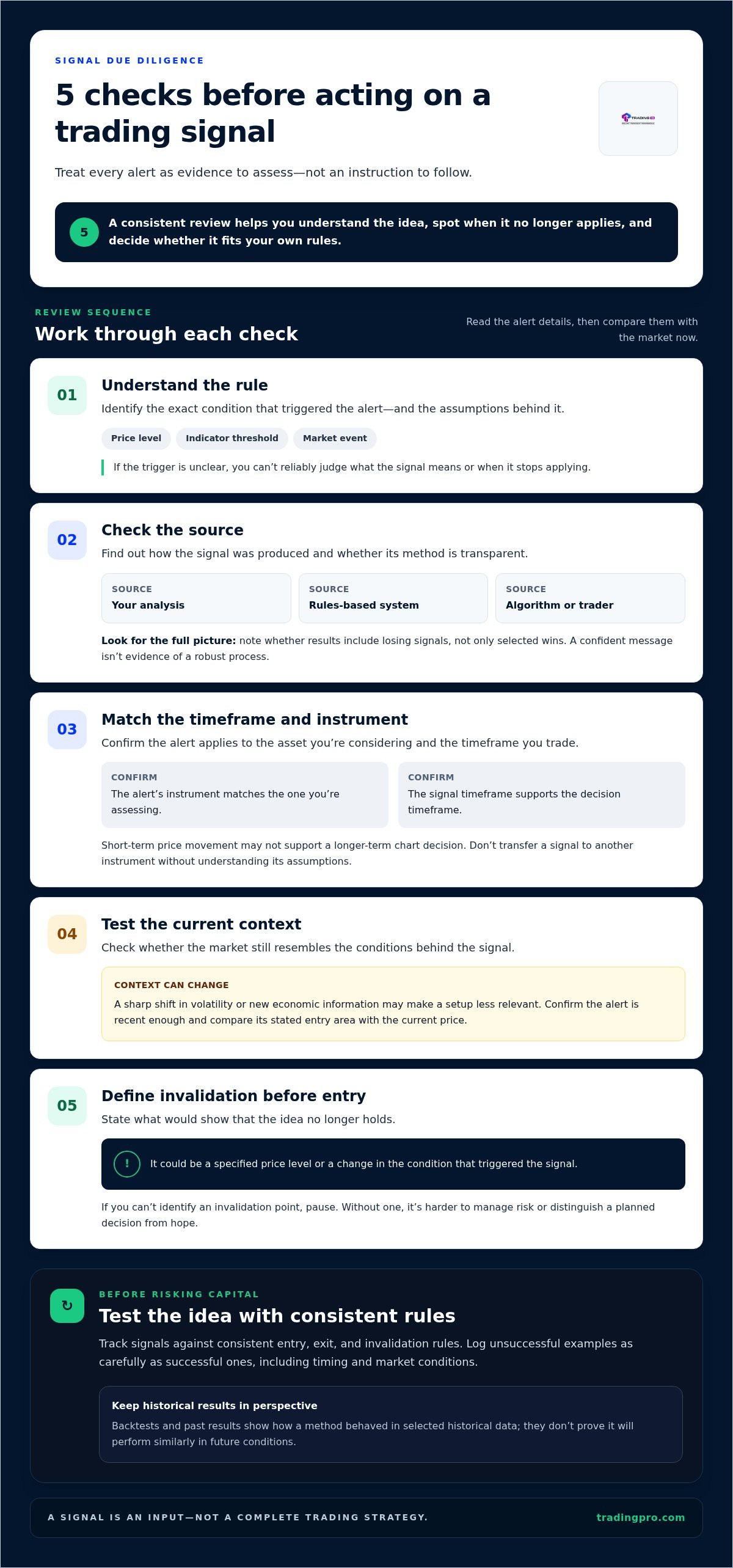
Turn each alert into a short due-diligence check before deciding whether it belongs in your plan. The aim isn’t to prove that a signal will work. It’s to understand the idea, identify what could make it irrelevant, and decide whether the risk fits your own rules. Use this checklist consistently, even when an alert looks especially compelling.
- Understand the rule. Identify the exact condition that triggered the alert. Is it based on a price level, an indicator crossing a threshold, or an event? If the trigger and its assumptions aren’t clear, you can’t reliably judge what the signal means or when it stops applying.
- Check the source. Find out whether the signal comes from your own analysis, a rules-based system, an algorithm, or another trader. Look for a transparent method and note whether results include losing signals, not just selected wins. A confident message isn’t evidence of a robust process.
- Match the timeframe and instrument. Confirm that the alert applies to the asset you’re considering and the timeframe you trade. A signal calculated from short-term price movement may not support a decision based on a longer-term chart. Don’t transfer it to another instrument without understanding its assumptions.
- Test the current context. Check whether the market still resembles the conditions behind the signal. A setup based on steady price movement may be less relevant after a sharp change in volatility or new economic information. Confirm the alert is recent enough to act on, and compare its stated entry area with the current price.
- Define invalidation before entry. State what would show that the idea no longer holds, such as a specified price level or a change in the condition that triggered it. If you can’t identify an invalidation point, pause. Without one, it’s harder to manage risk or distinguish a planned decision from hope.
Check the signal’s source, rules, and timing
Read the alert details, not just its headline. Record when it was generated, the instrument and timeframe it refers to, and the condition that would cancel the setup. Then compare those details with the market now. This alignment check helps distinguish a timely opportunity from a stale notification that no longer fits its original assumptions.
Test the idea before risking capital
Track signals against consistent entry, exit, and invalidation rules. Log unsuccessful examples as carefully as successful ones, along with the market conditions and timing. Backtests and past results can show how a method behaved in selected historical data, but they don’t prove it will perform similarly in future conditions. For a deeper framework, see Wiley’s guide to evaluating and optimizing trading strategies. You can also explore the Trade Hub as part of your analysis.
Build your process before increasing your exposure. As you shape your approach, you can explore the Rookie Account and consider how it fits your trading decisions.
Which Trading Signal Methods and Sources Fit Your Approach?
The right signal method is one you can understand, evaluate, and use consistently. Technical indicators focus on price and volume patterns; event and sentiment signals add information about news or market positioning. Each offers a different lens, and none is universally superior. Use this comparison to narrow your options, then weigh each method’s limits against your instrument, timeframe, and available time.
| Method | Typical input | Useful context | Key limitation |
|---|---|---|---|
| Technical indicators | Price or volume calculations, such as moving averages or RSI | Assessing trend direction, momentum, or potential changes in price behaviour | Can lag or produce misleading readings in different market conditions |
| Event-driven signals | Scheduled economic releases or other market-moving events | Considering how new information may alter volatility or market expectations | The market’s response may differ from expectations or already be reflected in prices |
| Sentiment signals | Market commentary, positioning, or trader activity | Adding context about prevailing views or potential crowding | Sentiment can shift quickly and may not predict price direction |
| Self-generated alerts | Rules and observations defined by the trader | Building familiarity with a method and adapting it to a personal process | Requires time, consistency, and careful testing |
| Third-party or social signals | Another provider’s analysis or a trader’s activity | Exploring perspectives or strategies beyond your own analysis | Methods, risk tolerance, and timing may not fit your needs |
Technical indicators versus event-driven signals
A moving average summarizes price over a selected period, while RSI measures recent momentum. Either may help frame a question, but neither is an automatic buy or sell rule. Scheduled economic events can change market conditions, so consider whether an indicator’s usual interpretation still fits before and after a release. A method may also behave differently across instruments and timeframes. Match its inputs to the market you actually trade.
Self-generated, third-party, and social signals
Building your own alerts takes more effort, but gives you direct control over the rules and can deepen your understanding of how they behave. Third-party signals may save analysis time, yet you still need to understand how they’re produced and whether their assumptions match your approach. Social trading lets you observe another trader’s strategy; copy trading lets you replicate strategies. Learn how social trading versus copy trading differ, then assess suitability rather than relying on someone else’s results.
Don’t judge a provider by a short run of strong performance or promotional claims alone. Look for clear methods, a meaningful record that includes difficult periods, and information about how risk is managed. Combining technical, event, and sentiment signals can add context, but it can also create conflicting cues. More inputs don’t automatically mean a stronger decision. Choose a small set you can interpret, and test whether each adds useful information before relying on it. That’s a practical foundation for using trading signals effectively.
How to Build a Repeatable Trading-Signal Workflow
A reliable workflow turns an alert into a deliberate decision, or a clear reason to stand aside. Use the same sequence every time. Consistency makes it easier to separate your process from the outcome of any single trade and assess whether using trading signals effectively fits your rules.
From alert to planned decision
Review the alert before thinking about an order. Confirm its age, instrument, timeframe, and triggering condition. Then compare it with your existing trading rules. A signal outside the market, schedule, or strategy you’ve chosen isn’t a reason to improvise.
- Verify the setup. Check the source and original alert details. Ask whether the market context has changed since it appeared and whether the price is still near the area the signal refers to.
- Write the entry rationale. State what evidence supports considering a trade and why it fits your rules. “The alert says buy” isn’t a rationale. Name the condition you’re responding to.
- Set an invalidation point. Define what would show the trade idea is no longer valid. Choose this before entry, not after the market moves against you.
- Plan the exit and position size. Decide how you intend to exit and set a position size that reflects your personal risk limits. Signal confidence alone shouldn’t determine how much you risk.
- Make a decision. Proceed only if the setup, rationale, and risk plan align. Otherwise, record why you passed. Standing aside is a valid outcome.
Manage risk and review every outcome
A useful signal process defines risk before a trade begins. Predefined position sizing and exit rules give you a consistent basis for decisions, even when an alert feels urgent. They don’t remove the possibility of loss, but they help keep a single signal from rewriting your plan in the moment.
Keep a journal that captures both decisions and outcomes. Use the same fields each time:
- Alert source, time received, instrument, and timeframe
- Triggering condition and market context at review
- Entry rationale, planned entry, invalidation point, and exit plan
- Planned position size and the risk limit you applied
- Outcome, including whether you followed the plan or missed the alert
- Any rule deviation and what you would change in your process
Log wins, losses, missed alerts, and trades you chose not to take. Reviewing only successful examples can hide where a method or your execution breaks down. Look for repeated process issues, such as reacting to stale alerts or changing exit rules mid-trade, rather than judging a method by one result.
If you’re building foundational market knowledge alongside your routine, a beginner forex guide can help you review core concepts that shape how currency markets move. As your approach takes shape, explore the Rookie Account as a next step in your trading journey.
Use TradingPRO Social Trading as a Tool, Not a Shortcut
Other traders’ activity can offer another perspective, but it doesn’t replace your own analysis. TradingPRO’s social and copy trading ecosystem gives clients ways to engage with other market participants’ strategies. Treat those strategies as information to assess, not instructions that bypass your process. A copied trade still responds to market conditions and can lose value.
How social and copy trading relate to signals
Social trading can mean observing another trader’s approach and using it as one input in your research. Copy trading goes further by letting you replicate another market participant’s strategy. The distinction matters: observing leaves you to make each trade decision, while copying doesn’t remove the need to understand what you’re following. For more on the difference, see the social trading versus copy trading guide.
Before engaging with a strategy, consider whether its instruments, trading pace, and approach to risk fit your goals and tolerance for potential losses. A strategy built around frequent short-term decisions may not suit someone seeking a different pace. A period of strong results also doesn’t establish how that approach may behave in another market. Avoid choosing on short-term performance or promotional claims alone. Look for a clear understanding of the strategy and how its risks could affect your overall exposure.
Keep responsibility for your decisions. Monitor what you’re following, review whether the original rationale still makes sense, and be prepared to reassess if conditions or your objectives change. Copying a strategy doesn’t guarantee a particular outcome or shield you from market risk. It can be one signal-related input, but it should sit inside a plan you understand and can evaluate.
Take the next step with a defined approach
A disciplined process gives every signal a clear place: assess its source and meaning, check the current context, set your risk limits, and review the decision afterward. Apply the same standards to social or copied strategies. If you can’t explain why an approach fits your plan, pause rather than outsourcing judgment.
TradingPRO’s Rookie Account is its primary account offering. As you develop a structured approach to signals and trading decisions, you can register with TradingPRO. Keep your expectations grounded: a sound process can help you make considered decisions, but it can’t ensure a winning trade or prevent losses.
Make Your Next Trading Decision More Deliberate
Your next step isn’t to collect more alerts. It’s to build a process you can apply consistently, learn from, and adjust when market conditions change. Keep asking what evidence supports a signal, what would change your view, and whether the decision fits your own risk boundaries. That discipline gives you a clearer basis for action, including the decision to wait.
Using trading signals effectively is a skill developed through careful judgment, not certainty. TradingPRO’s social and copy trading capabilities offer ways to engage with other traders’ strategies, while the Rookie Account remains the company’s primary account offering. Treat any strategy as something to understand and assess, not a replacement for your own decision-making.
Take your next step with a plan that keeps risk and personal responsibility in focus. Register with TradingPRO and continue building an approach that’s informed, disciplined, and your own.
Frequently Asked Questions
What is the most effective way to use trading signals?
The most effective way is to make each signal pass a decision rule before it influences an order. For example, decide in advance whether you’ll ignore an alert that arrives after the price has already moved beyond your planned entry area. This keeps urgency from replacing judgment. Using trading signals effectively means applying the same standards to attractive and unconvincing alerts, then reviewing whether your decision followed your plan.
Can trading signals guarantee profit?
No. A signal can identify a possible setup, but it can’t control what the market does next. Even when an alert’s method is clear, unexpected developments or changing conditions can undermine its assumptions. Treat claims about past success as information about earlier conditions, not a promise about future trades. Before acting, decide what loss you’re prepared to accept and whether the idea still makes sense if the expected move doesn’t happen.
How do I know whether a trading signal is reliable?
No single measure can prove that a signal is reliable. Look for enough detail to understand how it is generated and where it applies, then compare a range of outcomes rather than a handful of highlighted wins. For example, note whether signals arrived too late to act on or repeatedly failed in a particular type of market. Test with consistent assumptions, and don’t treat a strong historical record as evidence of future performance.
Should beginners use trading signals?
Beginners can use signals as examples for learning how an observation becomes a trade idea, but shouldn’t rely on alerts instead of building core knowledge. Practise identifying what an entry, exit, and risk limit mean on a chart before deciding whether a signal makes sense. A useful exercise is to write down what you think the alert means, then compare it with its stated method and timeframe. Learning comes first; no signal makes every trade suitable.
Are technical indicators better than trading signals from other traders?
Neither is automatically better; the stronger fit depends on how clearly you can interpret and assess the source. An RSI reading follows a calculation, while another trader may combine observations that aren’t obvious from a brief alert. Compare what each source reveals, what it leaves unexplained, and how quickly you can verify it. If one method consistently creates confusion or clashes with your approach, simplify rather than treating it as confirmation.
How many trading signals should I use at once?
There’s no fixed number that works for every trader. Start with only the signals you can explain and record separately. For instance, if two alerts disagree, know which rule takes priority before the conflict appears. If you can’t identify what each input contributes, more alerts may add noise rather than useful context. Keep the method set manageable, then assess whether each signal improves clarity under consistent criteria.
Can I copy another trader’s signals automatically?
TradingPRO’s copy trading capabilities let clients replicate other market participants’ strategies, but copied trades remain exposed to market risk. Before following a strategy, consider whether its instruments, pace, and potential fluctuations fit your objectives and tolerance for loss. Decide how you’ll monitor it and what would prompt you to reassess. A trader’s past results or current activity can inform your research, but neither guarantees that your experience will match theirs.


