




- Published on: 2026-10-17 10:14:22
Low Commission Trading Account: Compare the Costs That Matter in 2026

A low commission trading account can still cost more than an alternative with a higher commission. The headline rate is only one part of the calculation: spreads, slippage and other applicable charges can also affect what you pay to trade.
Account pricing can be difficult to compare because providers use different terms, and a “commission-free” label doesn’t automatically mean lower overall costs. This guide explains how commissions and spreads work together, which other charges to consider, and how to compare them against your trading frequency and position size.
Your trading style matters when choosing an account structure. TradingPRO offers Rookie, Micro, Pro and Scalp accounts to compare against your approach. Focus on the terms that apply to your account and region, then assess the likely costs for your activity. The goal is a clear comparison, not simply the smallest-looking fee.
Key Takeaways
- Separate per-trade commission from the wider cost of opening and holding a position. Focus on charges relevant to your instruments and account terms.
- Compare spread-based and commission-plus-spread pricing by checking what each model includes and which costs may be easy to overlook.
- Build a realistic comparison around your instruments, trade frequency, typical position size and holding period.
- Choose a low commission trading account by estimating costs for your own trading pattern, not by relying on a headline fee.
- Compare the Rookie, Micro, Pro and Scalp accounts against your approach, and review the applicable terms before deciding.
What makes a low commission trading account genuinely cost-effective?
A low commission trading account isn’t automatically the cheapest choice. It’s an account whose applicable charges suit what you trade and how you trade it. A per-trade commission is only one possible expense. The cost of opening and holding a position may also depend on the spread, financing, currency conversion and other applicable terms.
Total trading cost depends on the trade you place and the terms that apply to your instrument and account. Assess the full cost pattern you’re likely to incur, rather than focusing only on the most prominent fee in an advert. A zero-commission headline may be useful, but it can’t establish the lowest-cost option if other charges affect your activity.
Commission, spread, and total trading cost are different
A commission is a charge associated with executing a trade, where applicable. It may be calculated per transaction or according to the trade size, depending on the account terms. The bid-ask spread is different: it’s the gap between the price available to sell, the bid, and the price available to buy, the ask. Rather than appearing as a separate commission line, that gap is reflected in the quoted prices.
For example, entering a position generally means buying at the ask. Closing it immediately may mean selling at the bid, so the difference can affect the result even if there’s no separate commission. The exact cost mix varies by instrument and account terms, so compare equivalent trades. For U.S. securities, relevant regulatory information is available from the U.S. Securities and Exchange Commission (SEC); applicable transaction charges depend on the transaction and terms.
Think in layers: execution charges, the spread at entry and exit, and any costs that accrue while a position remains open. Not every charge applies to every instrument or account. Identify the relevant ones before estimating the total.
Why your trading pattern changes the answer
Trade frequency affects how often execution-related charges may arise. A frequent trader may pay closer attention to the cost of each entry and exit. Someone who trades occasionally may focus more on the cost of holding a position or charges tied to a particular instrument. Neither pattern automatically makes one pricing model cheaper.
Trade size matters, too. If a charge is calculated in relation to transaction size, a larger position can make it more significant. Holding period also shapes the comparison: applicable holding costs may matter more for a position kept open longer than for one closed promptly.
Hypothetical example: Imagine two traders comparing accounts for the same instrument. One opens and closes positions frequently; the other makes fewer trades and holds each position longer. The first may weigh repeated execution costs and spreads more heavily, while the second may examine applicable holding charges more closely. Neither can identify the lower-cost option from a commission headline alone. They need to compare their activity with the relevant account terms.
Build your comparison around the trades you expect to make. Record the instruments you use, how often you plan to trade, your typical position size and your usual holding period. Then assess each relevant charge against that pattern. This turns “low commission” from a marketing label into a decision you can test.
Which charges should you compare beyond the trading commission?
A useful comparison starts with a full fee map, not a single line in an account summary. Review trading charges, holding costs, currency conversion and account-related fees. Which ones apply depends on your instrument, account terms and how you use the account. Treat each category as something to check, not as a charge every trader will pay.
Terms can differ by instrument, account structure and jurisdiction. If you trade across regions, compare the current documentation for your account and focus on the products you plan to trade. A fee schedule for one market or instrument may not describe the costs of another.
Trading costs: spreads and per-trade commissions
Commissions may be charged per transaction, by trade size or according to another structure set out in the account terms. The method can vary across instruments and account arrangements. Check how the charge is calculated and whether it applies to both opening and closing a position.
The spread is the difference between the quoted buy and sell prices. It’s a cost to consider, not necessarily a fixed fee: it can vary by instrument and trading conditions. A “commission-free” label describes only one possible charge, not the full cost of executing a trade. Compare the applicable commission and spread together, using the same instrument and a similar trade size for each account.
Holding and account-related charges to check
If you keep a position open overnight, check whether the instrument and account terms involve financing or another holding cost. The relevance depends on how the position is structured and how long it remains open. Don’t assume the charge applies to every product or is the same across accounts.
Currency conversion is another item to review if your trade, account balance, deposits or withdrawals involve different currencies. Inactivity charges may also appear in account terms, but matter only if the stated conditions apply to your account. Look for the triggering event, calculation method and any stated time period instead of treating the charge as universal.
Keep brokerage charges separate from fund-level expenses. If you trade an investment product such as a fund, its own operating expenses may affect its value or returns. Those expenses are distinct from a broker’s charges for executing or maintaining a trade. Include both in your overall assessment where relevant, but don’t count a fund expense as a trading commission.
- Trading: applicable commission and spread.
- Holding: possible financing or other position-related costs.
- Conversion: currency exchange charges where currencies differ.
- Account-related: possible inactivity or service charges under stated terms.
Use this list as a filter. Mark each item as applicable, not applicable or requiring a closer read for your jurisdiction and chosen instrument. This keeps the comparison focused and avoids adding hypothetical charges to your estimate. You can view the TradingPRO account registration page as you consider your options.
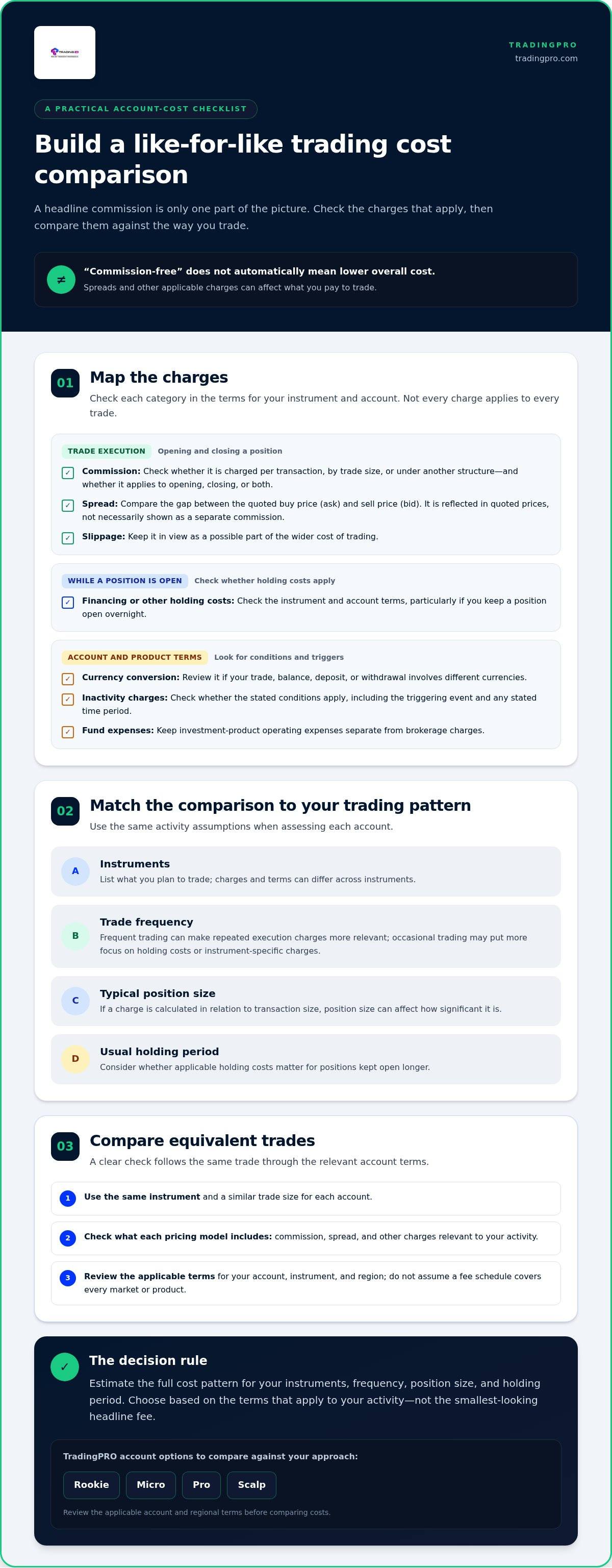
Commission-free, spread-based, or commission-plus-spread: how do models compare?
Pricing labels describe how charges may be presented, not what a particular trading pattern will cost. A low commission doesn’t guarantee a low total cost, and “commission-free” doesn’t settle the comparison. Assess each model using the same instrument, position size, trade frequency and holding period. The best fit depends on the charges that apply to your trades.
| Model | What to inspect | May suit | What can be overlooked |
|---|---|---|---|
| Commission-free | Spread and any applicable account or holding charges | Traders who prefer no separate per-trade commission | Other execution costs may still apply |
| Spread-based | How the spread is quoted and how it varies by instrument and conditions | Traders who value a pricing structure centered on the quoted spread | The spread can affect entry and exit costs even without a separate commission |
| Commission-plus-spread | Commission calculation, spread, and any other relevant charges | Traders who want to compare separately stated execution costs | A low commission can distract from the spread or other applicable costs |
When a headline commission can mislead
Comparing commission alone leaves out the rest of the transaction. A model with no separate commission may still involve a spread. An account advertising a low commission may also have a spread and, depending on the instrument and terms, a holding cost. Neither model is inherently better or worse. The headline figure is simply one part of the comparison.
Keep the comparison like-for-like. Assess the same instrument and equivalent position size using the same assumed entry and exit conditions. Include any relevant holding period and costs. If the fee information doesn’t provide comparable assumptions, don’t declare a universal winner. A model that suits one trader’s pattern may not suit another’s.
Match the model to frequency and holding period
An occasional trader can ask: what will each completed trade cost, and could an account-related charge matter during periods of low activity? An active trader can consider how repeated entries and exits affect cumulative commission and spread. Frequency changes how often a charge may arise, but it doesn’t determine which model is cheaper by itself. Trade size and the applicable calculation method matter, too.
Holding time adds another dimension. A trader who usually closes positions within a session may weigh execution costs more heavily. Someone who holds positions overnight should check whether financing applies to that instrument and account arrangement. Terms can differ between products.
Hypothetical comparison: Suppose two accounts offer different pricing models for the same instrument. Compare both using one assumed position size and identical entry, exit and holding conditions. Then repeat the exercise using your expected trade frequency. This shows which charges drive the difference without inventing rates or treating a model label as proof.
Use the result to assess each account against your routine. Compare the charges that apply, not the simplicity of the label.
How can you compare low commission trading accounts step by step?
Turn account research into a repeatable comparison. Assess a low commission trading account against the trades you expect to make, not a generic example or a headline fee. Use current account terms for your jurisdiction and chosen instruments. Terms can vary between regional entities, so don’t assume a fee schedule found online applies to your account.
- Define what you’ll trade. List the instruments you’re considering. Charges can vary by instrument, so focus on products you may actually use rather than comparing unrelated fee schedules.
- Estimate your trading frequency. Note how often you expect to open and close positions over a consistent period, such as a typical month. This shows how often applicable execution charges could arise.
- Set a typical position size. Use a realistic size for your planned activity. If a charge is calculated by transaction size, the amount traded can change its impact on your comparison.
- Choose a holding period. Record how long you expect positions to remain open. This helps identify whether overnight financing or other holding terms deserve attention.
- Collect the applicable terms. For each account, note commissions, spread information, relevant financing or conversion charges, and any account fees that apply. Use the current documentation for your region.
Build a like-for-like cost comparison
Compare each account using the same instruments, position sizes, trade frequency and holding periods. A simple estimate can add the applicable opening and closing commissions, the spread cost, and any relevant holding, conversion or account charges. Record the costs in a consistent currency and over the same timeframe. If you need to make assumptions, write them beside the estimate, including how you interpret quoted spreads and whether positions are held overnight.
Treat the result as an estimate, not a prediction of costs in every market condition or a forecast of trading results. Costs can depend on the instrument, account terms and circumstances of a trade. If a fee can’t be compared on the same basis, mark that limitation instead of treating the figures as directly equivalent.
Check the account fit before opening
Cost is one filter. Check whether the account’s stated structure suits your experience and intended approach, then review regional terms, eligible instruments and relevant risk disclosures before deciding. A beginner can include the Rookie Account in an initial comparison without assuming it has a particular fee or feature. If you’re learning the basics, pair the cost review with a forex trading guide for beginners so account pricing doesn’t replace understanding the instrument and its risks.
After you’ve made your comparison, review the TradingPRO account registration page alongside the applicable account terms for your region.
How do TradingPRO account tiers fit a low-cost trading decision?
TradingPRO offers four account tiers: Rookie, Micro, Pro and Scalp. Compare them against your trading needs rather than treating them as a ranking from cheapest to most expensive. The tier name alone doesn’t tell you which charges apply or whether the terms suit your instruments, trade frequency, position size and holding period.
If you’re beginning your comparison, the Rookie Account is a practical place to start. Then use the same checklist for Micro, Pro and Scalp. Check the current terms for the account and region relevant to you instead of relying on assumptions drawn from another jurisdiction or general online descriptions.
Choose an account tier by your trading needs
Start with your planned approach. Write down what you intend to trade, how often you expect to place trades, the position sizes you have in mind and how long you may hold positions. Use those details as a consistent test for each tier. A low commission trading account is a useful fit only if its applicable terms align with the activity you expect.
Next, compare the relevant account documentation. Note the charges and conditions that apply to your chosen instruments, and mark any differences between tiers. Don’t infer a commission, spread, minimum or other feature from the name “Rookie,” “Micro,” “Pro” or “Scalp.” Use the current terms for your region to establish those details. Choose the account you understand and can assess against your own comparison, not simply the one with the most persuasive label.
Take the next step with clear cost expectations
Before deciding, review the applicable account terms, eligible instruments and risk information. Make sure the fee details you used reflect your region and the account you’re considering. Keep any assumptions visible so you can revisit the decision if your planned activity changes.
Use your comparison to clarify your priorities, not to predict results. Account costs are only one part of a trading decision, and no pricing structure removes market risk. Move forward with a clear view of the terms and a considered approach.
For the next step, register with TradingPRO and review the relevant account terms and risk information as you proceed.
Make your next account decision with confidence
Your trading approach can change as you gain experience, explore different instruments or adjust how long you hold positions. Treat your account choice as a decision to revisit when your routine changes, not a permanent label. Keep a simple record of the assumptions behind your choice so you can reassess whether the account still fits your activity.
A low commission trading account should support a clear, informed decision, not create pressure to trade more or chase a promised result. TradingPRO’s Rookie, Micro, Pro and Scalp tiers give you options to compare against your approach. Focus on fit, understand the terms that apply to you and move forward at a considered pace.
Register with TradingPRO when you’re ready to take the next step. Stay deliberate, keep learning and base your trading decisions on information you understand.
Frequently Asked Questions
What is a low commission trading account?
A low commission trading account is one where the charges relevant to your activity are comparatively manageable, not simply one with a small commission line. If you trade different instruments, assess the applicable pricing for each instead of assuming one advertised rate applies across the board. Compare current terms for your region and judge the account by the overall cost pattern for your intended activity.
Is a commission-free trading account always cheaper?
No. Commission-free means there’s no separate commission for the trades covered by that offer, but it doesn’t mean every part of execution or account use is cost-free. A trader could still face a spread or an applicable charge for holding a position. Check the terms for the specific instrument and account, then compare the same trade assumptions across models.
What fees should I compare when choosing a trading account?
Review charges that could apply to your planned use: commissions, spreads, position-holding costs, currency conversion and account-related fees. Also consider whether an investment product has its own fund expenses, which are separate from brokerage charges. If you expect to trade in a currency different from your account’s base currency, examine the relevant conversion terms. Don’t include a fee that doesn’t apply to your instrument or circumstances.
How do I calculate the total cost of a trading account?
Estimate costs over a consistent period using your expected instruments, trade count, position sizes and holding times. For each example, include the applicable commission and spread, plus any relevant holding, conversion or account charges. Keep the currency and assumptions consistent across accounts. The result is a planning estimate, not a fixed quote: actual charges can depend on current terms and trading conditions, and the calculation says nothing about potential profit or loss.
Can trading spreads cost more than a commission?
Yes, that can happen, but it depends on the instrument, the spread that applies, the trade size and the commission structure. A trader making repeated entries and exits may notice the spread’s cumulative effect, while another trade pattern may make commission more prominent. Compare both costs for equivalent trades using current terms. Neither “tight spread” nor “low commission” alone proves which option will cost less for you.
Which TradingPRO account tier should a beginner compare first?
A beginner can start by comparing the Rookie Account, then assess its current terms alongside the instruments they plan to trade and their expected activity. The name alone doesn’t establish a fee structure or suitability. Review the applicable regional documentation and risk information, and note what you still need to understand before choosing. A considered comparison supports an informed decision, but it can’t remove trading risk or guarantee an outcome.


