




- Published on: 2026-09-02 10:20:43
Managing Trading Profits: 2026 Capital & Tax Guide

The most dangerous moment in your trading career isn't when you're losing money; it's the second you start winning. Most traders spend years obsessing over entries and exits, only to watch their hard-earned gains evaporate because they lacked a professional capital preservation strategy. It's an exhausting cycle that separates the amateurs from the elite. You've done the hard work of capturing the market's momentum. Now, you must learn the high-performance art of keeping it.
This guide provides the definitive blueprint on how to manage trading profits with the precision of an institutional fund manager. You'll master the elite tactics required to protect your capital, reinvest for maximum compounding, and navigate the 2026 tax landscape with absolute confidence. We're stripping away the confusion and replacing it with a proactive, results-driven framework. We will break down the exact math for taking profits, compare withdrawal strategies against account scaling, and clarify your tax obligations to ensure you're building sustainable wealth. It's time to stop reacting to your balance and start commanding your financial future with total authority.
Key Takeaways
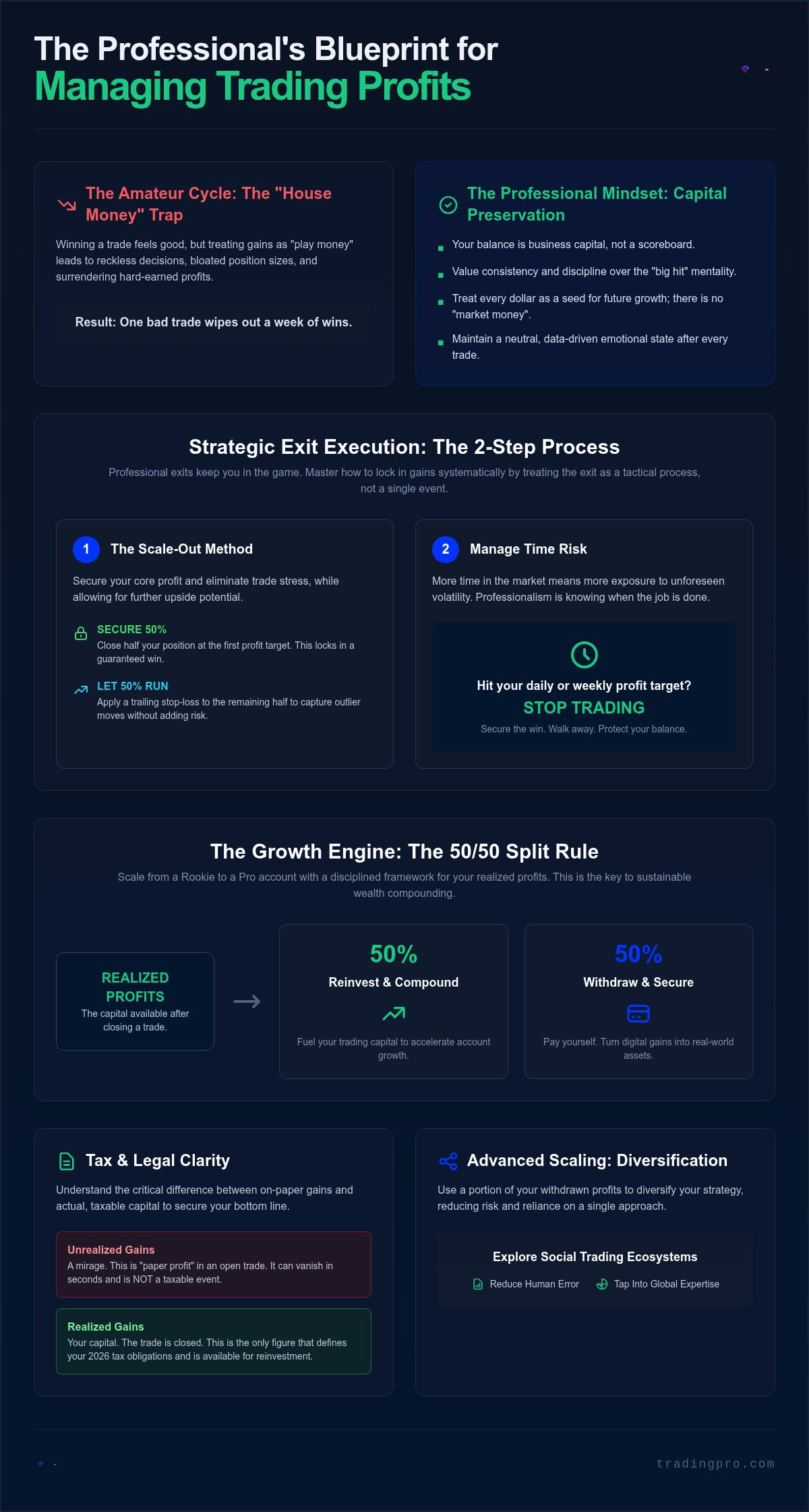
- Defeat the "house money" effect by implementing a systematic scale-out strategy that protects your core capital while letting winners run.
- Master the professional framework for how to manage trading profits by balancing aggressive reinvestment with frictionless withdrawals.
- Scale your success from a Rookie Account to a Pro level using a disciplined 50/50 split to fuel sustainable wealth growth.
- Secure your bottom line with a clear understanding of 2026 tax obligations and the precision record-keeping required to avoid legal surprises.
- Diversify your realized gains through a Social Trading ecosystem to reduce human error and tap into global expertise.
The Psychology of Winning: Why Profit Management is a Skill
Winning a trade is a dopamine hit. Managing the aftermath is a professional discipline. Most traders fail because they fall victim to the "House Money" effect. They treat gains as "extra" money rather than hard-earned capital. This mental shift triggers reckless entries and bloated position sizes. It's the primary reason retail traders often surrender an entire month of progress in a single afternoon. To succeed, you must stop playing defense and start an offensive campaign for capital preservation. Mastering how to manage trading profits requires a business-owner mindset. Your account balance isn't a scoreboard; it's your firm's operating capital. Every pip earned is a line item that demands protection.
- Treat every dollar as a seed for future growth.
- Recognize that "market money" is a myth.
- Value consistency over the "big hit" mentality.
- Establish a neutral state after every successful exit.
Overcoming the Fear of 'Leaving Money on the Table'
FOMO doesn't just happen before a trade; it's a plague that strikes after you exit. You see the price continue to climb after you've closed and feel a sense of loss. You haven't lost anything. A closed profit is the only reality in high-frequency markets. Professional Profit Taking is about precision, not perfection. Reframe those "missed gains" as the necessary premium you pay for discipline. It's the cost of ensuring you're never the one caught in a sudden reversal. When you understand how to manage trading profits, you realize that missing the last 10% of a move is a small price for securing the first 90%.
The Institutional Approach to Emotional Stability
Elite performance requires a neutral state. High-performance traders don't celebrate wins with ego; they process them as data points. At TradingPRO, we prioritize a frictionless experience to remove the technical friction that often fuels emotional volatility. Whether you're starting with a Rookie Account or scaling through a Pro tier, the goal remains the same: separate your identity from the PnL. This institutional detachment allows you to execute your next move without the baggage of your last success. Stability is the foundation of scale.
Strategic Exit Execution: Locking in Gains Systematically
Precision entries get you into the game, but professional exits keep you there. Most retail traders treat an exit as a single, binary event. It's a mistake that leads to unnecessary drawdowns. To master how to manage trading profits, you must treat the exit as a tactical process. Start with the 'Scale-Out' method. Close 50% of your position at your first target to secure a profit floor. This move eliminates the stress of the trade. Use trailing stops for the remaining half. Let the market's momentum carry your gains higher while your stop-loss acts as a rising floor. You protect the core gain while staying positioned for the outlier moves that define a successful month.
Manage your time risk as aggressively as your price risk. The longer a trade stays open, the more it's exposed to unforeseen volatility. Set hard daily and weekly profit targets. Once you hit your objective, shut down the terminal. Over-trading after a win is the fastest way to surrender your edge. Professionalism is knowing when the job is done. Secure the win. Walk away. Prepare for the next session with a protected balance.
Technical Tools for Profit Retention
Execute with institutional accuracy. Use the TradingPRO Trade Hub to map your exit levels before you even enter the market. Automated take-profit levels are non-negotiable. They remove the human hesitation that often leads to "hoping" for one more pip. In high-speed environments, liquidity determines your success. Our infrastructure ensures your orders hit the tape at the desired price, even during peak volume. This frictionless execution is the difference between a theoretical gain and a realized one.
Managing 'Unrealized' vs. 'Realized' Gains
Unrealized gains are a mirage. They don't belong to you until the trade is closed. This distinction is vital when navigating the high volatility of emerging markets like Nigeria or the Philippines, where sudden currency fluctuations can evaporate paper profits in seconds. As outlined in IRS Tax Topic 409, your financial reality and tax obligations are defined by these closed transactions. Realized profit is the only capital available for reinvestment. Stop counting pips that haven't hit your balance. Focus on the finality of the closed trade to build lasting wealth. If you're ready to start scaling with precision, register your account and take command of your execution strategy.
The Growth Paradox: Reinvesting vs. Withdrawing Gains
Capturing the win is only half the battle. The real test of a professional is what happens after the trade closes. You face a critical choice: do you compound your gains to reach elite status, or do you withdraw them to enjoy the fruits of your labor? Professional capital management isn't about choosing one; it's about a structured allocation that fuels both your account and your lifestyle. This is the definitive strategy for how to manage trading profits without stalling your momentum.
We recommend the 50/50 Rule for traders scaling their first accounts. Allocate half of your realized gains to your account balance to accelerate compounding. Withdraw the remaining half. This "Pay Yourself First" philosophy transforms trading from an abstract numbers game into a tangible income stream. It builds the psychological resilience needed to handle larger position sizes because you've already proven that the money is real. It turns market volatility into personal stability.
The Power of Compounding in 2026
Compounding is the engine of wealth. Starting with a Rookie Account allows you to refine your edge with lower stakes, but the math of growth remains constant. As your balance increases, your execution speed becomes critical. Slippage on a small lot is negligible; slippage on a Pro-tier position is a significant leak. Our infrastructure ensures that as you scale, your precision remains absolute. The following table illustrates the difference between aggressive growth and consistent income on a $1,000 starting balance.
| Month | 5% Monthly Compounding (Balance) | 5% Monthly Withdrawal (Total Income) |
|---|---|---|
| 1 | $1,050.00 | $50.00 |
| 6 | $1,340.10 | $300.00 |
| 12 | $1,795.86 | $600.00 |
Recognize your "Account Ceiling." If you're consistently hitting your profit targets in a Micro Account, it's time to transition to Pro tiers. Scaling isn't just about more money; it's about accessing the elite tools and tighter spreads required for high-volume success. Don't let a small account limit your global potential.
Withdrawal Logistics and Frictionless Access
Your strategy is only as good as your access to capital. A professional broker provides the frictionless infrastructure needed to move money at the speed of the market. Setting up a "Trading Salary" stabilizes your personal finances and removes the pressure to force trades during low-probability setups. Treat your withdrawals as a scheduled business expense. To maximize your capital efficiency, learn more about our deposit and withdrawal bonuses. This ensures your move from realized profit to usable cash is as efficient as your trading execution.
Tax Implications of Forex Trading: Protecting Your Bottom Line
The taxman doesn't care about your win rate; he cares about your realized net. As you master how to manage trading profits, your focus must shift from the adrenaline of the trade to the precision of your reporting. In the United States, 2026 federal income tax rates start at 10% for single filers on income up to $12,400 and climb to 37% for those earning over $640,601. Most retail forex gains are treated as ordinary income under Section 988, but professional traders often utilize Section 1256 contracts to access a favorable 60/40 split between long-term and short-term capital gains. This distinction can save you thousands in liability. Stop treating taxes as an afterthought. It's a core component of your capital preservation strategy.
Your account tier dictates your reporting workload. A Scalp Account generates thousands of micro-transactions, requiring robust data management to track every pip. Conversely, a Rookie Account might have fewer entries, but the necessity for meticulous record-keeping remains absolute. Every spread, commission, and swap fee must be accounted for to ensure you aren't overpaying on your net gain. Disclaimer: This guide does not constitute legal or tax advice. Always consult a certified tax professional regarding specific 2026 regulations in your jurisdiction.
Global Tax Trends for Retail Traders in 2026
Regulatory scrutiny is intensifying across the globe. In 2026, major trading hubs in Southeast Asia and South Africa have modernized their electronic delivery rules to track digital financial footprints more effectively. Your "Tax Residency" is your primary defense; it determines which government has the first claim on your global trading profits. Meticulous broker statements are no longer optional. They are your best shield in an audit. Authorities are increasingly using blockchain-adjacent tracking and cross-border data sharing to verify reported income. If you cannot prove it with a statement, it didn't happen.
Automating Your Tax Preparation
True wealth isn't built on a single strategy; it's built on a diversified ecosystem. Once you've secured your initial gains, the next evolution in how to manage trading profits is to transition from a sole operator to a portfolio manager. Social Trading allows you to leverage the expertise of high-performance Master traders, effectively hedging your own human error and psychological fatigue. By allocating a percentage of your realized gains to proven strategies, you create a passive income stream that complements your active trading. This isn't just about following others. It's about institutional-grade diversification that stabilizes your equity curve and protects your bottom line.
- Reduce individual risk by spreading capital across multiple strategies.
- Capitalize on 24/7 market opportunities without constant screen time.
- Hedge against personal trading slumps with passive replication.
- Scale your account balance faster by combining active and social returns.
Building a Portfolio of Traders
Vetting is your primary responsibility as a capital manager. Don't be blinded by total profit percentages. Professional diversification requires a deep dive into 'Drawdown' and 'Profit Consistency'. A Master trader who gains 50% but risks 40% of the account is a liability, not an asset. Look for those who maintain tight risk parameters and steady growth. For a deeper breakdown of these mechanics, see our Social Trading vs Copy Trading: The 2026 Guide. Managing a diversified social portfolio gives your trading business an institutional feel, allowing you to act as the CEO of your own capital.
Risk-Adjusted Scaling with TradingPRO
As your managed capital grows, your infrastructure must evolve to handle the increased volume. Transitioning from a Rookie setup to a ScalpX account ensures you have the precision tools required for elite performance. High-performance scaling isn't just about larger lot sizes; it's about the speed of execution. In a global market turning over $7.5 trillion per day, milliseconds determine your slippage and your final profit. Mastery of how to manage trading profits culminates in this fusion of active skill, social diversification, and elite technology. Take the final step toward professional status. Secure your future and register your TradingPRO account today.
Command Your Capital: The Path to Elite Performance
Professional trading is a marathon of discipline, not a sprint of luck. You now have the blueprint for how to manage trading profits with the precision of a global institution. By mastering systematic exits, balancing reinvestment with regular withdrawals, and maintaining a proactive tax strategy, you've separated yourself from the retail majority. True wealth is built on the foundation of capital preservation and smart diversification through social tools. Your gains are no longer just numbers on a screen; they are the fuel for your long-term financial legacy.
Success requires a partner that matches your ambition. Since 2017, TradingPRO has provided institutional-grade infrastructure and tier-1 liquidity to ensure your exits are as precise as your entries. With negative balance protection as your safety net, you can scale with absolute confidence. It's time to stop reacting to the market and start commanding your results. Start your professional journey with a TradingPRO Rookie Account and join the elite ranks of traders who know how to keep what they earn. The market is moving; make sure you're moving with it.
Frequently Asked Questions
How much of my trading profit should I withdraw each month?
Aim for a 50/50 split between reinvestment and withdrawal. This professional framework ensures you're paying yourself a salary while still fueling the compounding engine. Beginners often find this balance helps them avoid the "house money" effect. It's the most sustainable way for how to manage trading profits because it turns abstract pips into real-world security. Regular withdrawals reinforce your discipline and keep your trading business grounded in financial reality.
Do I have to pay taxes on forex trading profits if I don't withdraw them?
Yes, you generally owe taxes on all realized gains within the tax year. In the US, the IRS considers a trade "realized" once the position is closed, even if the money stays in your trading account. Leaving profits in your balance doesn't defer your liability. Meticulous record-keeping is essential here to ensure you're only paying what you actually owe. Always verify current 2026 reporting standards for your specific residency to avoid legal surprises.
What is the best way to track my trading profits for tax purposes in 2026?
The most precise method is using automated reporting tools to export monthly statements. TradingPRO allows you to generate clean CSV or PDF files that track net profit after all spreads and commissions. This digital footprint is your best defense during an audit. Avoid manual spreadsheets which are prone to human error. Consistent monthly exports ensure your tax preparation is frictionless when filing season arrives, keeping your focus on market performance.
Should I reinvest all my profits to grow my account faster?
Reinvesting everything is a common mistake that leads to burnout. While compounding is powerful, you need to see tangible rewards to maintain emotional stability. Withdrawing a portion of your gains protects your personal finances from market volatility. It also prevents you from becoming over-leveraged as your account size grows. A balanced approach ensures you're building a sustainable wealth engine rather than just chasing a higher balance that you're afraid to lose.
How do I protect my profits from sudden market reversals?
Protect your gains by implementing systematic exit strategies like trailing stops and the "scale-out" method. Trailing stops act as a rising floor, locking in profit as the market moves in your favor. Scaling out allows you to close 50% of a position at your first target, securing the trade's core gain. This removes the "all or nothing" pressure. Combined with automated take-profit levels, these tools ensure you don't give back your hard-earned pips.
Is there a difference in how Rookie and Pro accounts handle profit withdrawals?
Both account tiers utilize the same high-performance withdrawal infrastructure, ensuring fast and reliable access to your funds. The difference is found in the scaling journey. A Rookie Account is the ideal starting point for managing small initial profits with lower risk. As your gains grow, transitioning to a Pro Account provides the institutional spreads and execution speed required for higher volume profit management. Your withdrawal experience remains frictionless regardless of your current account tier.
Can social trading help me manage the risk of my existing profits?
Social trading is an elite diversification tool for your realized gains. By allocating a percentage of your profits to high-performance "Master" traders, you reduce your reliance on a single strategy. This hedges against personal trading slumps and "human error" in your own execution. It transforms your role from a solo trader into a capital manager. This institutional approach stabilizes your equity curve and ensures your profits are working for you across multiple market conditions.
What happens if my trading account goes into a negative balance after taking profits?
TradingPRO provides Negative Balance Protection as a core safety feature for every client. If a sudden market gap causes your account to drop below zero, we reset the balance to neutral at our own expense. This trust-builder ensures your losses can never exceed your deposit. It's a critical safety net that protects your remaining capital from extreme volatility. You can trade with total confidence knowing your personal liability is strictly limited to your account balance.


