

- Published on: 2026-09-05 10:04:23
Master the Markets: The Ultimate Checklist of Skills Needed for a Professional Trader in 2026
Over 80% of retail traders lose their capital annually, yet the global financial markets move a staggering $9.6 trillion every single day. You've likely felt the exhaustion of battling market noise or the frustration of watching a promising setup crumble under the weight of a single emotional decision. It's a common hurdle, but it's one that the elite have already cleared by building a superior, professional framework. You deserve a clear path to that same institutional-grade success.
This article delivers the definitive roadmap to the specific skills needed for a professional trader to dominate in 2026. Discover how to harness the latest AI-driven technical tools and master the psychological discipline required to scale your performance with precision. We will break down the cognitive strategies, technical requirements, and the high-performance mindset that separate the retail amateur from the professional elite. Get ready to transform your approach, eliminate hesitation, and secure your position in a fast-moving global landscape.
Key Takeaways
- Master the art of data synthesis to separate high-probability signals from market noise and execute with institutional precision.
- Develop the essential skills needed for a professional trader by replacing emotional decision-making with a systematic psychological fortress.
- Implement Bayesian thinking and rigorous risk-reward management to protect your capital and ensure sustainable growth in 2026.
- Harness advanced execution technology and operational organization to act as a force multiplier for your trading performance.
- Use social trading ecosystems to replicate elite strategies and accelerate your transition from a retail beginner to a market professional.
Analytical Mastery: Synthesizing Data into Actionable Intelligence
Stop drowning in data. Start swimming in intelligence. Analytical mastery isn't about how much you know; it's about how much you can ignore. While the average retail participant gets lost in the labyrinth of endless indicators, the elite focus on the variables that actually move the needle. Professional stock traders understand that 90% of market movement is noise. The ability to isolate high-probability signals from this chaos is among the most vital skills needed for a professional trader in 2026.
Amateurs spend hours scrolling social feeds. Professionals build systems. In the current era, data is cheap but synthesis is expensive. You don't need more charts. You need better filters. Modern retail environments are shifting toward quantitative awareness. This means you must understand how volatility and liquidity interact rather than just waiting for an indicator to turn green. Information filtering has evolved from a convenience into a core survival skill.
Technical vs. Fundamental Analysis in 2026
Pure technical analysis is a relic of the past. A hybrid approach is no longer optional for those who want to dominate. You must understand how macro-economic shifts, such as interest rate pivots or global supply chain disruptions, ripple through short-term technical patterns. If you ignore the macro environment, your "perfect" chart setup is likely just a trap for the uninformed. Market Context is the total sum of economic sentiment and liquidity that validates or invalidates every technical signal you see.
The Art of Information Filtering
Your social feed is often your greatest liability. Herd mentality is the fastest route to a margin call. You need to centralize your intelligence to maintain an edge. Use professional tools like the TradingPRO Trade Hub to consolidate your data into a single, clean workspace. This prevents the "analysis paralysis" that comes from jumping between twenty different tabs.
Efficiency is the hallmark of the pro level. Establish a daily research routine that takes less than 30 minutes. Focus on high-impact news and institutional order flow. Professionalism is about consistency, not the number of hours spent staring at a screen. By mastering these skills needed for a professional trader, you transform from a reactive gambler into a proactive market operator. You gain the confidence to act when others hesitate because your decisions are based on synthesized intelligence, not just raw data.
The Psychological Fortress: Discipline and Emotional Regulation
Emotional volatility is the undisputed killer of retail capital. While amateurs obsess over indicators, the elite dominate the psychological arena. Statistics confirm that approximately 70-85% of retail CFD accounts lose money; a failure rate driven largely by impulsive decisions and fear. Building a psychological fortress is not an option. It is the foundation of the skills needed for a professional trader to survive the high-velocity shifts of 2026.
Discipline is often misunderstood as raw willpower. In a professional context, discipline is the mechanical adherence to a pre-defined system. You must develop focus endurance to maintain peak concentration during high-frequency market windows. Professional traders view losses as simple operating expenses. Just as a traditional business pays rent, a trader pays for market data through controlled, systemic losses. This shift in perspective transforms a perceived failure into a necessary cost of doing business.
Developing Emotional Detachment
A professional never executes a trade outside of their written parameters. If the setup doesn't meet every single criteria in the plan, the trade does not exist. This rule-based environment is your only defense against cognitive biases like FOMO or revenge trading. Use Demo accounts to practice this mechanical discipline without financial risk. It's the perfect training ground to ensure your execution is flawless before you register your professional account and commit real capital.
By treating your trading as a business rather than a hobby, you eliminate the emotional highs and lows that lead to ruin. The skills needed for a professional trader in 2026 are as much about what you don't do as what you do. Stay focused. Stay systematic. Let the market noise pass you by while you wait for the signals that align with your fortress-like framework.
Risk Management and Bayesian Thinking
Professionalism is defined by how you handle being wrong. In a market where daily forex turnover has surged toward $9.6 trillion, looking for certainty is a retail trap. Instead, the elite employ Bayesian thinking. This is the process of constantly updating your probability of success as new information arrives. If a central bank shift or a geopolitical event occurs, you don't stick to your original feeling. You recalculate the odds. This dynamic adaptability is one of the most critical skills needed for a professional trader to survive 2026 volatility.
Long-term survival depends entirely on your Risk-Reward (RR) ratio. It's the only metric that truly matters. Even the most sophisticated strategies will face drawdowns. Professional drawdown management isn't about avoiding losses; it's about ensuring those losses never compromise your ability to trade the next day. Position sizing acts as your mathematical shield. By risking a fixed, small percentage of your capital per trade, you ensure that even a string of losses is nothing more than a temporary setback on an upward equity curve.
Thinking in Probabilities
Stop searching for the holy grail setup. Professionals search for edge. An edge is simply a higher probability of one thing happening over another. Bayesian logic dictates that you should never be married to a trade. If the environment changes, your thesis must change too. It's vital to understand that a 40% win rate can be highly profitable with pro-level risk management. If your winners are three times larger than your losers, you'll consistently grow your capital while the perfectionists go bust.
Tactical Risk Control
Precision execution requires precision planning. Use a Forex Profit Calculator to pre-determine your exit points before you ever enter a position. This removes the temptation to hope when a trade goes south. These tactical controls are fundamental skills needed for a professional trader who values capital preservation over ego. Institutional-grade environments often provide Negative Balance Protection to ensure your losses don't exceed your deposits. This safety net is essential, but it doesn't replace the need for hard stops. Professionals always set hard stops in the system. Mental stops are for amateurs; they vanish the moment the pressure starts to rise.
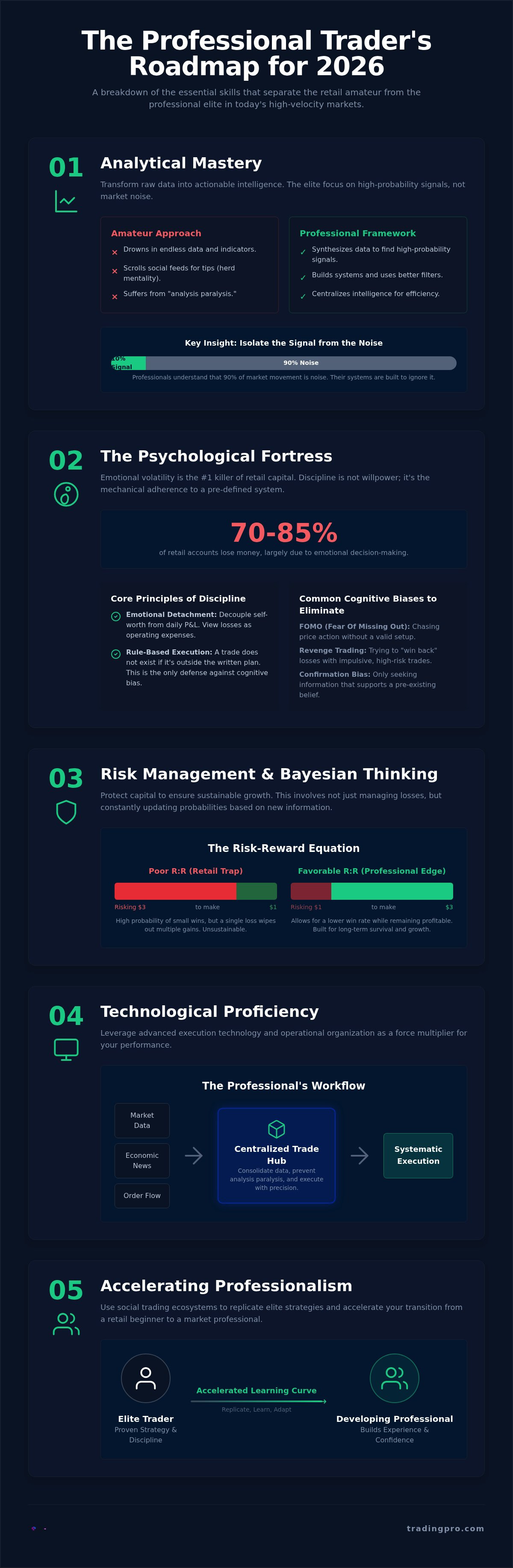
Technological Proficiency and Operational Organization
Technology is the professional trader’s force multiplier. In a landscape where MetaTrader 5 updates like Build 6180 integrate AI for market analysis, being tech-savvy is non-negotiable. It's one of the most practical skills needed for a professional trader. You must understand the mechanics of how your orders reach the market. For instance, knowing the difference between ECN (Electronic Communication Network) and STP (Straight Through Processing) models determines how much you lose to slippage. Professionals demand transparency and direct access.
Execution speed isn't just about your internet connection. It's a skill that requires the right institutional-grade infrastructure. If your broker's execution is slow, your strategy is dead on arrival. High-performance trading is about capturing price points with surgical precision. Amateurs hope for a price; professionals secure it.
Optimizing Your Trading Infrastructure
Speed is the currency of the market. Professional scalpers utilize ScalpX accounts for millisecond execution to ensure they get the price they see. This isn't just about having a fast computer. It involves using a Virtual Private Server (VPS) to minimize latency between your platform and the exchange. Check out our guide on the Best Trading Infrastructure for Scalping to see how the pros build their setups.
Professional Workflow and Journaling
Record-keeping is the line in the sand between a gambler and a professional. You cannot improve what you do not measure. A digital trading journal allows you to audit your performance with objective data. Professionals don't just look at their profit; they look at their execution quality, drawdown duration, and emotional state during the trade.
Organize your workspace for maximum focus. Minimal distraction leads to maximum efficiency. The post-market review is where the real growth happens. Pros look for patterns in their errors and successes in their logs to refine their edge daily. If you're ready to upgrade your operational efficiency, register for a Pro account today and gain access to the tools that drive elite performance.
Accelerating Professionalism: The Social Trading Shortcut
Traditional education takes years. Market immersion takes months. In the high-stakes environment of 2026, "Portfolio Replication" has emerged as a sophisticated method to reverse-engineer elite success. It isn't just about mirroring trades; it's about studying the logic behind them. By watching how a seasoned operator manages a position during a volatile news event, you gain market intuition that no textbook can provide. This strategic observation is one of the most effective skills needed for a professional trader who wants to compress their learning curve and achieve institutional-grade results.
The goal is a transition from copying to creating. You start by observing, but you finish by executing your own unique edge. This evolution requires a platform that facilitates growth rather than just providing a mirror. The TradingPRO Rookie Account serves as the ideal training ground. It allows you to apply professional strategies in a live environment while you refine your own technical and psychological framework. You aren't just following; you're apprenticing under the world's best.
Learning through Replication
Don't just hit a button. Analyze. To build the skills needed for a professional trader, you must dissect a "Master Trader’s" statistics. Look beyond the profit percentage. Examine their maximum drawdown, their recovery factor, and their average hold time. Understanding their risk profile is more valuable than seeing their gains. Use our guide on Social Trading vs Copy Trading to identify which model aligns with your educational goals. The "Observer Effect" is a powerful psychological tool. When you witness professional discipline in real-time, you internalize the habits required for long-term survival.
Scaling to Institutional Grade
Your journey doesn't end at the Rookie level. As your skills mature and your confidence stabilizes, the path to the Pro environment becomes clear. TradingPRO’s multi-tier system is designed to support every stage of this professional journey. You move from the Rookie tier to the Pro Account as your metrics improve, ensuring you always have the infrastructure you need to match your growing expertise. We provide the tools, the speed, and the ecosystem. You provide the ambition.
Ready to turn these skills into results? Register for your TradingPRO account today and join the ranks of the global elite.
Secure Your Competitive Edge in the 2026 Markets
Transitioning from a retail amateur to a professional elite requires more than just a strategy; it demands a total system upgrade. You now have the definitive roadmap for the skills needed for a professional trader in a high-velocity landscape. Success belongs to the operators who prioritize Bayesian risk management, psychological resilience, and operational precision over the daily market noise. Professionalism is a choice, and you've already taken the first step by mastering these concepts.
Your evolution starts with the right infrastructure. TradingPRO delivers institutional-grade execution speed and a comprehensive social trading ecosystem designed specifically for growth. We safeguard your progress with negative balance protection across all account tiers, allowing you to focus entirely on peak performance. The tools are ready. The roadmap is clear. It's time to dominate the global financial stage.
Master the markets with a TradingPRO Rookie Account and start your journey toward the professional elite today. Your future in the global markets is waiting for you to take the lead.
Frequently Asked Questions
What are the top 5 skills needed for a professional trader?
The top 5 skills needed for a professional trader in 2026 include analytical synthesis, psychological resilience, Bayesian risk management, technological proficiency, and operational discipline. You don't just need to read a chart; you must synthesize macro data into actionable intelligence while maintaining a fortress-like mindset. Mastering these specific competencies allows you to navigate the $9.6 trillion daily forex turnover with the precision of an institutional operator rather than a retail gambler.
Do I need a degree in finance to become a professional trader in 2026?
You don't need a formal finance degree to excel in 2026. While institutional roles once required specific credentials, the modern trading landscape prioritizes technical literacy and consistent performance over academic theory. Successful market participants focus on mastering the actual skills needed for a professional trader, such as quantitative analysis and risk control. Practical experience in professional environments, like the TradingPRO Rookie Account, often outweighs years of classroom study without live market application.
How long does it take to develop professional trading skills?
Developing professional-grade proficiency typically requires six to eighteen months of dedicated, consistent practice. This timeline depends on your ability to process information and maintain emotional control during drawdowns. You can accelerate this journey by utilizing structured environments and social trading ecosystems to observe expert behavior in real-time. Consistency in your daily research routine and performance auditing is the fastest way to bridge the gap between a retail beginner and an elite operator.
Can social trading help me learn the skills of a pro faster?
Social trading is a powerful accelerator for skill development. It allows you to observe the real-time decision-making processes of seasoned experts, providing a practical look at how they handle volatility and risk. By analyzing a Master Trader's stats and replication logic, you build market intuition much faster than through solitary study. This "Observer Effect" helps you internalize professional habits and builds the confidence necessary for your own independent execution as you scale through different account tiers.
What is the most important psychological skill for a trader?
Emotional detachment is the most critical psychological skill. You must learn to decouple your self-worth from daily profit and loss fluctuations to maintain objective decision-making. Professional traders view losses as simple operating expenses rather than personal failures. This detachment allows you to execute your system without hesitation or fear. Without this fortress-like mindset, even the most advanced technical strategy will eventually fail under the pressure of market volatility and impulsive retail behavior.
How much capital do I need to start practicing professional skills?
You don't need a massive bankroll to begin practicing professional-level skills. Modern brokerage infrastructure, such as the TradingPRO Micro Account, allows you to execute trades with minimal capital while focusing on precision and discipline. The goal is to master your process and risk management before scaling to larger tiers. Starting small ensures that you can refine your methodology and build your psychological fortress without facing catastrophic financial risk during your initial learning phase.
Is risk management a skill or a strategy?
Risk management is a fundamental skill that utilizes mathematical strategies. While the "strategy" involves calculating position sizes and risk-reward ratios, the "skill" lies in your ability to apply these rules consistently under intense pressure. It's your mathematical shield against market uncertainty. Professionals treat risk management as a non-negotiable part of their operational framework. Mastering this skill ensures that no single loss can ever compromise your long-term survival or your deposit in the global markets.
Why is discipline more important than technical analysis?
Technical analysis provides your market entries, but discipline ensures your long-term survival. You can have a perfect chart setup, but without the discipline to follow your exit rules, that trade can still lead to ruin. Discipline is the mechanical adherence to your pre-defined system, regardless of emotional impulses like fear or greed. It's the difference between a gambler chasing a "feeling" and a professional operator executing a high-probability business plan with surgical precision.


