



- Published on: 2026-09-06 00:32:20
Mastering Trading Psychology: 2026 Mental Edge Guide

The most dangerous risk in the 2026 market isn't a volatile spike or a sudden regulatory shift; it's the person staring back at you in the mirror. Even with the elimination of the $25,000 PDT rule, most traders still fail because they're fighting their own biology instead of the price action. Mastering trading psychology for beginners is the only way to survive this high-velocity environment. You've likely felt that paralyzing hesitation when a perfect setup appears. You've experienced the white-hot urge to revenge trade after a minor loss or the frantic FOMO that drives you into a crowded, overextended position. It's exhausting to watch your capital vanish because of a split-second emotional lapse.
This guide delivers the elite mental frameworks used by professional heavyweights to transform fear into fuel and greed into systematic execution. We'll build a repeatable routine that turns you from a reactive gambler into a disciplined market operator. You'll learn how to leverage the Rookie Account infrastructure to practice these high-stakes mental shifts with institutional-grade security. From neutralizing market swings to executing post-trade analysis like a pro, we're providing the definitive blueprint for absolute emotional stability and peak performance.
Key Takeaways
- Identify the evolutionary cognitive biases that trigger loss aversion and learn the frameworks to override these instincts during high-stakes market moves.
- Conquer the "Big Four" emotional traps—fear, greed, hope, and regret—to ensure every execution is driven by logic rather than impulse.
- Master trading psychology for beginners by transitioning from a "win-at-all-costs" mindset to a process-oriented professional strategy.
- Leverage the Rookie Account as a specialized psychological training ground to build bulletproof discipline with minimal financial risk.
- Use Social Trading to observe and replicate the elite mental routines used by seasoned authorities to navigate 2026 market swings.
What is Trading Psychology and Why Does it Determine Your Success?
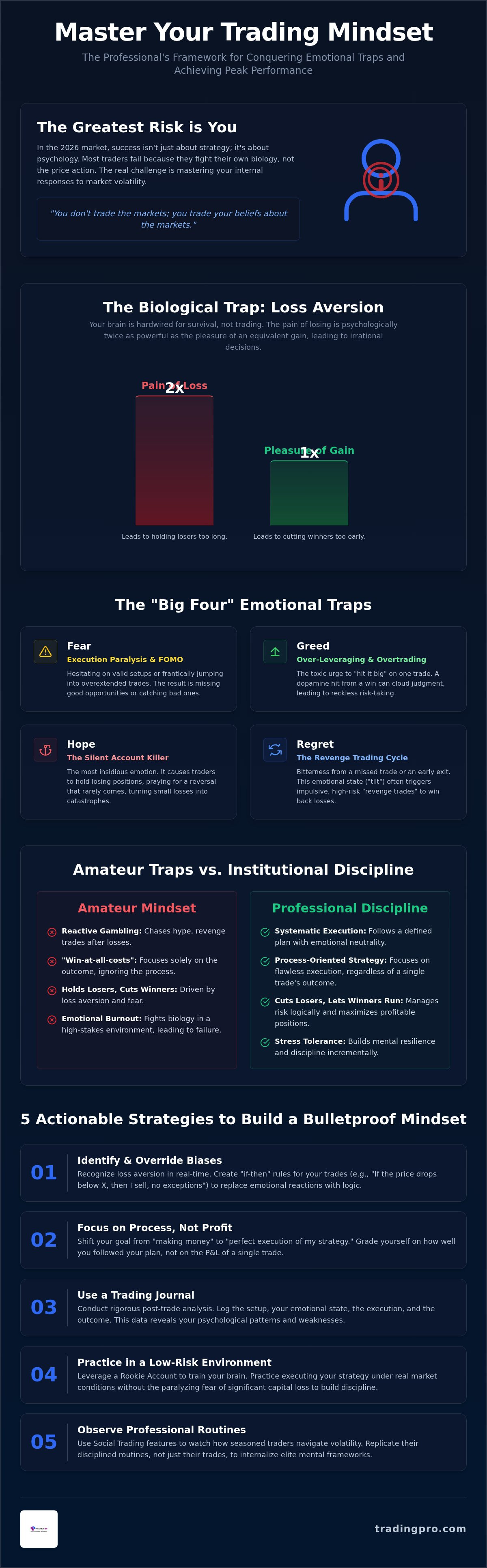
Trading psychology isn't a soft skill. It's the hard-coded operating system for your market execution. It represents the precise intersection where internal cognitive biases meet external market data. In the 2026 landscape, mental speed is your greatest competitive advantage. The elimination of the FINRA PDT rule has opened the floodgates for active trading, but it has also increased market noise. High volatility demands faster processing and absolute emotional neutrality. A strategy with a 90% win rate is functionally useless if you lack the 100% discipline required to pull the trigger or cut a losing position. You don't trade the markets; you trade your beliefs about the markets.
The Biological Trap: Why Losing Hurts More Than Winning Feels Good
Evolution didn't design your brain to trade. It designed it to survive. This survival instinct manifests as loss aversion, a psychological phenomenon where the pain of losing capital feels twice as intense as the pleasure of gaining it. This often triggers The Disposition Effect, a bias where traders hold losing positions too long in a desperate hope for a turnaround while cutting winners early to lock in a sense of safety. Winning carries its own set of risks. Every successful trade releases a dopamine hit that can cloud your judgment. It makes you feel invincible, which inevitably leads to overtrading and reckless over-leveraging. You must recognize these biological impulses before they hijack your terminal.
Trading Psychology for Beginners: The First 90 Days
Most failures in trading psychology for beginners occur within the first 90 days. It isn't usually a lack of technical knowledge that kills accounts; it's emotional burnout. You're fighting millions of years of biology in a high-stakes, fast-moving environment. You must build stress tolerance incrementally. Start small. Use a TradingPRO Rookie Account to practice execution without the paralyzing fear of significant capital loss. This infrastructure allows you to treat the market as a laboratory. You aren't just trading assets. You're training your brain to remain neutral during violent market swings. Expect a steep learning curve. Success isn't about being right every time. It's about being disciplined enough to follow your process when the market proves you wrong.
The Big Four: Navigating Fear, Greed, Hope, and Regret
The market is a mirror of human emotion. To dominate it, you must master the four psychological pillars that dictate every buy and sell order. While many resources touch on the Basics of Trading Psychology, professional success requires a deeper dive into how these forces hijack your strategy. Understanding these drivers is the foundation of trading psychology for beginners who want to move beyond the amateur level.
Fear manifests as execution paralysis. You see the perfect setup, but you're too afraid of being wrong to click the button. Greed is the opposite; it's the toxic urge to over-leverage your position because you want to "hit it big" on a single trade. Hope is perhaps the most insidious, leading to the gambler's fallacy where you hold a losing trade, praying for a reversal that never comes. Competitors often ignore hope, but it's the silent killer that turns a small loss into an account-clearing catastrophe. Finally, regret creates an emotional hangover. It's the bitterness of missing a move or exiting too early, which often leads to the next dangerous cycle.
Conquering FOMO (Fear of Missing Out)
Social media feeds are a primary source of distortion. They showcase curated wins while hiding the brutal reality of the drawdown. Beginners often feel a frantic urge to jump into a green candle simply because they don't want to be left behind. To remain objective, you must rely on institutional-grade infrastructure that provides real-time data rather than hype. When the market moves without you, accept it. The market is infinite; your capital is not. Professional traders know that missing a trade is better than catching a bad one.
The Revenge Trading Cycle
Revenge trading is the fastest way to blow a Micro account. It starts with "tilt," a state of emotional frustration after a loss that makes you want to "win it back" immediately. This isn't trading; it's gambling. You lose your systematic edge the moment you try to settle a score with the market. Developing a bulletproof mindset means accepting that losses are a business expense, not a personal failure.
Implement these circuit breakers to protect your capital:
- The Three-Loss Rule: If you hit three consecutive losses, close the terminal for the day.
- Physical Distance: Step away from your desk for 15 minutes after any significant drawdown.
- Process Audit: Review your trade plan before re-entering. If your next trade isn't in the plan, don't take it.
Building this discipline is the core of trading psychology for beginners. It separates those who treat the market as a hobby from those who treat it as a high-performance business. If you're ready to test your discipline in a live environment with professional tools, open your account today and start executing with precision.
Amateur Traps vs. Institutional Discipline: A Comparison
The divide between a struggling novice and a high-performance operator isn't found in a secret indicator. It's found in their reaction to market friction. Amateurs view a loss as a personal failure or a sign that the market is rigged. Professionals categorize losses as a standard business expense, no different from an office lease or a utility bill. This shift in perspective is the essence of trading psychology for beginners who intend to stay in the game long-term. You must stop taking the market's movements personally if you want to extract capital from it.
Amateurs trade to win. Professionals trade to follow a process. When you focus solely on profit, you become a slave to the outcome of every individual trade. This outcome-dependence triggers the emotional volatility that destroys accounts. By contrast, an institutional mindset prioritizes the integrity of the system. If you followed your rules and lost money, that was a successful trade. If you broke your rules and made money, that was a failure. Tools like the TradingPRO Trade Hub facilitate this by automating the objective components of your setup, stripping away the temptation to guess when the pressure is on.
A clinical study on fear and greed in traders highlights that those with the highest emotional responses to market swings consistently underperform. Pros mitigate this by focusing 100% of their energy on risk management rather than potential rewards. They know that if they manage the downside, the upside takes care of itself. Beginners chase pips; pros manage risk.
The Psychology of Risk Management
Position sizing is your ultimate psychological stabilizer. If a single trade makes your heart race, your position is too large. You've transitioned from trading to gambling. Institutional discipline requires you to risk only what your system dictates, regardless of how certain a setup feels. Features like Negative Balance Protection provide a critical mental safety net, eliminating ruin anxiety so you can execute with absolute confidence. Discipline is not the absence of emotion, but the adherence to a system despite it.
Developing a Professional Routine
You don't find discipline; you build it through repetition. A professional routine starts before the markets open. Pre-market objective setting ensures you enter the arena with a clear, neutral mind. You must also maintain a rigorous trading journal. It isn't just for tracking price points; it's for spotting the emotional patterns that precede a mistake. For those just starting, combining these mental habits with the structural knowledge in our Forex Trading for Beginners Guide creates a foundation that is difficult to shake. Success is the result of what you do every day, not what you do once in a while.
Actionable Strategies to Build a Bulletproof Trading Mindset
You don't need a million dollars to build a billion-dollar mindset. You need a framework that makes discipline the path of least resistance. Trading psychology for beginners isn't about suppressing your feelings. It's about building a structure where emotions can't interfere with execution. Follow these five steps to lock in your mental edge.
- Step 1: Start with "Disposable" Capital. Use the psychological freedom of a Rookie Account. When you trade with capital you can afford to lose, you deactivate the "fight or flight" response that leads to hesitation.
- Step 2: Define Your "Why." Connect your market performance to specific, long-term goals. If your only motivation is a vague desire for "more money," you'll fold during the first drawdown.
- Step 3: Master One Setup. Choice paralysis is a silent killer in 2026's high-speed markets. Be a specialist. Master one pattern until its execution becomes second nature.
- Step 4: Use Hard Stop-Losses. Remove the "Hope" factor from your terminal. Once your stop is set, the decision is out of your hands. This prevents the toxic urge to move stops or "wait for a bounce."
- Step 5: Review and Refine. Turn your losses into data points. A loss is only a failure if you don't extract the lesson. Use your journal to audit your mental state as much as your entry price.
The Power of the Demo Account
Practicing in a risk-free environment is essential for building mental muscle memory. You need to master your platform's mechanics before real capital is at risk. Our Practicing Without Risk: The No-Deposit Demo Account Guide provides the blueprint for transitioning from a simulated environment to live markets without the "shock" of real-world volatility. Treat your demo as a professional laboratory.
Managing Volatility in Emerging Markets
High-volatility sessions, such as the opening of Nigeria or Philippines market hours, require razor-sharp mental processing. Rapid price swings often trigger panic if you aren't prepared for the speed. Using a Scalp Account ensures maximum execution speed, which significantly reduces the anxiety caused by slippage. Stay grounded during "black swan" events by trusting your system. When the market moves fast, your discipline must move faster. If you're ready to execute with professional precision, register your account today and claim your competitive advantage.
Scaling Success: How TradingPRO Infrastructure Enforces Discipline
Trading psychology for beginners isn't just theory; it's a practice reinforced by the right environment. Our infrastructure is engineered to protect you from your own impulses. The Rookie Account serves as the ultimate low-friction entry point, acting as a high-stakes laboratory where you can develop psychological callouses without the stress of high-capital exposure. As your mental stamina increases, our multi-tiered system lets you scale seamlessly into Micro and Pro Accounts. This gradual progression ensures your technical skills never outpace your emotional maturity. You move at the speed of your own confidence, backed by institutional stability.
Social Trading as a Mental Crutch
High-performance trading doesn't have to be a solo journey. Social Trading offers a unique shortcut to disciplined execution by allowing you to mirror the moves of seasoned authorities. This isn't just about profit; it's about observation and mental conditioning. You get to see the "calm" in a professional's trade history during periods of extreme market turbulence. By diversifying your "mental risk" across multiple strategies, you reduce the psychological pressure to be right every time. You learn the rhythm of professional discipline through direct replication, seeing exactly how elites handle risk management in real-time.
Continuous improvement is the hallmark of the global trading elite. The TradingPRO Blog provides a constant stream of mindset training and tactical updates to keep your edge sharp. We don't just provide a terminal; we provide a partnership in your high-performance journey. Every tool, from our precision execution to our security protocols, is designed to facilitate your growth from a novice into a systematic operator.
Join the Global Trading Elite
The 2026 market belongs to those who can master their minds as effectively as their charts. You have the frameworks. You understand the traps. Now, you need the platform that rewards your discipline. TradingPRO empowers you with institutional-grade tools designed for speed, security, and precision. Don't let another volatile session pass without the mental edge you deserve. Start your Rookie journey with TradingPRO today and take command of your financial future.
Dominate the 2026 Market with Mental Precision
The transition from an amateur gambler to a systematic operator requires more than just a strategy. It demands a complete psychological overhaul. You've learned how to neutralize the "Big Four" emotional traps and replace reactive impulses with institutional discipline. This mastery of trading psychology for beginners is the ultimate competitive advantage in a high-velocity landscape where speed and precision are non-negotiable. You don't have to fight these biological battles alone.
Our global multi-tiered infrastructure provides the exact environment you need to scale your success. With Negative Balance Protection and an advanced Social Trading ecosystem, you can execute with absolute confidence while observing elite routines in real-time. It's time to stop letting fear and greed dictate your equity curve. Step into a professional routine that prioritizes process over luck. Your journey to market mastery begins with a single, disciplined decision. Join the Elite: Register Your TradingPRO Rookie Account Now and start trading with a bulletproof edge. The future of your portfolio is in your hands; execute it with precision.
Frequently Asked Questions
How do I stop being emotional when trading?
You eliminate emotion by replacing it with a rigid, rules-based execution system. Emotion thrives in uncertainty; therefore, a defined trade plan is your primary defense. Focus on the process rather than the profit. By treating every trade as a single data point in a series of thousands, you detach your self-worth from individual outcomes. Using a systematic approach ensures logic remains the dominant force during high-volatility sessions.
Can I trade with $1 and still learn trading psychology?
Yes, you can start practicing trading psychology for beginners with as little as $1 by using a Rookie Account. This low-friction entry point provides the psychological advantage of trading with real capital without the crushing stress of significant financial risk. It allows you to build the mental muscle memory required for live execution. Practicing with minimal capital is the most effective way to bridge the gap between theory and reality.
What is the best way to handle a losing streak?
The most effective way to handle a losing streak is to implement a mandatory circuit breaker and step away from the terminal. Continuing to trade while frustrated leads to revenge trading, which is a guaranteed way to blow your account. Review your trade journal to ensure you followed your system. If your process was correct, accept the losses as a standard business expense. If you broke your rules, return to a demo environment.
Is copy trading good for beginners who struggle with discipline?
Social Trading is an excellent tool for beginners because it allows you to replicate the disciplined execution of professional market operators. By copying an expert's strategy, you bypass the emotional fatigue of making constant decisions under pressure. This mentor-driven environment provides a real-time masterclass in risk management. It helps you diversify your mental risk while observing how elite traders navigate complex market swings with absolute emotional neutrality.
Why do I keep closing my winning trades too early?
You likely close winning trades early because of the disposition effect, which is the biological urge to lock in a small gain to avoid the pain of a potential reversal. This fear-based reaction prevents you from achieving the high risk-to-reward ratios necessary for long-term profitability. To combat this, set your take-profit levels in advance and refuse to move them. Trust your pre-trade analysis more than your mid-trade anxiety.
How long does it take to master trading psychology?
Mastering trading psychology is a continuous journey that typically takes months of consistent live execution to see significant progress. Most traders find the first 90 days are the most challenging as they learn to override their survival instincts. Your progress depends on your commitment to a professional routine and your ability to review losses objectively. Speed up this process by using Social Trading to observe institutional discipline in action every day.
Does a demo account actually help with trading psychology?
A demo account is essential for mastering platform mechanics and building a foundational routine, but it cannot fully replicate the emotional pressure of live capital. Use it to refine your strategy without financial risk. Once you've mastered your setup, transition to a Rookie Account. This allows you to experience the real psychological shifts of winning and losing while keeping your financial exposure low. It's the ultimate training ground for mental stamina.
What is the #1 psychological mistake beginners make?
The most common mistake is outcome dependence, where a beginner judges the quality of a trade based on whether it made money or lost money. This mindset is dangerous because a bad trade can sometimes be profitable by luck, reinforcing poor habits. Professional trading psychology for beginners focuses on process over profit. You must learn to value the integrity of your execution more than the result of any single trade to achieve consistency.


