



- Published on: 2026-10-17 01:28:42
Negative Balance Protection Broker: What Traders Should Check

Could a sudden market gap leave you owing more than you deposited, even if your broker advertises a safeguard? A negative balance protection broker may limit your losses to the funds in a covered account, but the label alone doesn’t tell you which accounts, products, or client types qualify. The terms matter.
It’s understandable to want a clear backstop when leverage and fast price moves can magnify losses. Negative balance protection isn’t a shield against losing your deposit, and it’s different from margin controls that may close positions before losses deepen. Coverage can depend on the broker’s legal entity, your account, the product you trade, and your client classification.
This guide explains how the protection works, where its limits lie, and what to compare before opening an account. You’ll get a practical checklist for reviewing eligibility, scope, and key terms, plus a clear distinction between balance protection and margin close-out rules. At TradingPRO, choosing between Rookie, Micro, Pro, and Scalp accounts is a separate decision from understanding the protection that applies to your trading.
Key Takeaways
- Check whether protection limits losses to the funds in your account. It doesn’t prevent losses to your deposit.
- Understand what happens after a fast market move, including when a balance adjustment may apply and how the broker handles it under its terms.
- Separate margin calls and stop-outs, which manage open-position risk, from negative balance protection, which addresses potential account debt.
- Assess a negative balance protection broker by its legal entity, your client category, covered accounts and products, and adjustment terms.
- Review the protection terms first, then compare TradingPRO’s Rookie, Micro, Pro, and Scalp accounts with your experience and trading approach.
What Does Negative Balance Protection Mean for a Broker’s Clients?
Negative balance protection is a safeguard that, when it applies under a broker’s terms, limits a client’s liability so a trading account does not remain below zero after losses. It addresses potential debt to the broker. It doesn’t determine whether a trade can lose money or whether deposited funds are safe from trading losses.
This distinction matters most in leveraged trading. Leverage gives a position market exposure greater than the funds committed to it, so a sharp price move can create losses quickly. If prices gap past expected levels, available margin may not be enough to absorb the loss before a position can be closed. Whether a negative balance is adjusted, and how, depends on the applicable terms. A broker’s name alone doesn’t establish the protection’s scope.
The idea has a limited parallel with Overdraft Protection in banking: both concern a balance falling below zero. The mechanisms and contractual terms differ, so treat the analogy as a starting point, not proof that a trading account has the same safeguards.
How can a trading account fall below zero?
Leverage magnifies both market exposure and the effect of price changes on account equity. A rapid move, especially a gap between quoted prices, can outpace available margin and the opportunity to close at the expected level. The resulting loss may exceed the funds in the account before the broker processes a close-out or applies a balance adjustment under its terms.
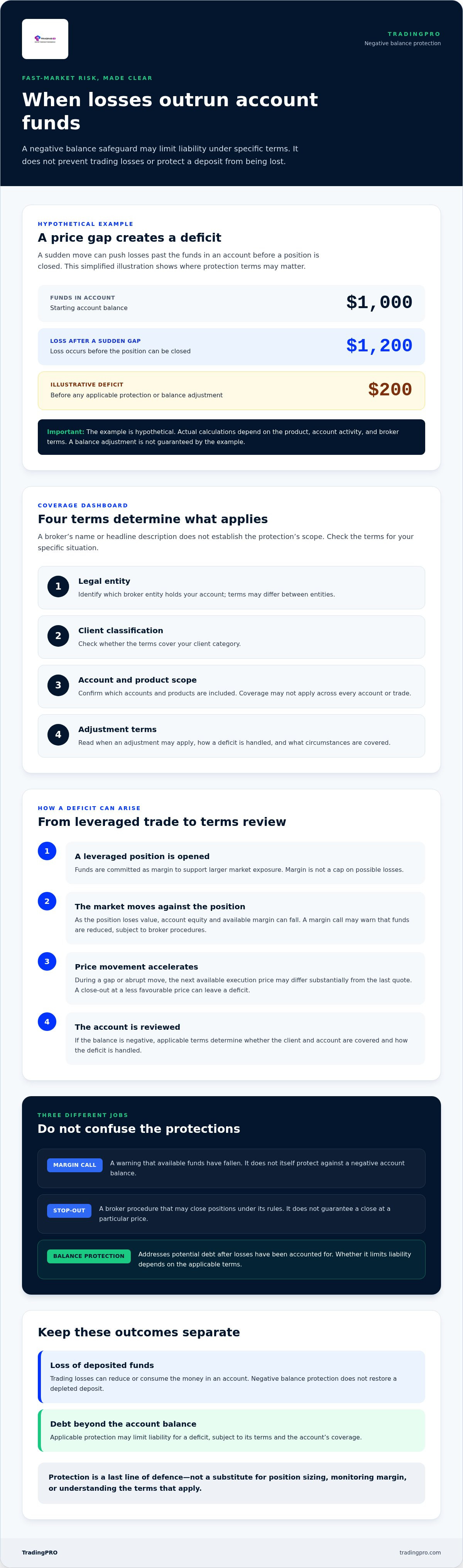
Hypothetical example: A trader has $1,000 in an account and opens a leveraged position. A sudden gap produces a $1,200 loss before the position can be closed. In this simplified illustration, the account would show a $200 deficit before any applicable protection or adjustment. Actual calculations depend on the product, account activity, and broker terms.
What negative balance protection is, and is not
Protection concerns liability for a negative account balance. If the relevant terms cover the account and situation, the broker may limit what the client owes to the funds in that account. The safeguard doesn’t reverse a losing trade, restore a depleted deposit, or create a profitable outcome.
Keep these outcomes distinct:
- Loss of deposited funds: Trading losses can reduce or consume the money in an account.
- Debt beyond the account balance: Applicable negative balance protection may limit liability for a deficit, subject to its terms.
Assess a negative balance protection broker by the terms that apply to your specific account, not by a headline or general description. Protection is a last line of defence, not a substitute for position sizing, monitoring margin, or informed trading decisions.
How Negative Balance Protection Works During Fast Market Moves
A negative balance event can unfold in moments, but the account outcome depends on more than the market move. Margin procedures, execution conditions, the relevant legal entity, and the terms for your client category all matter. Follow the sequence to see where a potential deficit can arise and where protection terms come into play.
- A leveraged position is opened. The trader commits funds as margin to support a larger market exposure. Margin isn’t a cap on possible losses.
- The market moves against the position. As the position loses value, account equity and available margin can fall. A margin call may warn that funds are reduced, subject to the broker’s procedures.
- Price movement accelerates. In a gap or abrupt move, the next available execution price may differ substantially from the last quoted price. A close-out may happen at a less favourable price than expected, potentially leaving a deficit.
- The account is reviewed. If the account balance is negative, the broker’s applicable terms determine whether protection covers the client and account, and how the deficit is handled.
From margin pressure to a negative account balance
Margin is the funds supporting an open leveraged position. It helps maintain the trade but doesn’t guarantee it can be closed at a particular price. A margin call is a warning that available funds have fallen, not the same thing as negative balance protection. For example, a hypothetical price gap could carry losses past the available margin before a position closes. Fast markets can leave little time for margin warnings, position closure, and execution to work as intended.
These controls have different jobs. Margin calls alert traders to pressure on available funds, while stop-out procedures may close positions under the broker’s rules. Negative balance protection addresses a possible deficit after losses have been accounted for. This distinction is reflected in the European framework for retail CFD protections: ESMA’s regulatory measures discuss protections alongside other measures, rather than treating them as one mechanism.
What happens after an account balance turns negative?
A negative figure isn’t enough to predict the final outcome. The broker’s relevant terms determine whether a balance adjustment applies, what circumstances it covers, and how the review is handled. The entity, account scope, and client classification can all affect the terms that govern an account. Don’t assume an automatic reset, a fixed processing timeline, or identical treatment across products.
Before trading, locate the terms for the specific entity and account you’ll use, then read how the broker describes negative balances and adjustments. If you’re considering a TradingPRO account, include the relevant terms in your setup review before you open a trading account.
Negative Balance Protection vs. Margin Calls and Stop-Outs
These safeguards are related, but they don’t do the same job. Margin calls and stop-outs concern open positions and available funds. Negative balance protection concerns what happens if the account ends up with a deficit. Keep the sequence clear: risk controls may act while trades are open; balance protection may become relevant after losses are reflected in the account.
| Mechanism | Purpose | Typical timing | What it does |
|---|---|---|---|
| Margin call | Warns of reduced margin or available funds | As account margin declines, according to the broker’s process | Alerts the client to pressure on the account; it doesn’t itself guarantee a position will close or prevent further losses |
| Stop-out | Manage risk from open positions | When defined account conditions are reached | May close one or more positions under the broker’s procedures |
| Negative balance protection | Address potential liability for a negative account balance | After losses are reflected and the account is assessed under applicable terms | May limit a covered client’s liability for a deficit, subject to the relevant terms |
Risk controls manage positions; balance protection addresses potential debt. This is the quickest way to distinguish a trading intervention from a safeguard concerning the resulting account balance. The broker’s procedures and the terms applicable to the account determine how each mechanism operates.
Margin call versus stop-out: what changes?
A margin call is a warning associated with declining account margin. It signals that the funds supporting open positions are under pressure, but the notice itself isn’t the same as a position closure. A stop-out is a process that may close positions once specified conditions are met. Don’t assume a universal threshold, a fixed order of closures, or execution at a particular price. Those details depend on the broker’s terms and account conditions.
For example, a trader might receive a margin warning and choose to reduce exposure or add funds, depending on the broker’s rules and available options. If conditions continue to deteriorate, a stop-out procedure may follow. These mechanisms address open-position risk, not guarantee that losses stay within the deposited amount.
Why negative balance protection is a separate safeguard
Negative balance protection doesn’t control when a trade opens or closes. It concerns the account balance after trading losses and any applicable adjustments are considered. It can’t prevent a losing trade or preserve deposited capital. Whether it limits liability for a deficit depends on the applicable entity, client category, account scope, and terms.
When assessing a negative balance protection broker, read the margin and stop-out rules separately from the balance protection wording. Identify the conditions that trigger warnings or closures, then see how the terms address a negative balance. This gives you a clearer view of the full risk framework without treating one safeguard as a substitute for another.
How to Evaluate a Broker’s Negative Balance Protection Terms
A protection label is only useful if you know exactly which terms govern your account. A brokerage brand may operate through regional legal entities, and the entity serving you can affect the applicable agreement. Review the current legal documents for your jurisdiction and account before relying on a summary page or general statement. Assess a negative balance protection broker by the scope and conditions in its terms, not the headline alone.
Use this checklist to focus your review:
- Entity: Identify the legal entity named in your account agreement. Match it to the entity shown in the broker’s current legal documents for your jurisdiction.
- Client category: Check whether the terms apply to your classification, such as retail or professional, and note any conditions that could change it.
- Account and product scope: Look for the accounts and trading products covered. Don’t assume the same wording applies across every account tier or instrument.
- Trigger: Find out what event or account state activates the protection. Check whether the terms define how losses, open positions, or account balances are assessed.
- Adjustment terms: Read how a deficit may be addressed, including stated exclusions, procedures, and definitions. Don’t assume a particular adjustment method or timeline unless the terms specify it.
Which terms should traders read closely?
Read the account agreement alongside any risk disclosure and product-specific terms it references. Search for phrases such as “negative balance,” “deficit,” “adjustment,” and “client classification,” then read the surrounding clauses rather than relying on a search result snippet. Compare the wording with the account and products you intend to use. Similar account names don’t prove identical coverage, especially where regional entities or account tiers differ.
Use the current documents that apply to your jurisdiction, not a cached page or an agreement for another region. If the documents refer to one another, follow those references to review definitions, exclusions, and procedures in context.
How to test the safeguard against realistic scenarios
Stress-test the wording against plausible market conditions. Consider a sudden gap that moves price past an expected exit, a market reopening after the weekend at a different level, or rapid volatility affecting several open positions. For each case, ask what the terms say about coverage, assessment, and any adjustment. If the terms don’t explain a scenario, don’t treat silence as a guarantee.
Keep your trading plan separate from the safeguard. Set position sizes and loss limits based on your own risk tolerance, and consider how you would manage exposure if a position moved sharply against you. Protection terms describe possible treatment of an account deficit; they don’t ensure a trade closes at a preferred price or preserve deposited funds.
Once you’ve reviewed the applicable terms, explore account options with a clear view of the agreement that will govern your trading.
Choose a Trading Account with Clear Risk Awareness
Make the account decision in the right order: understand what the protection terms say, read the agreement that applies to you, then compare account options with your experience and trading approach. A negative balance protection broker label shouldn’t determine your account choice on its own. Risk terms and account suitability are separate checks, and neither removes the possibility of trading losses.
Match account choice to experience and trading approach
Start with practical questions: how familiar are you with leveraged trading, which instruments do you plan to trade, and how often will you monitor open positions? Consider how you set position sizes and respond when markets move against you. If you’re learning the basics, build your understanding of order types, margin, and potential losses before increasing exposure. Account selection should follow your readiness, not a promise of protection.
TradingPRO offers Rookie, Micro, Pro, and Scalp account tiers. These are account choices, not statements about which protection applies. Review the relevant terms for your entity, client category, account, and products before deciding what safeguards govern your activity. If you’re exploring a beginner-focused option, learn about the Rookie Account. Consider it alongside your experience and trading habits.
A useful way to compare options is to write down your requirements first:
- Experience: Identify the products and trading processes you already understand, and where you still need practice.
- Approach: Consider your typical holding periods, how often you review positions, and how you plan to manage risk.
- Terms: Match the account agreement to the protection wording you’ve reviewed. Don’t assume account names imply specific safeguards.
Take the next step without confusing protection with certainty
Every trade can lose money, including funds you deposit. Negative balance protection, where applicable under the terms, concerns potential liability for a negative account balance. It doesn’t preserve your capital, guarantee a particular exit price, or turn a risky trade into a safe one. Keep position sizing and loss limits central to your plan, even after reviewing the protection terms.
TradingPRO’s account tiers give you options to consider as you match an account to your experience and trading approach. Understand the safeguard, read the applicable terms, and then select an account that fits your needs. When you’re ready, create a TradingPRO account with your risk plan and terms review in place.
Make Your Next Trading Decision with Confidence
Let clear terms guide your next move. Before opening an account, understand the agreement that applies to you and how it fits your trading approach. Assess a negative balance protection broker through its applicable terms, not as a promise of safety or a reason to take on more risk.
Then consider which TradingPRO account tier suits your experience, from Rookie to Micro, Pro, or Scalp, and whether the social and copy trading ecosystem fits how you want to engage with the markets. Keep that account decision separate from protection terms, and set your own boundaries for risk.
Ready to take a considered next step? Create a TradingPRO account and move forward with a clear plan and informed expectations.
Frequently Asked Questions
Does negative balance protection mean I cannot lose my deposit?
No. It concerns potential debt beyond an account’s available balance, subject to the applicable terms. A losing position could consume the funds you deposited while the protection addresses only whether you owe more than the remaining account balance. It isn’t capital insurance or a profit guarantee. Plan each trade around the possibility of losing your deposited funds, and use position sizing and other risk controls.
Can a broker close my trades before negative balance protection applies?
Yes, a broker may use margin calls or stop-out procedures to manage open positions before a negative balance becomes relevant. The applicable terms describe the conditions and process. A warning may prompt you to review your exposure, but it doesn’t mean a position will close immediately or at a chosen price. Read the account documentation to understand what the broker says may happen as margin changes.
How does negative balance protection work during a market gap?
A market gap can cause the next available price to differ sharply from the previous one, so a position may incur a larger loss than expected. If this leaves the account in deficit, the governing terms determine whether and how that balance is addressed. A gap doesn’t guarantee that protection will apply, nor does protection prevent the loss itself. Review how your account terms describe gaps and keep exposure within your risk plan.
Is negative balance protection available on every account and in every country?
No, don’t assume it applies universally. The legal entity serving you, your jurisdiction and client category, the account type, and the product can all affect the relevant terms. Wording for one account or region may not describe another. Use the current documents for the account you’re considering, and review the scope and exclusions rather than relying on a general marketing statement.
What is the difference between negative balance protection and a stop-out?
A stop-out is a process that may close open positions when specified account conditions are reached. Negative balance protection addresses a different issue: how a negative account balance is treated under applicable terms. A stop-out may occur without any deficit, while a deficit may still require review under the protection wording. Read both provisions separately; one doesn’t automatically replace the other.
Does negative balance protection make leveraged trading safe?
No. Leverage can magnify losses, and you may lose some or all of your deposited funds. Protection, where the relevant terms provide for it, concerns a specific potential liability; it doesn’t prevent volatility, promise a particular execution price, or make a strategy profitable. Before trading, consider how much exposure you can manage and decide in advance how you’ll respond if a position moves against you.
What should I check before choosing a negative balance protection broker?
Start with the legal entity named in the agreement for your account, then check eligibility, covered accounts and products, exclusions, and how the terms address a deficit. Search the documents for definitions such as “negative balance” or “adjustment,” and read the clauses in context. Compare those details with the separate margin and stop-out rules. This gives you a clearer basis for comparing brokers than a headline claim alone.


