




- Published on: 2026-09-03 10:00:30
Reporting Trading Income to Tax Authorities: The 2026 Professional Guide
Your trading success is only as secure as your reporting. While many see tax season as a burden, elite performers recognize it as the ultimate audit of their operational efficiency. If you've spent the year leveraging social algorithms, you're likely facing the new complexities of copy trading taxes and the debut of Form 1099-DA. It's easy to feel overwhelmed by hundreds of micro-lot trades or the fear of a regulatory deep dive. You've built a portfolio designed for peak performance. Don't let administrative friction stall your momentum.
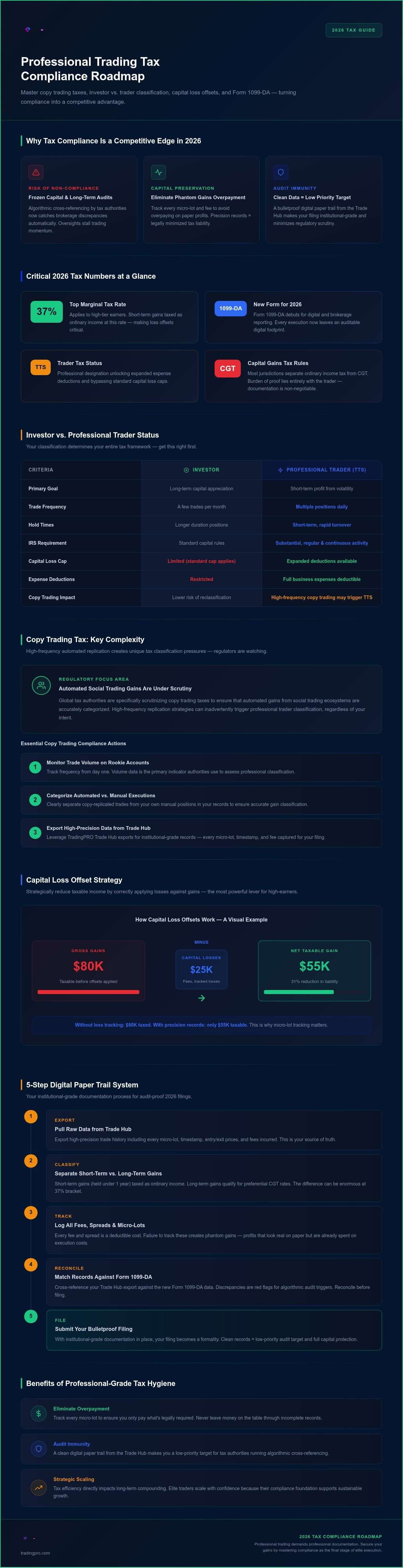
We understand that precision in the markets must be matched by precision in your documentation. This professional guide provides the definitive roadmap for 2026, cutting through the confusion of investor versus trader status and capital loss offsets. You'll master the complexities of the updated tax brackets, including the 37 percent top marginal rate for high-tier earners. We're delivering a frictionless strategy to transform your raw Trade Hub data into a bulletproof filing. Prepare to secure your profits and navigate the 2026 tax landscape with the confidence of a global market leader.
Key Takeaways
- Identify your classification as an investor or professional trader to unlock the most advantageous tax framework for your 2026 filings.
- Simplify the management of copy trading taxes by leveraging high-precision data exports from the TradingPRO Trade Hub.
- Master the mechanics of capital loss offsets to strategically reduce your taxable income and protect your net gains.
- Establish a bulletproof digital paper trail that ensures institutional-grade transparency and effectively eliminates audit risks.
- Treat tax compliance as the final stage of an elite trading execution to ensure your capital remains secure and scalable.
The Foundation of Professional Trading: Why Tax Compliance Matters in 2026
Elite trading isn't just about hitting the right entry price. It's about protecting the capital you've fought to accumulate. In 2026, tax compliance serves as the ultimate differentiator between the amateur and the high-performance professional. We view reporting as the final stage of a successful execution. If you can't document your gains, you haven't truly secured them. Ambitious traders treat their tax obligations as a hallmark of excellence rather than a burden.
The risks of non-disclosure have never been higher. Tax authorities now utilize advanced algorithmic tools to cross-reference brokerage data with individual filings. A simple oversight can lead to more than just a fine. It can result in frozen trading capital and long-term audits that stall your momentum. Professional reporting acts as a mechanism for verifying your strategy's net profitability. It forces you to look at the hard data, ensuring your growth is sustainable and your institutional stability is beyond reproach.
The Global Landscape of Trading Taxes
Global authorities are no longer playing catch-up with the retail market. 2026 marks a new era of transparency where every execution leaves a digital footprint. Most jurisdictions distinguish between ordinary income tax and Capital Gains Tax, and the burden of proof rests entirely on your shoulders. Regulators are specifically scrutinizing copy trading taxes to ensure that automated gains from social ecosystems are accurately categorized. Whether you're trading from a Rookie Account or managing high-volume flows, the expectation of transparency is absolute.
Capital Preservation Through Accurate Reporting
Precision in reporting is a tool for capital preservation. Accurate records prevent you from overpaying on "phantom gains"-profits that appear on paper but are offset by fees or losses you've failed to track. There's a significant psychological edge in having your financial house in order. It provides the confidence needed to scale from a basic setup to a Scalp Account or Pro environment. Consider these benefits of professional-grade data hygiene:
- Eliminate Overpayment: Track every micro-lot to ensure you only pay what's legally required.
- Audit Immunity: A clean digital paper trail from the Trade Hub makes you a low-priority target for tax authorities.
- Strategic Scaling: Professional mentors prioritize tax efficiency because it directly impacts your long-term compounding potential.
Don't let administrative friction cap your potential. Secure your profits by mastering the mechanics of compliance today. It's the only way to ensure your trading empire is built on a foundation of security and reliability.
Classifying Your Trading Activity: Investor vs. Professional Trader Status
Your tax liability depends on how you define your relationship with the market. Most retail participants are classified as investors, meaning they seek long-term growth and capital appreciation. Professional traders, however, aim to profit from daily market swings and price volatility. This distinction is critical when managing copy trading taxes, as the frequency of automated executions can inadvertently push you toward a professional classification. If your strategy involves high-frequency replication, you need to understand where the line is drawn.
The IRS and global authorities look for specific indicators of business intent. They analyze your trade frequency, the average length of your hold times, and your overall dedication to the craft. According to the IRS guidance on trader tax status, you must prove that your activity is substantial, regular, and continuous. Trader Tax Status (TTS) is a professional designation for active market participants. Without this status, you're limited by standard capital loss caps and restricted expense deductions. To cross the threshold from hobbyist to business owner, your primary goal must be short-term profit rather than long-term investment for growth.
The Rookie Transition: When Does Your Status Change?
Every elite career starts somewhere. Monitoring your trade volume on a Rookie Account is the first step in gauging your path toward professional status. While a hobbyist might execute a few trades a month, a professional typically manages multiple positions daily. High leverage also signals active market participation rather than passive growth. If your intent is to generate a primary living from the market, your status has likely already shifted. You've moved beyond simple investing into the high-octane world of professional execution.
Benefits of Professional Trader Classification
Claiming professional status unlocks institutional-grade advantages. You can deduct trading-related expenses like advanced software, data feeds, and even home office costs. These deductions are taken "above the line," reducing your adjusted gross income directly. The most potent tool is the Mark-to-Market election. This allows active day traders to treat gains and losses as ordinary income, bypassing the standard $3,000 capital loss limitation. It provides massive flexibility for loss carry-forwards, ensuring one high-volatility month doesn't derail your entire year's progress. Professional status transforms tax season from a liability into a strategic advantage.
Start building your track record with a platform that supports your professional evolution. Open your account today to secure the data transparency you need for elite reporting.
Organizing Your Digital Paper Trail: A Step-by-Step Data Hygiene Guide
High-performance trading requires high-performance record keeping. Your digital paper trail is your ultimate defense against regulatory friction. Establish a clean record for every execution. This discipline must extend across all your environments, from initial testing on Micro accounts to high-velocity strategies on Scalp accounts. Tax authorities demand more than just a summary of your wins. They require a granular breakdown of your activity. Categorize every trade by asset class to ensure your filings match specific form requirements perfectly. This level of organization is the hallmark of a professional who values institutional stability.
Reconcile your deposits and withdrawals with absolute precision. Your net equity must align with your reported figures to prevent automated red flags during the 2026 tax season. Managing copy trading taxes becomes a streamlined process when your data hygiene is impeccable. Professional traders don't leave these details to chance. They utilize institutional-grade tools to automate the data collection process. This ensures that every profit margin and every commission is accounted for without the risk of manual error.
Essential Documentation Checklist
Maintain these three pillars of evidence to secure your standing. Your monthly and annual brokerage statements serve as the primary source of truth for any audit. You must also keep detailed trade logs with timestamps. These prove your hold times, which is vital for distinguishing between different tax treatments. Finally, archive all receipts for your trading infrastructure. This includes costs for your VPS, platform subscriptions, and educational resources. These are essential for maximizing your professional deductions.
Using the TradingPRO Trade Hub for Reporting
Mastering copy trading taxes requires high-fidelity data that you can access instantly. The Trade Hub allows you to export high-precision records with a single click. Use advanced filtering to separate data from different account environments. For instance, you can isolate high-frequency data from a Scalp account to keep your reporting modular and organized. This ensures your data is formatted for a seamless handover to your tax professional. Institutional-grade transparency is the standard for the modern elite trader. Don't settle for fragmented records when you can have a unified, professional reporting ecosystem.
Complex Scenarios: Reporting Copy Trading and Capital Loss Offsets
High-performance automation requires elite-level reporting. Managing copy trading taxes requires a nuanced understanding of how automation interacts with traditional tax codes. In a high-volatility environment, you'll likely face a mix of realized and unrealized gains. Only realized gains, where a position is closed, trigger a taxable event. Unrealized gains represent your expanded potential, but they remain tax-neutral until you hit the exit button. Mastering this distinction ensures you don't over-calculate your liability during mid-year volatility spikes. It's the difference between a professional strategy and an administrative oversight.
The Tax Implications of Social Trading
Classifying copy trading income often falls into a grey area. For most, it's treated as passive investment income. However, if you've achieved Trader Tax Status as discussed in previous sections, these automated executions become part of your active business income. This shift is significant. It allows you to report performance fees paid to strategy providers as a deductible business expense. These fees represent the cost of institutional-grade intelligence. You should view them as a direct reduction of your taxable profit. To understand the strategic differences between these execution styles, consult our Social Trading vs Copy Trading Guide. It provides the context needed to categorize your activity accurately for tax authorities.
Mastering the Wash Sale Rule and Loss Offsets
Capital losses are the silver lining of a high-stakes market. They act as a powerful shield for your net profitability. You can use these losses to offset your capital gains dollar-for-dollar. If your losses exceed your gains, you can offset ordinary income up to the current legal limits. Professional traders use tax loss harvesting at the end of the fiscal year to optimize their final numbers. This involves closing losing positions to realize the loss and lower the tax bill. You must be cautious of the Wash Sale Rule. This 30-day rule disallows a loss claim if you purchase a "substantially identical" security within 30 days before or after the sale. In an automated environment, your software might inadvertently trigger a wash sale. Monitoring your replication settings is vital to avoid disallowed claims. By mastering the nuances of copy trading taxes, you transform a complex obligation into a strategic advantage.
Secure your financial future with a partner that values precision. Register your account today and take control of your professional reporting.
Institutional Stability: Leveraging TradingPRO Infrastructure for Frictionless Reporting
Institutional stability is the bedrock of elite performance. We provide a safe-haven where organized, transparent data isn't an afterthought; it's a core feature. Managing copy trading taxes requires a platform that understands the high-stakes nature of global markets. Our ecosystem ensures your records are beyond reproach. By utilizing segregated accounts, you can maintain absolute clarity across your different strategies. This separation prevents the cross-contamination of data that often plagues amateur setups. You've worked hard to build your capital. Don't let administrative friction compromise your growth.
Precision in execution leads directly to precision in reporting. High-performance infrastructure reduces the slippage that can distort your final tax numbers. When you trade with institutional-grade speed, the price you execute is the price you document. This eliminates the "grey area" calculations that often trigger regulatory scrutiny. We empower you to treat your trading desk like a global firm. Secure your profits with the same level of transparency used by the world's leading financial institutions. Mastering copy trading taxes is a frictionless experience when you have the right partner.
Global Scale for the Retail Trader
TradingPRO operates at a global scale. This ensures your records are maintained to the highest international standards. Our high-performance execution creates clean, high-fidelity tax logs that satisfy even the most rigorous authorities. We don't just facilitate trades; we facilitate your long-term success. Knowledge is the most effective tool for capital preservation in a fast-moving landscape. You can explore more professional insights and stay updated on regulatory shifts by visiting the TradingPRO Blog. It's your resource for maintaining a competitive edge.
Next Steps: Professionalizing Your Trading Desk
Finalizing your 2026 filings requires a proactive approach. We recommend consulting with a tax specialist who understands the nuances of multi-asset brokerage. Once your reporting systems are fully automated, it's time to elevate your environment. Upgrading to a Scalp Account provides the low-latency infrastructure needed for advanced execution. This move signals your transition into the ranks of seasoned market authorities. Don't let administrative hurdles slow your momentum. Register your professional account today and secure the institutional stability your capital deserves.
Secure Your Profits and Scale with Confidence
Mastering the complexities of copy trading taxes is the final step in a professional execution cycle. You've learned to distinguish between investor and trader status, ensuring you leverage every available deduction. You've also seen how a clean digital paper trail transforms tax season from a liability into a strategic audit of your net profitability. True market leaders don't leave their compliance to chance; they build on a foundation of institutional stability and data-driven precision.
Success in 2026 requires a partner that prioritizes your security as much as your speed. Our global multi-asset infrastructure provides the precision Trade Hub reporting you need for frictionless filings. With integrated features like Negative Balance Protection, you can focus on expanding your portfolio while we provide the data transparency required by global authorities. It's time to stop reacting to tax deadlines and start dominating the markets with a bulletproof administrative strategy. Your path to sustainable, long-term growth starts with professional-grade accountability.
Scale your trading with an institutional-grade Rookie Account and join the ranks of elite market performers today. The future of your trading empire is built on the decisions you make now.
Frequently Asked Questions
Do I have to report trading income if I did not withdraw the money from my account?
Yes, you must report all realized gains regardless of whether you withdraw funds. Tax authorities view the closing of a position as the taxable event. If you buy and sell an asset within your TradingPRO account, the resulting profit is taxable for that fiscal year. Leaving the capital in your account to scale into a Pro or Scalp environment doesn't defer your tax liability. Secure your records today to avoid future friction.
What is the difference between capital gains and ordinary income for traders?
Capital gains apply to investors seeking long-term growth, while ordinary income rates apply to those with Trader Tax Status. Short-term capital gains are typically taxed at ordinary income rates based on your specific tax bracket. Long-term gains, for assets held over a year, often enjoy lower preferential rates. Most high-frequency participants in our social ecosystem find their profits taxed at ordinary rates due to rapid execution speeds and high volume.
Can I deduct my trading platform fees and educational costs from my taxes?
Deductions depend on your classification. If you qualify for Trader Tax Status, you can deduct business expenses like platform fees, VPS costs, and educational resources directly from your income. Investors generally cannot deduct these as itemized expenses under current 2026 regulations. We recommend maintaining precise records in the Trade Hub to ensure your tax professional can maximize every legal deduction available to your specific account tier. Precision is the path to profitability.
How do I report income from copy trading or social trading feeds?
Income from copy trading is reported based on the underlying assets traded, such as forex or commodities. You must track the performance fees paid to strategy providers, as these are often deductible for professional traders. Managing copy trading taxes requires high-fidelity data exports that show every automated execution. Use the TradingPRO Trade Hub to generate granular reports that separate your manual trades from replicated social strategies for absolute transparency and institutional-grade compliance.
What happens if I forget to report my trading losses to the tax authorities?
Failing to report losses is a missed opportunity for capital preservation. You can use realized losses to offset your gains, potentially reducing your total tax bill to zero. If you omit these, you'll overpay on your net profits. Tax authorities may also flag discrepancies if your reported income doesn't match the institutional data they receive from brokers. Always include your losses to protect your capital and maintain a clean, professional audit trail.
Is there a minimum profit threshold before I am required to report trading income?
Most jurisdictions require you to report all income, even if it falls below certain filing thresholds for total earnings. While some regions have a de minimis limit for casual hobbies, professional trading activity is scrutinized heavily. Even a Rookie Account with modest gains should be documented. Reporting every dollar ensures you establish a consistent track record. This is essential for institutional stability and future scaling into higher-tier accounts like our Pro or Scalp environments.
How does the Mark-to-Market election change my tax filing process?
The Mark-to-Market election under Section 475 allows you to treat all open positions as if they were sold on the last day of the year. This eliminates the wash sale rule and allows you to treat losses as ordinary rather than capital. It simplifies the reporting of copy trading taxes by creating a definitive year-end cutoff. This election is a powerful tool for active traders but requires a formal, proactive filing with the IRS to be valid.
What documents do I need from my broker to file my taxes correctly in 2026?
You need your comprehensive annual statement and the new Form 1099-DA for digital assets where applicable. TradingPRO provides high-precision data exports through the Trade Hub, covering every execution from Micro to Scalp accounts. Ensure you have a detailed log of all commissions, performance fees, and swap charges. These documents form the digital paper trail necessary to verify your net profitability and satisfy the latest 2026 reporting standards with absolute confidence.


