




- Published on: 2026-09-03 06:47:17
Risk Management for Copy Trading: Protecting Your Capital in 2026

Passive income is a dangerous illusion if you aren't the one holding the kill switch. Most investors treat social trading like a set and forget lottery ticket. They watch as a single market spike erases months of gains through uncontrolled drawdowns and hidden leverage. You already know that effective risk management for copy trading requires more than just hitting follow; it demands the same institutional-grade precision the pros use to defend their own portfolios. This isn't about luck. It's about control.
Securing your capital is your absolute priority in 2026. You want the rewards of expert execution without the vulnerability of a hands-off approach. This guide delivers the elite strategies needed to build a high-performance income stream while maintaining a hard safety net. We'll break down how to utilize specific account tiers, from the low-risk entry of a Rookie Account to the high-speed execution of a Scalp Account. You'll learn to neutralize slippage and command your risk-to-reward ratios with total authority. Prepare to transform your capital into a protected powerhouse by implementing the security protocols used by global leaders.
Key Takeaways
- Command your portfolio by shifting from passive observation to active oversight. Learn why hands-off trading actually requires more precise risk planning.
- Implement the three pillars of risk management for copy trading to define absolute equity stops. Calculate the exact math behind the 10% allocation rule.
- Neutralize catastrophic losses by setting non-negotiable Maximum Drawdown triggers. Automate your safety net to protect capital during unexpected market spikes.
- Select the optimal infrastructure for your strategy. Use Rookie Accounts to buffer against volatility or Scalp Accounts to eliminate the hidden costs of high-frequency replication.
- Audit master traders with institutional rigor. Prioritize historical drawdown over raw ROI to build a sustainable and resilient income stream.
The Reality of Copy Trading: Why Strategy Replication Requires Risk Management
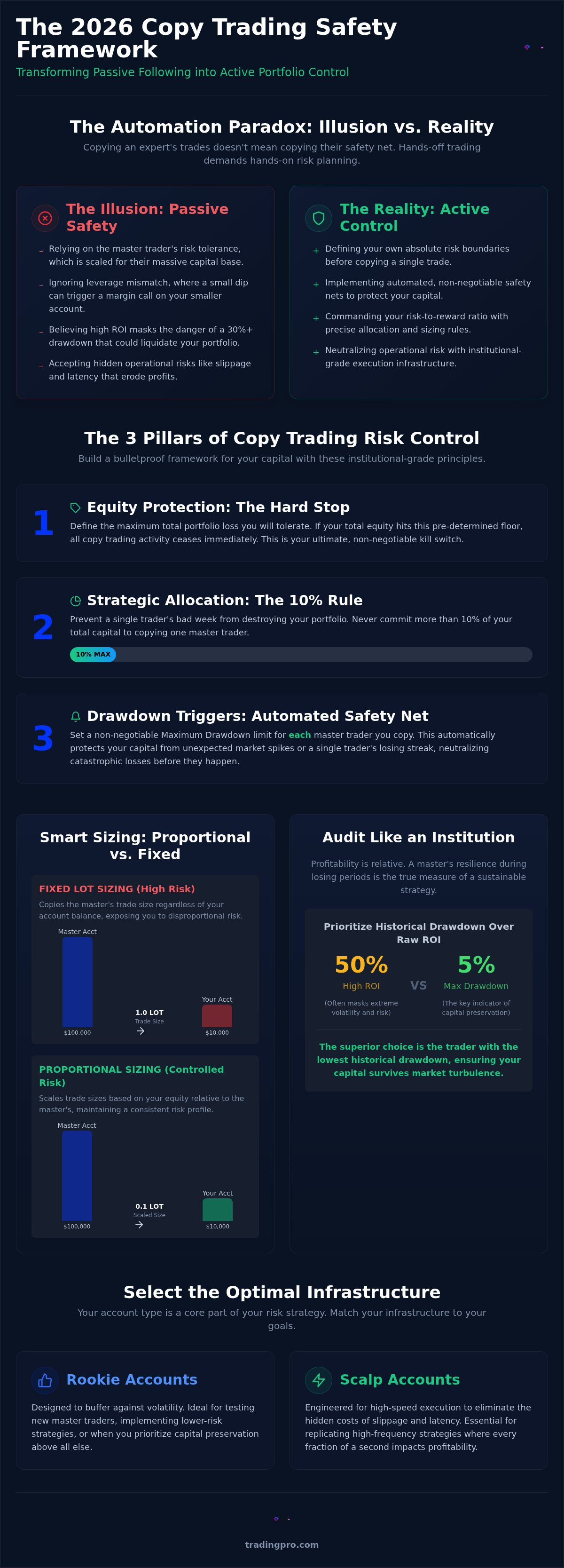
Automation is a force multiplier, not a substitute for intelligence. This is the Automation Paradox: while you replicate the moves of an elite trader, you cannot replicate their specific risk tolerance or their unique capital base. Many investors fall into the trap of believing that "following a pro" equates to "inheriting safety." It doesn't. In fact, hands-off trading requires more aggressive hands-on risk planning to ensure your account survives the master's mistakes.
2026 markets move with predatory speed. You aren't just fighting market volatility. You're fighting operational friction. Successful risk management for copy trading distinguishes between these two threats. Market risk is the price action you see on the charts. Operational risk is the hidden slippage and latency that eats your margins before the trade even closes. TradingPRO infrastructure is engineered to crush these operational barriers, providing a safe haven where your strategy replication remains precise and protected.
The Illusion of Passive Safety
Profitability is relative. A master trader might celebrate a month of 10% gains despite a 30% drawdown because their multi-million dollar liquidity pool can absorb the hit. If you're copying that same strategy with a smaller account, that 30% dip could trigger a margin call and liquidate your entire portfolio. You must define your own boundaries rather than relying on theirs. Copy Trading Risk is the delta between master execution and copier equity.
- Capital Disparity: Masters often trade with massive balances that allow for wider stop-losses.
- Leverage Mismatch: Replicating a high-leverage strategy on a low-equity account is a recipe for instant depletion.
- Psychological Gap: The master knows their plan; you only see the result. This uncertainty requires a hard safety net.
Execution Speed as a Risk Factor
Seconds are an eternity in modern markets. A winning entry for a master becomes a losing entry for you if your platform lags. This delay is where most "hidden" losses occur. Utilizing the best trading infrastructure for scalping is non-negotiable for anyone serious about replication. Institutional-grade execution ensures your copy is a mirror, not a distorted reflection. When you eliminate execution lag, you're practicing the most fundamental form of risk management for copy trading: ensuring you actually get the price you were promised.
The 3 Pillars of Copy Trading Risk Control: Equity, Allocation, and Correlation
Success in replication isn't just about picking the right trader. It's the result of building a bulletproof framework. You need an institutional-grade architecture to survive the inevitable shifts in market sentiment. This section reveals the three pillars of risk management for copy trading: Equity, Allocation, and Correlation. Mastering these ensures you remain the commander of your portfolio, even when the markets turn volatile. Control is the only currency that matters in 2026.
Equity protection starts with a non-negotiable Hard Stop. Before copying your first trade, define the exact dollar amount you're willing to risk across your entire portfolio. If your account hits that floor, all copying must cease immediately. Combine this with strict allocation sizing. Never commit more than 10% of your total capital to a single master trader. This math prevents one trader's bad week from becoming your financial disaster. Finally, calibrate your leverage. Matching your account leverage to the master's risk profile ensures that margin requirements don't trigger premature liquidations during a drawdown.
Equity-Based Position Sizing
Precision is everything. Use the TradingPRO Trade Hub to calculate margin requirements before you commit capital. Most beginners make the mistake of fixed lot copying, where every trade is the same size regardless of account balance. Proportional equity copying is the superior choice. It scales trade sizes based on your specific balance relative to the master's equity. Adjust your multiplier to match your personal risk appetite. If you want half the risk of the master, set your multiplier to 0.5 to maintain a safe-haven buffer.
Strategic Diversification
True protection comes from low correlation. Copying three different traders who all scalp EUR/USD isn't diversification; it's tripled exposure. Consult our Social Trading vs Copy Trading guide to identify and select distinct trading styles. Pair a high-frequency scalper with a long-term swing trader. This balance ensures that while one strategy waits for a setup, the other captures immediate momentum. Watch for hidden correlation in emerging market pairs. These often mirror major indices and can create unexpected risk clusters if not monitored closely.
Building this framework is the first step toward elite status. To start applying these institutional-grade controls and secure your path to sustainable growth, open your account today and take absolute command of your financial future.
Advanced Drawdown Management: Setting Your Institutional-Grade Safety Net
Professional traders don't fear losses. They fear uncontrolled losses. Maximum Drawdown (MDD) is your ultimate metric of pain. It measures the largest peak-to-trough decline in a strategy's history. In 2026, setting a non-negotiable MDD exit trigger is the cornerstone of elite risk management for copy trading. If a master trader exceeds their historical drawdown by even a fraction, your "Circuit Breaker" must engage. Pause replication instantly during extreme market events or high-volatility news cycles. This proactive stance ensures you aren't the one funding a master's learning curve during a market shift.
Command your portfolio by analyzing the Recovery Factor before committing capital. This critical ratio compares total net profit to the maximum drawdown. A master with high returns but a low recovery factor is a ticking time bomb. You want traders who bounce back with precision. Look for a recovery factor above 1.5 to ensure the strategy has the historical resilience to overcome setbacks without gambling. High-performance mentors prioritize capital preservation over ego. You must do the same.
Setting Automated Equity Stops
An Equity Stop is your hard floor. It's a definitive command that closes all copied positions if your account value hits a specific threshold. While a master trader might have the deep liquidity to weather a storm, retail accounts often face a "point of no return" at 20-30% drawdown. Crossing this line makes mathematical recovery exponentially difficult. Implement these automated stops to prevent catastrophic account depletion. For a comprehensive protection checklist and specific setup guides, consult our Managing Drawdown sibling article. Protect your equity with zero hesitation.
The Psychology of the 'Pause' Button
Strategy Drift is a silent killer. It occurs when a master trader abandons their proven system under pressure. Recognize the warning signs early. If a scalper starts holding losing positions overnight or a conservative trader begins increasing lot sizes to chase losses, hit the pause button. Use demo environments to test new risk settings or evaluate a new master trader without exposing real capital. Institutional stability requires total emotional detachment. Never "revenge-copy" to win back losses. Stick to your risk management for copy trading protocols. Precision beats desperation every time.
Account-Specific Risk Mitigation: From Rookie to Pro Tiers
Elite risk management for copy trading begins with your choice of infrastructure. Your account tier isn't just a label. It's a strategic decision that dictates how much market friction you absorb. Matching your account type to the master trader's execution style is the difference between a synchronized mirror and a distorted reflection. TradingPRO provides a specialized multi-tier structure to ensure your capital is protected by the most relevant defensive layers available in 2026.
Negative Balance Protection serves as the ultimate institutional safety net for every client. This protocol ensures that even during extreme black swan events, you can never lose more than your initial deposit. While the market might move with predatory speed, this hard limit remains absolute. It provides the "safe-haven" feel necessary to trade with confidence in high-stakes environments. Beyond this baseline, your specific account tier refines your defensive posture.
The Rookie Advantage for Beginners
First-time copy traders often face the highest psychological pressure. The TradingPRO Rookie Account is engineered to neutralize this anxiety through granular risk testing. By leveraging micro-lots, you can replicate high-volatility master strategies with significantly smaller capital outlays. This allows you to observe the strategy's performance in real-market conditions without overexposing your portfolio. You can also utilize a Deposit Bonus (with T&Cs) to create an additional equity buffer. This extra margin provides more room for the strategy to breathe during natural market fluctuations, making the Rookie tier the ideal entry point for those prioritizing capital preservation.
ScalpX and Pro: Minimizing Operational Risk
High-frequency strategies demand more than just a safety net. They require precision. If you are copying a master who executes dozens of trades daily, you must use the ScalpX environment. In this tier, raw spreads eliminate the "fee erosion" that often turns a master's winning day into a follower's losing one. Slippage is a lethal operational risk. Milliseconds of delay result in price gaps that widen your drawdowns. Institutional-grade execution ensures you enter and exit at the exact price points intended by the master. By removing the cost of friction, you maximize your profit margins and maintain a predictable risk-to-reward ratio.
Take command of these institutional tools to secure your financial future. Select your account tier today and start replicating success with absolute precision.
The 2026 Copy Trading Safety Framework: Your Path to Sustainable Growth
Sustainable growth isn't a byproduct of luck. It's the result of a rigorous, repeatable framework. To dominate the markets in 2026, you must shift your perspective. Stop seeing yourself as a passenger. Start acting like the Chief Risk Officer of your own capital. This final framework synthesizes everything you've learned about risk management for copy trading into four decisive steps. High-performance execution starts now.
- Step 1: Audit the master trader. Ignore the "All-Time Profit" vanity metric. Deep dive into their historical drawdown to understand the true cost of their success. If their recovery factor is low, their ROI is irrelevant.
- Step 2: Calibrate your sizing. Match your trade volume to your specific account tier. A Rookie Account requires granular micro-lot positioning, while a Scalp Account demands zero-spread precision to maintain your margins.
- Step 3: Deploy hard stops. Set your equity floor and "circuit breaker" alerts immediately. These are your automated guardians. They ensure that a master's bad day never becomes your account's last day.
- Step 4: Review weekly. Perform a portfolio audit every Sunday. Identify strategy drift or correlation spikes before they impact your balance. Stay proactive to keep your portfolio optimized.
The Master Trader Audit
Looking past the "All-Time Profit" is your first act of professional due diligence. You must see the "Worst-Case Month" to understand if your equity can survive the master's darkest days. Verify the trader's performance within the broader market dynamics explained in our Forex Trading for Beginners Guide. This context helps you identify if a master thrives in all conditions or only during specific trends. Always remember that past performance is never a guarantee of future results. Your safety net is built on what happens next, not what happened last year. Treat every trade as a fresh risk event.
Continuous Empowerment
Knowledge is your ultimate hedge. Use the TradingPRO Blog for real-time market risk updates to stay ahead of global shifts. Transitioning from a "copier" to a "portfolio manager" mindset is the final step in your evolution. You are no longer just following; you are orchestrating a diversified, high-performance engine. This institutional approach to risk management for copy trading ensures your capital remains a protected powerhouse. You have the tools. You have the strategy. You have the elite infrastructure of a global leader. Now, take the lead and secure your financial legacy.
Join the TradingPRO Social Ecosystem and start copying with confidence to lock in your competitive advantage today.
Secure Your Financial Legacy with Professional Precision
The transition from a passive copier to an elite portfolio manager is complete. You now possess the institutional-grade framework required to thrive in 2026 markets. By auditing historical drawdowns instead of chasing raw ROI, you've already bypassed the most common retail traps. You understand that matching your strategy to the right infrastructure, whether through a Rookie Account or a Scalp Account, is the only way to eliminate the hidden risks of slippage and fee erosion.
Your capital deserves a safe haven. TradingPRO provides the global multi-tier account infrastructure and institutional-grade execution speed needed to mirror success with absolute accuracy. With Negative Balance Protection guaranteed, you can pursue ambitious growth goals without the fear of catastrophic depletion. Mastering risk management for copy trading is no longer a goal; it's your competitive advantage. The tools are ready. The strategy is set. It's time to take command of your future.
Start Your Copy Trading Journey with a TradingPRO Rookie Account and build your high-performance income stream today.
Frequently Asked Questions
What is the most common risk in copy trading for beginners?
The primary danger is the illusion of passive safety. Beginners often forget that a master trader's capital base is usually much larger than their own. This disparity means a drawdown that's manageable for the pro could be fatal for a small account. Effective risk management for copy trading requires you to set your own boundaries rather than blindly inheriting theirs. Start with a Rookie Account to test strategies with micro-lots first.
How do I set a stop-loss for my entire copy trading portfolio?
You protect your entire portfolio by implementing a global equity stop. This is a non-negotiable floor where the platform automatically kills all active copies if your balance drops to a predefined level. It acts as your ultimate circuit breaker. Most professionals set this at 20% or 30% of their total capital. This ensures that even a catastrophic market event won't wipe out your entire investment in a single session.
Can I lose more than my initial deposit when copy trading?
You cannot lose more than your initial deposit when you trade with institutional-grade protection. TradingPRO guarantees Negative Balance Protection across all account tiers, from Rookie to Scalp accounts. This ensures that your account balance'll never drop below zero, even during extreme market spikes. While the markets are volatile, this safety net provides a secure environment where your liability is strictly limited to the funds you've actually deposited.
How many traders should I copy at once to manage risk?
Aim to replicate three to five traders with distinct, non-correlated styles. Copying too many masters creates a management nightmare and often leads to over-exposure in specific currency pairs. Conversely, relying on just one trader creates a single point of failure. Balance your portfolio by pairing a high-frequency scalper on a Scalp Account with a long-term swing trader. This diversification smooths out your equity curve and stabilizes your growth trajectory.
What happens if the master trader I am copying uses high leverage?
If a master trader uses high leverage, your account'll mirror that intensity proportionally. This is a significant risk if your account equity is smaller than the master's balance. You must use a multiplier setting to downscale the trade sizes. For example, setting a 0.5 multiplier ensures you only take half the risk of the pro. This calibration is a vital step in risk management for copy trading to prevent margin calls.
Is copy trading safer than manual trading for rookies?
Copying isn't inherently safer; it's a different type of risk profile. It allows you to leverage professional expertise, but you still need a structured plan. For rookies, the safest path is using a Rookie Account to replicate strategies with micro-lots. This provides a low-stakes environment to learn how master traders handle drawdowns. It's safer than manual trading only if you maintain strict control over your allocation and equity stops.
How does slippage affect my risk-to-reward ratio in social trading?
Slippage is the delta between the master's price and your actual fill price. Even a few pips of delay can turn a winning strategy into a losing one for the follower. This erosion directly degrades your risk-to-reward ratio by increasing your realized losses and shrinking your gains. Using the high-speed infrastructure of a Pro or Scalp Account is essential. These tiers provide the institutional-grade execution needed to minimize latency and protect your profit margins.
What is an equity stop-loss and how do I calculate it?
An equity stop-loss is a hard limit that terminates all copying when your account value hits a specific floor. You calculate it by looking at the Maximum Drawdown of your chosen traders and adding a safety margin. If the master's historical drawdown is 15%, you might set your equity stop at 20%. This buffer ensures you exit the market before a strategy drift leads to catastrophic depletion. It's the ultimate defensive tool.


