




- Published on: 2025-12-04 17:06:00
The South African Beginner's Manual to Forex Trading how to trade forex.
Forex trading in South Africa has gained remarkable traction in recent months. According to Google Trends data in the past 90 days. The search interest in ‘forex trading’ remains consistently high, with levels averaging above 70% peak popularity across the country.
This steady momentum shows that South Africans are increasingly exploring forex as an alternative investment and income source, outpacing interest in other financial topics.
As this trend continues to rise, more first-time traders are entering the market but success requires understanding the basics of trading, FSCA regulations and how the Rand (ZAR) behaves in global currency movements.
This guide will walk you through everything you need to start trading safely and confidently.
How Much Money Do You Need to Start Forex Trading in South Africa?
One of the first questions new traders ask is how much money they need to begin. The truth is, you don’t need a fortune to start forex trading in South Africa. Thanks to modern technology and regulated brokers, it’s now possible to open an account with as little as R1,000 to R5,000 (roughly $50 to $250).
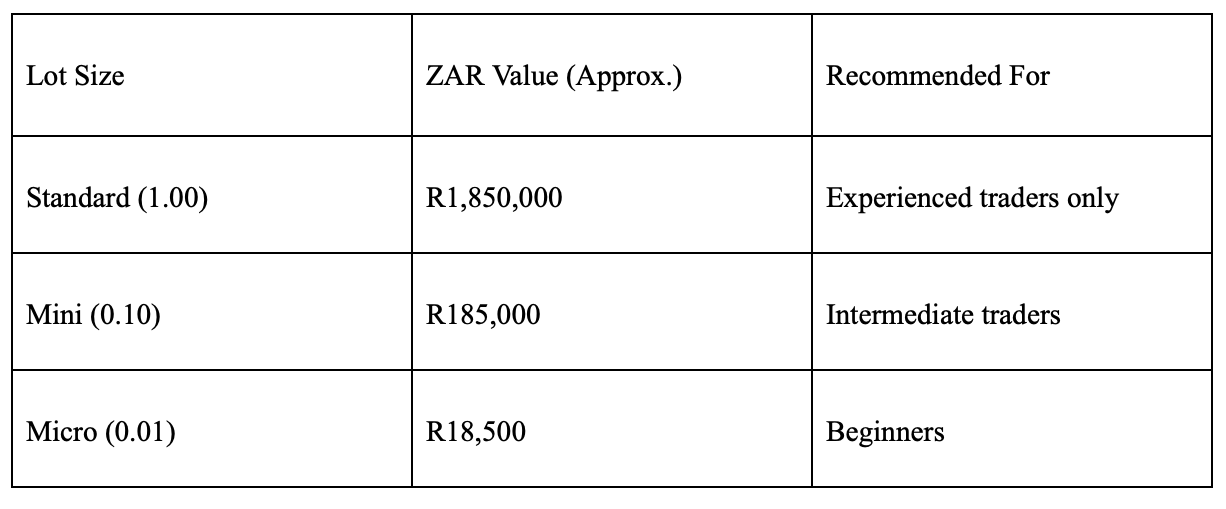
Most FSCA-regulated brokers, such as TradingPRO, allow micro-lot trading (0.01 lots), which means you can trade smaller positions and limit your risk exposure. This flexibility lets beginners practice with real market conditions while keeping potential losses low.
When starting, it is more important to focus on risk management and trading strategy than on how much you deposit. The recommended approach is to risk no more than 1% of your total capital per trade, which helps protect your account from sudden losses.
Leverage is another important factor. South African brokers typically offer leverage up to 1:2000, allowing you to control larger positions with a smaller deposit. However, while high leverage can increase potential profits, it also magnifies losses if used carelessly. Beginners should start with lower leverage and increase only as they gain confidence and consistency.
Tip: Begin with a small deposit, trade micro lots, and aim to grow your account gradually as you gain experience. The goal is to build consistency, not chase quick profits.
1. The Absolute Basics: What is Forex Trading?
Forex, short for Foreign Exchange, is simply the act of buying one currency while simultaneously selling another. It is the largest and most liquid financial market globally, with trillions of Rands exchanged every single day. As a trader, your goal is to profit from the continuous changes in currency values.
Imagine you exchange Rands (ZAR) for US Dollars (USD) for a vacation. When you return, you convert your leftover Dollars back into Rands. If the Rand has weakened, you’ll get more Rands back than before.
That’s forex trading in action, but traders do it to make a profit, not for travel.
2. Understanding Currency Pairs
All currencies are traded in pairs, where one is bought and the other is sold.
For South Africans, the USD/ZAR pair is the most important.
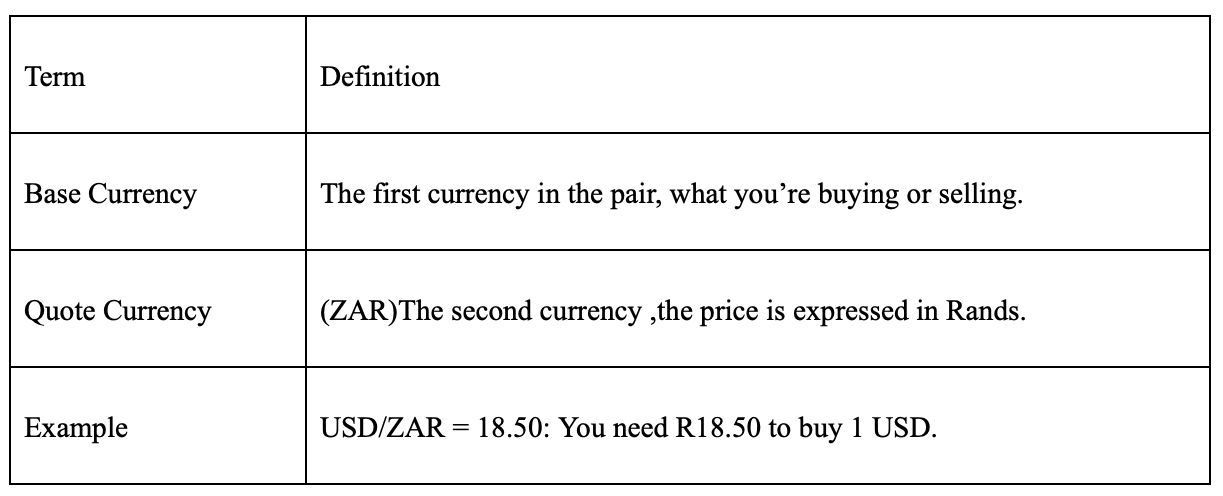
Buy (Go Long): You expect the USD to strengthen against the Rand (USD/ZAR rises).
Sell (Go Short): You expect the USD to weaken against the Rand (USD/ZAR falls).
Pips, Spreads, and Fees
Pip: The smallest movement in price (usually 0.0001).
Spread: The small fee charged by your broker.
Leverage: Allows you to control large positions with a smaller deposit but increases risk.
3. How to Start Forex Trading in South Africa (Step-by-Step) for beginners South Africa.
This is where many beginners go wrong, they start trading without a plan.
Common Mistakes South African Traders Make
Many South African beginners dive into forex trading with excitement but overlook the habits and practices that experienced traders consider essential.
Understanding these common pitfalls early can save you from unnecessary losses and frustration.
Here are some of the biggest mistakes to avoid:
1. Trading without a plan
Jumping into trades randomly or based on social media “tips” is one of the most common errors. Every successful trader follows a defined strategy that includes entry and exit rules, risk management, and profit targets.
2. Overusing leverage
Many beginners are tempted by the high leverage offered by brokers. While leverage increases your exposure, it also multiplies losses. Even a small market move can wipe out your capital if the trade goes against you.
3. Ignoring stop losses
Failing to set stop losses exposes traders to unlimited downside risk. A stop loss acts as your safety net, protecting your capital when the market moves in the wrong direction.
4. Trading during high-volatility news
Events such as SARB rate announcements or U.S. economic data releases can move the USD/ZAR pair by hundreds of pips in minutes. Beginners often get caught in this volatility and suffer large losses.
5. Chasing losses
Trying to recover from a losing streak by increasing trade size is dangerous. This emotional trading leads to poor decisions and more losses.
6. Using unregulated offshore brokers
Some unlicensed brokers lure traders with unrealistic bonuses or instant payouts. These platforms are risky and provide no financial protection.
Successful traders focus on discipline, capital protection, and patience. Learn the rules, practice with a demo account, and trade with a regulated broker like TradingPRO to build long-term consistency.
Follow these six steps for a safe, structured start:
Step 1: Choose an FSCA-Regulated Broker
Only trade with brokers licensed by the Financial Sector Conduct Authority (FSCA) South Africa’s official regulator.
Check the broker’s FSP number on fsca.co.za.
Why this matters:
- FSCA regulation ensures segregated funds so your money stays separate.
- Audited transparency means you know the broker is financially sound.
- Local protection gives you legal authority if disputes arise.
Avoid offshore or unlicensed brokers. Many scam sites target beginners with unrealistic promises.
TradingPRO is a regulated broker operating in South Africa. TradingPRO is licensed by the Financial Sector Conduct Authority (FSCA) under FSP No. 49624.
What stands out with TradingPRO:
- Offers trading through popular platforms such as MetaTrader 4 and MetaTrader 5, giving you access to professional charting, technical indicators and seamless execution.
- Promotes quick account verification (within 15-20 minutes) and rapid withdrawals (under 24 hours) which adds to liquidity and flexibility.
- Supports multiple instruments beyond forex (commodities, indices, cryptocurrencies) and maintains tight spreads (as low as 0.0 pips) to maximise trading potential.
TradingPRO’s local presence and FSCA licence give South African traders the security and support they need to trade confidently. You can explore account options and demo trading at tradingpro.com.
Step 2: Practice with a Demo Account
Open a forex demo account with fake money to learn safely.
Use it to:
- Test trading platforms like MetaTrader 4 or MetaTrader 5
- Practice placing orders and setting stop losses
- Build confidence before risking real money
Tip: Treat your demo trades as real because your discipline starts here.
Step 3: Fund Your Account and Start Small
Once confident, start live trading with the smallest account size possible.
Many South African brokers allow starting from R1,000 to R5,000 (about $50 to $250).
Use micro lots (0.01) and risk less than 1% per trade.
Step 4: Manage Your Risk
The 1% rule is your golden safety net.
Never risk more than 1% of your total account balance on a single trade.
Example:
If your account is R10,000, your maximum risk per trade is R100.
Small risk keeps you emotionally stable and prevents large drawdowns.
Step 5: Follow the Rand (ZAR)
Keep an eye on:
- SARB interest rate decisions because higher rates strengthen the Rand.
- Gold prices since rising gold often leads to a stronger Rand.
- Use economic calendars and local financial news to stay informed.
Step 6: Keep Trading Legal and Tax Compliant
Profits from forex trading are taxable under SARS income tax laws.
If trading regularly, you must register as a Provisional Taxpayer.
Deductible expenses include:
- Broker commissions and spreads
- Internet and platform fees
- Educational courses or mentorships
Keep records for at least five years because SARS may request proof.
4. Key South African Factors: SARB and Gold
The Role of SARB
The South African Reserve Bank (SARB) controls inflation by adjusting the Repo Rate.
When SARB raises rates → ZAR strengthens → USD/ZAR falls.
When SARB cuts rates → ZAR weakens → USD/ZAR rises.
Avoid trading an hour before and after SARB announcements because volatility can spike.
The Gold Connection
South Africa’s economy still benefits from gold exports.
- Rising gold means a stronger Rand.
- Falling gold means a weaker Rand.
Monitoring gold prices gives traders a clear edge in USD/ZAR forecasting.
Best Time to Trade Forex in South Africa
Timing plays an important role in trading success. Although the forex market operates 24 hours a day, five days a week, not every hour provides the same trading opportunities. The best time to trade forex in South Africa depends on when global trading sessions overlap, which leads to higher liquidity and stronger price movements.
The forex market operates across four major sessions: Sydney, Tokyo, London, and New York. Because South Africa is in the SAST (GMT+2) time zone, local traders can take advantage of the busiest and most active hours.
Peak Trading Hours (Most Active Periods)
10:00 AM to 6:00 PM SAST is the period when the London and New York sessions overlap, creating the highest trading volume and the tightest spreads. During these hours, pairs such as USD/ZAR, GBP/USD, and EUR/USD tend to move the most, offering better trading opportunities.
Asian Session (Lower Volatility)
12:00 AM to 8:00 AM SAST covers the Tokyo and Sydney sessions. Activity during this time is usually slower for ZAR pairs, which makes it suitable for traders who prefer steady, less volatile market conditions.
Avoiding Thin Markets
Late-night hours and global holidays often result in lower trading volume, wider spreads, and unpredictable price gaps. Avoid placing new trades during these periods unless you are following a longer-term strategy.
Tip: Plan your trades during the London and New York session overlap for higher liquidity and consistent price action. Always check the economic calendar for major SARB or U.S. news events that may affect the Rand.
5. Risk Management: Protecting Your Capital
Top Forex Trading Strategies for Beginners
6. Forex Tax in South Africa
Income Tax
Frequent traders are taxed as income earners (18% to 45%).
Forex profits are added to your annual income.
Provisional Tax
If self-employed, pay tax twice a year (August and February).
Record Keeping
Maintain:
- Trade logs
- Broker statements
- Expense receipts
Consult a registered tax practitioner for compliance and optimization.
7. Summary: Your 3 Step Success Plan
- Safety First: Use an FSCA regulated broker and start with a demo account.
- Risk is King: Never risk more than 1% per trade.
- Know Your Rand: Follow SARB announcements and gold prices.
Frequently Asked Questions (FAQ)
Is forex trading legal in South Africa?
Yes. It is legal when done through FSCA regulated brokers.
How much money do I need to start trading forex?
You can begin with as little as R1,000, but start with a demo account first.
Do I pay tax on forex trading profits?
Yes. Profits are taxable income under SARS laws.
What is the best time to trade forex in South Africa?
Between 10:00 AM and 6:00 PM SAST, overlapping the London and US sessions.
Which forex pair is best for South Africans?
USD/ZAR, as it is the most traded and closely tied to local economics.
Tools and Resources for South African Traders
Having the right tools and trusted resources makes a major difference in a trader’s success. Below are some of the most valuable platforms and references every South African trader should know.
Trading Platforms
- MetaTrader 4 (MT4) and MetaTrader 5 (MT5) are professional trading platforms that allow chart analysis, order placement, and the use of automated strategies known as Expert Advisors.
- TradingPRO WebTrader is an online platform that provides fast execution, live charts, and access to various instruments without requiring software installation.
Market Analysis and Charting
- TradingView offers advanced charting tools, real time data, and a large community of traders who share ideas.
- DailyFX and Investing.com provide free forex news, analysis, and updated economic calendars.
Regulation and Safety
- Financial Sector Conduct Authority (FSCA) helps you verify whether a broker is licensed at www.fsca.co.za.
- South African Reserve Bank (SARB) publishes important policy updates and monetary announcements at www.resbank.co.za.
Education and Practice
- TradingPRO Demo Account allows you to practice trading in real market conditions without risking your funds.
- Online Courses and Webinars are available from FSCA regulated brokers such as TradingPRO to help beginners build skills and confidence.
Tax and Compliance
- South African Revenue Service (SARS) provides official information on forex tax requirements at www.sars.gov.za.
Tip: Bookmark these sites and check them regularly. Staying informed about market events and regulatory updates helps you trade confidently and responsibly.
Trade Smart, Trade Safe
Forex trading offers South Africans access to one of the largest and most dynamic financial markets in the world. However, true success does not come from luck or speed. It comes from discipline, education, and strong risk management.
Focus on learning the fundamentals, protecting your capital, and trading only with FSCA regulated brokers you can trust. Stay informed about market trends, follow economic news, and always approach trading with patience and consistency.
With time, practice, and the right mindset, you can transform forex trading from a side interest into a sustainable long term career path. The goal is not just to make quick profits but to grow your skills and achieve financial independence through smart, safe, and responsible trading.
Start small, trade wisely, and let every decision move you closer to your financial goals.
Ready to Begin Your Trading Journey?
If you are ready to put your knowledge into practice, start with a TradingPRO demo account. It allows you to experience live market conditions, test strategies, and build confidence without risking your capital.
Once you have developed consistency and discipline, you can switch to a live funded account and continue building toward your trading goals.
Visit tradingpro.com to open your free demo account and start trading with confidence today.


