



- Published on: 2026-10-16 10:14:33
Trading Forums to Avoid: A 2026 Checklist for Spotting Red Flags

A confident trade call isn’t proof of expertise. Look beyond the prediction: can members explain their reasoning, disclose promotions, and discuss risk without pressuring others? These are practical ways to assess trading forums to avoid without dismissing every community where opinions differ.
Caution is sensible. Anonymous users may present unverified results as evidence, and polished promotional claims or scam links can look convincing at first glance. But disagreement alone isn’t a red flag. Focus on observable behavior rather than whether a poster shares your market outlook.
This checklist explains how to spot risky conduct, distinguish discussion from promotion or direct trade instructions, and respond to urgency tactics without rushing. It also shows how to use forum commentary as one source of perspective, not a substitute for independent judgment.
Finally, you’ll see how unmoderated forum advice differs from social and copy trading. Each has different features, and copying another person’s trades doesn’t make their decisions reliable signals.
Key Takeaways
- Assess trading forums to avoid by looking for repeated behaviors, not a single bad prediction or disagreement.
- Watch for pressure tactics such as guaranteed-return claims, urgent payment requests, and demands for secrecy.
- Consider the quality of evidence, promotion disclosures, and responses to reasonable questions before deciding whether a community deserves your attention.
- Use a repeatable review: inspect the rules and moderation, assess claims, protect personal information, then decide whether to participate.
- Build a steadier learning routine with independent study and careful review. Social and copy trading differ from forum chatter, but still involve risk.
Trading forums to avoid: understand the risks before you join
Judge a trading forum by patterns of behavior, not by one incorrect forecast or a member’s different market view. Markets are uncertain. A careful participant can make a reasoned argument and still be wrong. A risky community is more likely to show repeated pressure, misleading claims, or hostility toward basic questions.
Forums can help you learn how traders discuss markets, compare perspectives, and identify questions for further research. But posts aren’t personalized financial advice. A member’s circumstances, goals, and ability to absorb losses may differ from yours, even when their analysis sounds relevant. Treat discussion as material to assess, not an instruction to follow.
A confident forecast is an opinion, not evidence of skill. Evidence takes more than certainty or a screenshot. Look for reasoning you can examine, an account of the risks, and claims you can check independently. This distinction helps you identify trading forums to avoid without treating every disagreement or anonymous account as proof of fraud. For broader context on deceptive online activity, see this overview of Internet fraud.
When does a trading forum become a concern?
Notice what members are repeatedly encouraged to do. One post urging a quick decision may show poor judgment. A steady stream of “act now” messages, instructions to follow one poster without question, or claims that discussion must stay secret deserve closer scrutiny. Transparent members explain their reasoning and acknowledge uncertainty. Claims based on unverifiable results, or claims that disappear when questioned, offer little basis for trust.
Look for patterns rather than making a snap judgment. One warning sign is a reason to pause before sharing details or acting on a suggestion. Repeated behavior, moderators who ignore it, or hostility toward reasonable questions deserve more weight. This keeps your assessment grounded in what you can observe rather than assumptions about the whole community.
Why trading communities can still be useful
A thoughtful discussion can introduce unfamiliar terms, offer a perspective you hadn’t considered, or help you frame a better research question. Anonymous users aren’t automatically dishonest, and disagreement about markets can be productive. The value is in examining the ideas, not assuming that a poster has verified expertise or a record of successful trades.
Before acting, compare a claim with independent research and your own risk limits. Ask what evidence would support or challenge the argument, what could make the trade lose, and whether you understand the instrument being discussed. If you can’t answer those questions, don’t let confidence in a forum fill the gap. Use discussion as a source of ideas, not a substitute for independent judgment.
Trading forum red flags: spot pressure, deception, and unverifiable claims
Focus on behavior, not labels. One aggressive post or suspicious claim is a reason to pause, not proof that an entire forum is fraudulent. Repeated patterns matter: members pushing deposits, urging you to act before you can verify a claim, or discouraging questions can make a community risky to engage with. Use these signs to decide when to step back and investigate, rather than to make unsupported accusations about a named group.
Pressure, secrecy, and impossible certainty are caution signals. Promises of guaranteed profits or risk-free trades deserve particular skepticism. Trading involves uncertainty, so claims that remove all risk need evidence, not just confident wording. The FBI Internet Fraud resource outlines common online fraud concerns and reporting options. It can be useful context if a forum interaction moves beyond discussion into suspicious requests or offers.
Promises, paid signals, and pressure tactics
Watch for countdowns, private messages urging immediate action, or payment demands that increase after you’ve already paid. A seller may openly promote education or a paid service, but disclosure alone doesn’t validate performance claims. Ask what the claim is based on, whether losses are included, and whether results can be checked independently. If questions lead to more pressure instead of clear answers, pause.
Screenshots and testimonials can suggest consistent gains while leaving out losing trades, dates, or context. Treat them as claims, not verified records. Ask whether the person explains the method and its risks without insisting that you copy a trade, pay to unlock an “exclusive” tip, or move the conversation to a less visible channel.
Suspicious links, impersonation, and privacy risks
Unexpected links can lead to lookalike sites or pages designed to collect sensitive details. Check the account name and destination carefully, especially if a message claims to come from a moderator, trader, or platform representative. Never share passwords, verification codes, account access, or identity and financial details in public discussions or private messages. A convincing profile doesn’t prove someone’s identity.
- Don’t open unsolicited links or files. Navigate to a service using an address you already trust.
- Use the forum or platform’s reporting tools to flag suspicious accounts, posts, and messages.
- Review your account security settings and strengthen protections if you’ve clicked a questionable link or shared information.
These checks can help you decide whether to disengage, report a post, or keep reading without interacting. TradingPRO provides account options and social and copy trading for people exploring different ways to engage with markets. You can see the TradingPRO registration page while keeping the same discipline you would use anywhere else: understand what you’re engaging with, and don’t treat forum claims or copied opinions as promises of results.
Risky forum or ordinary disagreement? Assess the evidence
Markets invite different interpretations. One trader may see a breakout forming while another expects a reversal. That disagreement is ordinary; the quality of the reasoning matters more than whether a prediction matches yours. To assess trading forums to avoid, compare how members support their claims and respond to scrutiny, not just how often they agree with you.
Use this contrast as a guide, not a verdict about any named community:
- Ordinary disagreement: Members explain their assumptions, point to information others can examine, and accept that the market may move against their view.
- Pressure: A poster demands immediate action, treats questions as disloyalty, or pushes members to pay before they can evaluate a claim.
- Possible impersonation: An account claims to represent a familiar trader or organization but offers no reliable way to establish that identity.
- Unverifiable performance: Claims of repeated wins rely on selected screenshots or testimonials, with little context about losses, timeframe, or risk.
Context matters. Anonymous profiles are common online and don’t, by themselves, establish deception. A deleted post could reflect moderation, an edit, or a user leaving; it isn’t proof of misconduct on its own. Look for a wider pattern, such as changing claims, evasive explanations, or repeated promotion that moderators leave unaddressed.
What credible discussion looks like
Constructive traders show their working. They describe the assumptions behind an idea, identify factors that could invalidate it, and acknowledge possible downside. They can disagree without demanding that others place a trade or buy access to their opinion. Treat cited data as a lead to verify against its original source and relevant market context, not as an automatic conclusion. Clear reasoning earns attention; certainty alone doesn’t.
How to judge a trader’s claims without trusting screenshots
A cropped image may show a winning position but not what came before or after it. Selected trades can leave out losses, changes in position size, fees, or the period covered. Ask what timeframe the claim represents, what risk was taken, and whether losing periods are included. Even detailed posts can’t establish a complete, independently verified trading record. Forum posts alone can’t verify another person’s full results.
Popularity is no substitute for evidence. A large following may reflect entertaining commentary, frequent posting, or a persuasive style, not verified skill. Focus instead on whether the person’s reasoning is consistent, disclosures are clear, and reasonable questions receive direct answers. If the proof is incomplete, treat the claim as unverified opinion and make decisions using evidence you can assess independently.
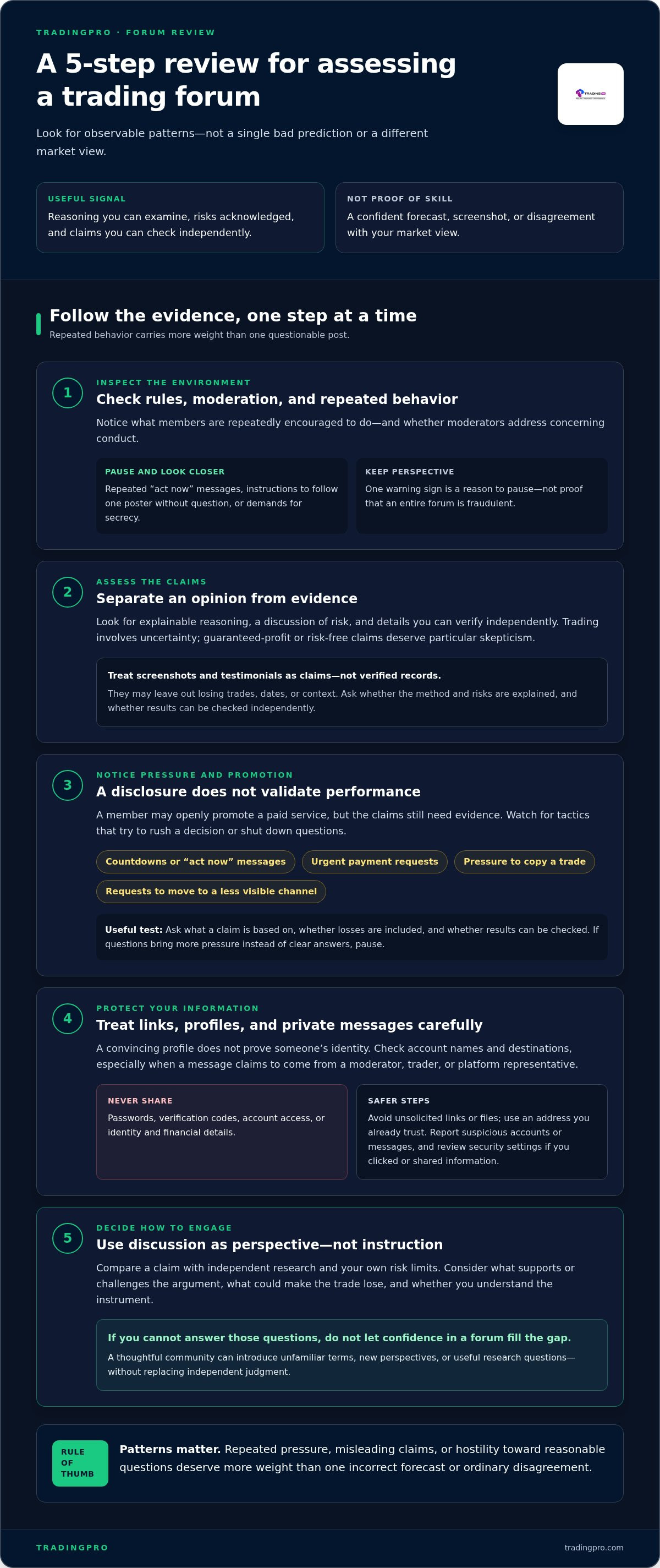
A practical checklist for assessing a trading forum
Use a repeatable process before you join, post, or act on a suggestion. It helps you evaluate trading forums to avoid based on what members and moderators actually do, rather than the forum’s branding or one memorable thread. Start with what you can observe, protect your information, and then decide whether participation makes sense.
- Inspect the rules. Read community guidelines, moderation policies, and any available requirements for disclosing paid promotions or conflicts of interest. Notice whether the rules discourage misleading claims and apply to popular contributors as well as new members.
- Review moderation. Check pinned guidance and a range of recent discussions, not just a viral post. See whether moderators remove spam, address rule breaches, and allow respectful questions. A written policy means little if the discussion consistently ignores it.
- Assess the claims. Before relying on a market view, identify its reasoning, assumptions, and possible downside. Treat cited facts as leads to verify through independent, reputable sources. If you’re still learning basic market terms, build that foundation before using forum commentary to interpret a trade.
- Protect your data. Use a unique password for the forum, and don’t post credentials, identity details, or sensitive financial information. Avoid sharing screenshots that expose account numbers or other private details. Apply the same caution to private messages as to public posts.
- Decide whether to participate. If the rules are clear, moderation is visible, and discussion leaves room for uncertainty, you may choose to read or contribute. If the overall pattern feels coercive or opaque, leave without sharing more information or following its suggestions.
Before joining or posting
Take time to assess the community before creating an account or adding personal details. Read its pinned guidance, recent threads, and available disclosure rules. A balanced review can show whether members explain their views and whether moderators respond when discussion goes off track. If you can’t find basic rules or moderation guidance, proceed carefully. Their absence alone doesn’t prove wrongdoing.
When a post or member raises concerns
Pause before responding to urgent trade instructions, payment requests, or unsolicited direct messages. Verify factual claims independently, and keep a record of relevant posts or messages if you believe behavior breaches the forum’s stated rules. Use block, mute, or report controls when available. Don’t escalate a dispute by sharing private details or engaging with suspicious links.
The aim isn’t to eliminate every uncertain interaction. It’s to make a deliberate decision while protecting your information and judgment. TradingPRO offers several account options for different trading needs; the account registration page is one place to explore the platform.
Build a more structured trading-learning routine beyond forum chatter
Turn forum discussions into questions to investigate, not instant trade instructions. If someone makes a claim about an asset or strategy, write down what would need to be true for it to hold up. Then compare the claim with independent research and consider whether it fits your knowledge, goals, and risk limits.
A repeatable routine builds stronger judgment than scrolling for the next prediction. Keep a brief decision log that records:
- The idea: What prompted you to consider the trade?
- The reasoning: Which information and assumptions support your view?
- The risk: What could prove the idea wrong, and what loss could you tolerate?
- The review: Afterward, did the decision follow your original plan, regardless of the outcome?
Use communities as one input, not a trading system
Choose a clear learning goal, study foundational concepts, and use discussion to surface questions or competing interpretations. Social trading and copy trading differ from unmoderated forum posts: TradingPRO’s social trading ecosystem lets clients copy experienced market participants’ strategies. That is a different way to engage with other traders’ approaches, not a guarantee that a strategy will suit your circumstances or perform as expected. Consider the format and its risks before deciding what role, if any, it should play in your learning routine.
TradingPRO offers social and copy trading to explore other participants’ strategies, but access doesn’t establish that a strategy will perform as expected. Keep independent study and careful review at the center. Forum commentary and copied trades are inputs to evaluate, not substitutes for understanding what you’re doing.
Choose a clear next step for your experience level
If you’re new to trading, start with fundamentals such as how markets work, how orders are placed, and how risk can affect an outcome. Build familiarity before considering advanced strategies or copying another participant’s approach. The Rookie Account is one TradingPRO account option. Choosing an account doesn’t remove trading risk or promise a particular result.
Keep your next step measured: strengthen your understanding, set personal limits, and make decisions only when you can explain the reasoning for yourself. You can explore TradingPRO’s platform options while keeping in mind that trading carries risk. Don’t treat forum opinions or another participant’s strategy as a guarantee.
Make your next trading decision your own
Build a process that keeps your judgment in the lead. Before acting on an idea, take time to understand it, test it against your own limits, and decide what evidence would change your mind. That habit matters more than finding a forum that always agrees with you.
The goal isn’t to avoid every online community. It’s to recognize trading forums to avoid when their conduct repeatedly replaces discussion with pressure, then choose learning tools carefully. TradingPRO offers Rookie, Micro, Pro, and Scalp accounts, as well as social and copy trading. These are different ways to engage with trading, not promises of performance or protection from loss.
Ready to explore your next step? Register with TradingPRO, and keep your decisions grounded in research, clear limits, and your own understanding. A deliberate approach can help you move forward with greater confidence.
Frequently Asked Questions
Are trading forums safe for beginners?
Forums can be useful for learning, but beginners should treat them as discussion spaces, not places to outsource decisions. Start by observing how members explain market terms and respond to follow-up questions. If a post refers to unfamiliar products or strategies, pause and learn how they work before considering any action. Don’t risk money just to keep up with a conversation or prove you belong in a group.
Can you trust trading advice on Reddit?
Don’t treat Reddit advice as reliable simply because a post has many upvotes, comments, or awards. Those signals reflect engagement, not necessarily accuracy or experience. Check whether the poster gives a clear rationale, identifies assumptions, and links to information you can verify. Consider the thread’s date, too. Market conditions and a company’s circumstances can change, so an older post may not support a current decision.
How can I tell if a trading group is a scam?
No single detail can establish that a group is a scam, but a combination of deceptive behavior deserves serious caution. For example, a group might claim its administrator works for a known company, then direct members to an unrelated site and demand payment to access an opportunity. Don’t rely on contact details supplied in the message. Verify identities and claims through sources you find independently. Leave and report suspicious conduct through the platform.
Is it safe to pay for trading signals from a forum?
Paying for a signal doesn’t make it accurate or suitable for your situation. Before spending money, understand what the service provides, whether promotions or conflicts are disclosed, and how it presents both losing and winning calls. Be wary if the seller won’t explain the approach or says the offer expires before you can review it. Never pay with money you can’t afford to lose, and don’t share account access to receive signals.
Can a trading forum guarantee profitable trades?
No forum can guarantee that a trade will be profitable. Markets can move against a well-researched position, and past outcomes don’t ensure future results. Treat statements such as “every call wins” as a reason to examine the claim, not as proof. Ask what could cause the idea to fail and whether the evidence covers a meaningful range of conditions. If the promise depends on acting immediately, step back rather than rushing.
What should I do if I shared personal information in a trading forum?
Act based on what you shared. If you posted a password, change it immediately anywhere you reused it, then enable multifactor authentication where available. If you revealed payment or banking details, contact the relevant financial institution using contact information you locate independently. Save messages and screenshots, report the account to the platform, and be alert for follow-up messages that use your details to sound legitimate. Don’t send additional information to anyone offering unsolicited help.


