



- Published on: 2026-02-18 18:00:00
Confirmation Bias: The Most Expensive Habit in Forex Trading
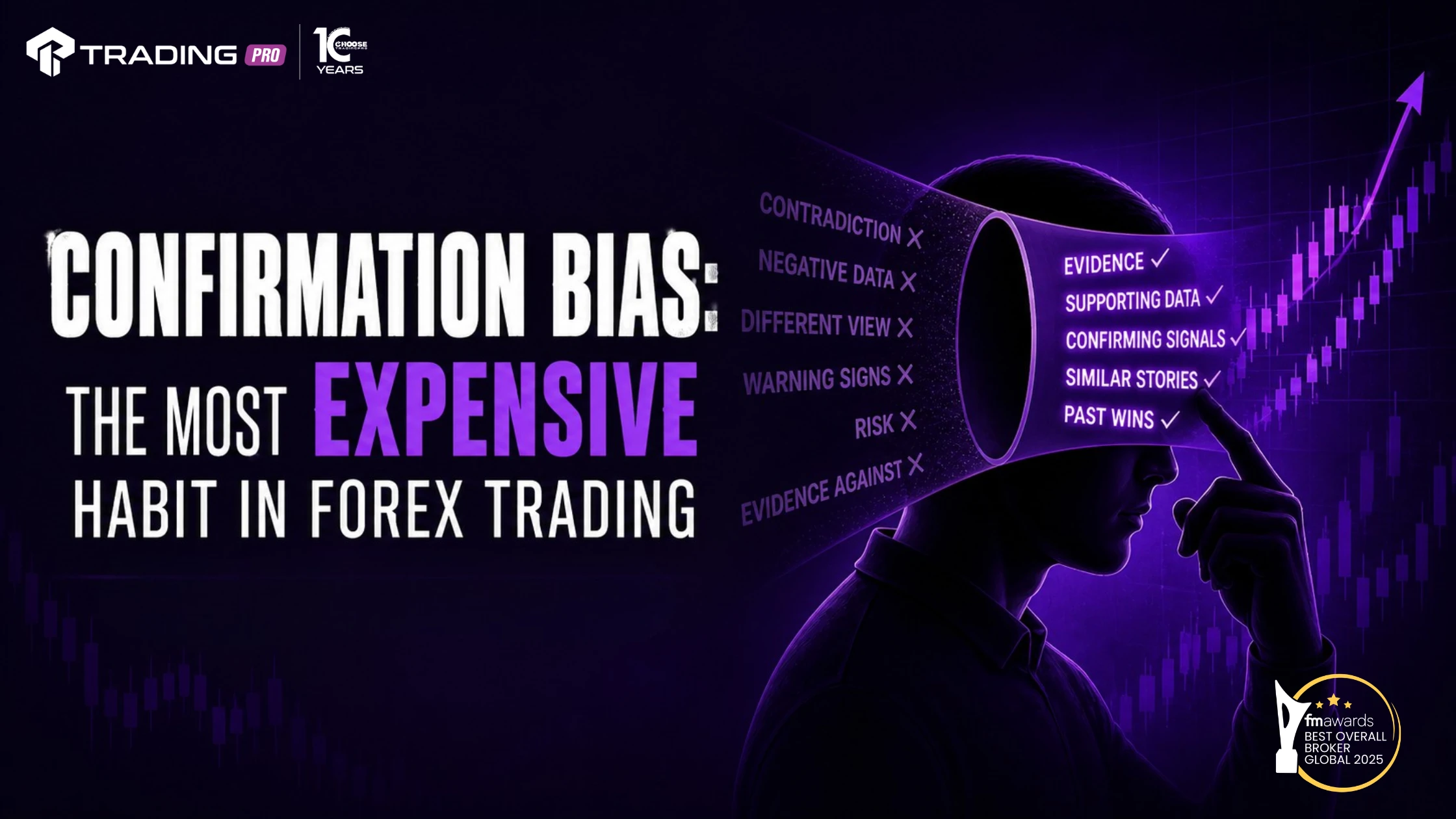
If you've spent any serious time in the forex market, you've probably blamed a bad trade on your strategy, an indicator, or even a central bank decision. Most traders do. But after decades of trading currencies across different economic cycles, one truth becomes impossible to ignore: the real damage rarely comes from the strategy itself. It comes from confirmation bias — and it's subtle enough that most traders never even realise it's happening.
What Confirmation Bias Looks Like in Real Trading
Confirmation bias is the tendency to favour information that supports what we already believe, while quietly dismissing anything that challenges it.
In forex trading, that might look like:
- Only reading analysis that agrees with your bullish EUR/USD outlook
- Ignoring a bearish divergence sitting plainly on your chart
- Dismissing weak inflation data because it doesn't fit your macro view
- Moving your stop-loss because you believe "the market just needs more time"
It doesn't feel irrational at the moment. In fact, it feels responsible — like you're doing more research. But you're not researching. You're reinforcing. And in a market driven by interest rates, liquidity, risk sentiment, and capital flows, that distinction is an expensive one.
Why Forex Punishes Bias So Quickly
The foreign exchange market is one of the most dynamic and reactive markets in the world. It responds constantly to:
- Central bank decisions and forward guidance
- CPI, inflation reports, and NFP releases
- GDP growth data and bond yields
- Geopolitical developments and risk sentiment shifts
When you become attached to a narrative — "the dollar must weaken" or "the euro is entering a long-term uptrend" — you stop observing the market objectively. You start filtering information instead of interpreting it. And once you filter data rather than read it, you are no longer trading price action. You are trading your opinion.
The market does not reward opinions. It rewards adaptability.
A Scenario Most Traders Will Recognise
Imagine you are convinced the US dollar is overvalued. You go long GBP/USD based on solid technical confirmation — a clean support level, bullish momentum, strong market structure. Then US jobs data beats expectations, Treasury yields spike, and the Federal Reserve signals tighter policy. The dollar strengthens.
Now comes the internal dialogue:
- "It's just temporary volatility."
- "The structure hasn't broken yet."
- "The market is overreacting."
Instead of reassessing, you defend the trade. This is confirmation bias in action — and this is precisely how manageable losses turn into painful, avoidable drawdowns.
How It Warps Technical Analysis
Technical indicators — RSI, MACD, moving averages, Fibonacci levels — are tools designed to provide structure and probability. But under the influence of confirmation bias, they become tools for validation instead.
You entered on a breakout. Price stalls. Rather than accepting the setup has failed, you:
- Drop to a lower timeframe to find supportive signals
- Redraw support levels slightly lower to justify staying in
- Add another indicator hoping it will confirm your view
The chart has not changed dramatically. Your interpretation has. Professional traders understand something fundamental here: a failed setup is part of the business. It is not a personal failure.
The Damage to Risk Management
Risk management is the foundation of long-term profitability in forex trading. That means predetermined stop-loss levels, controlled position sizing, favourable risk-to-reward ratios, and no emotional adjustments mid-trade.
Confirmation bias quietly attacks every one of these:
- You widen stops to give the trade "more room"
- You average down into a losing position
- You increase size to recover losses faster
- You remove the stop entirely because you are convinced you are right
These decisions rarely destroy accounts in a single moment. They erode them gradually — trade by trade. And gradual erosion is dangerous precisely because it feels survivable. Until it isn't.
The Psychological Roots
Confirmation bias is not a knowledge problem. It is a deeply human one, driven by:
- Ego — Nobody likes being wrong, especially in public or on record
- Loss aversion — Realising a loss feels significantly worse than simply holding one
- The illusion of control — More analysis creates a false sense of certainty and confidence
But trading is not about certainty. It is about probabilities. And working with probabilities requires flexibility — the willingness to be wrong and act on it quickly.
How Experienced Traders Reduce Bias
You cannot eliminate confirmation bias entirely. But you can control its influence through deliberate habits.
1. Define Invalidation Before Entry
Before entering any trade, clearly identify your entry level, stop-loss, take-profit, and — crucially — the exact point at which your idea is objectively wrong. If price reaches that level, exit. No negotiation, no extensions.
2. Build the Opposing Argument
Before committing capital, ask yourself: what is the strongest case against this trade? If you cannot answer that question clearly and honestly, you are not analysing — you are assuming.
3. Journal Honestly
A proper trading journal should capture why you entered, what contradicted your view at the time, how you felt during the trade, and why you exited. Patterns of bias become obvious when you review your history with fresh eyes.
4. Treat Losses as Business Expenses
Professional traders do not take losses personally. They treat them as operating costs — a necessary part of running a trading business. Your job is not to win every trade. Your job is to protect capital and execute your plan consistently.
The Long-Term Impact
In the short term, confirmation bias can actually reinforce itself. You ignore warning signs, the trade works out anyway, and that outcome builds false confidence. But over hundreds of trades, the consequences inevitably surface: larger drawdowns, inconsistent performance, emotional fatigue, and poor risk-adjusted returns.
The forex market evolves constantly. Monetary cycles shift. Correlations rotate. Liquidity conditions change. Rigid thinking struggles to survive that environment. Adaptive thinking thrives in it.
A Perspective From Years in the Market
Over time, a simple but powerful truth becomes clear: the market does not care about your conviction. It does not reward stubbornness. It rewards discipline.
The traders who last are not the ones who predict every move correctly. They are the ones who adapt quickly when price proves them wrong. Capital preservation compounds over time. Ego does not.
Final Thoughts
If there is one habit that can quietly sabotage your forex trading performance, it is confirmation bias. Not because you lack knowledge. Not because your strategy is flawed. But because human psychology is extraordinarily persuasive — and the market is an unforgiving environment for those who let it go unchecked.
The shift that changes everything is this: stop trying to be right. Start trying to be objective. Trade what price is doing — not what you hope it will do.
In the long run, discipline will outperform opinion every single time.
Follow TradingPRO for daily market analysis, trading psychology breakdowns, and professional forex insights:
Facebook | Instagram | Telegram | LinkedIn | Twitter (X)


