


- Published on: 2026-09-18 21:32:00
How Market Correlations Can Improve Trading Analysis
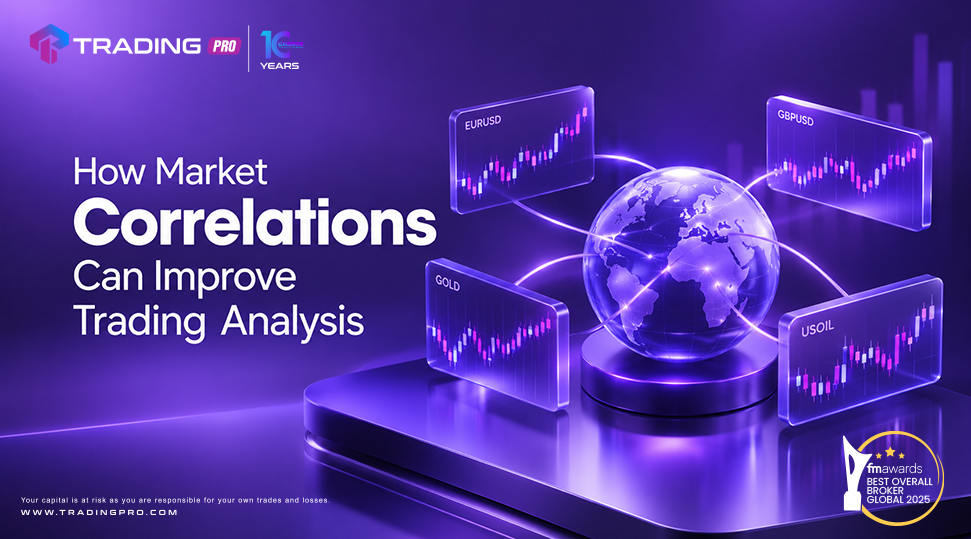
Financial markets do not always move independently. Changes in one market can sometimes coincide with movements in another, creating relationships that traders can monitor when analyzing market conditions. These relationships are known as market correlations.
Understanding correlations can give MENA traders another way to look at the market. Instead of focusing on one chart or asset alone, traders can consider how related markets are behaving and whether those movements support or contradict their current analysis.
Correlation is not a guarantee that two assets will always move together. Market relationships can change depending on economic conditions, investor sentiment, interest rates, geopolitical developments, and other factors. For this reason, correlations should be treated as one part of a broader trading analysis rather than a standalone signal.
What Is Market Correlation?
Market correlation describes the relationship between the movements of two assets or markets.
When two markets tend to move in the same direction, they are described as having a positive correlation. When they often move in opposite directions, they have a negative correlation. If there is little consistent relationship between their movements, the correlation may be weak.
For example, a trader may observe a relationship between certain commodities and currencies. If a particular commodity has historically influenced the economy of a country, changes in its price may sometimes coincide with changes in the country’s currency.
However, this relationship does not mean that one market will automatically predict the other. Correlation simply helps traders identify a pattern that may be worth monitoring.
Why Correlations Matter to MENA Traders
Market correlations can be particularly useful when traders are following several asset classes at the same time.
MENA markets are connected to global financial markets through trade, investment, commodities, currencies, and international economic activity. As a result, developments outside the region can influence how traders view market conditions within the region.
For example, movements in oil prices can be relevant when analyzing economies that are closely connected to the energy sector. Similarly, changes in global interest-rate expectations can affect currencies, bonds, equities, and investor sentiment across different markets.
By monitoring related markets, traders can build a broader view instead of relying on a single price chart.
Common Types of Market Relationships
Commodities and Currencies
Commodities and currencies can sometimes have important relationships. This is especially relevant for economies where commodities play a significant role in exports or government revenues.
For MENA traders, energy markets can be an important area to monitor. Changes in oil prices may affect expectations around economic activity, government revenues, and broader market sentiment in oil-sensitive economies.
The relationship can vary over time, so traders should avoid assuming that a particular currency will always react in the same way to commodity prices.
Stocks and Market Sentiment
Stock markets can also provide information about broader investor sentiment.
When investors become more confident about economic conditions, equity markets may experience increased demand. On the other hand, periods of uncertainty can lead investors to become more cautious.
Looking at equity indices alongside other markets can therefore help traders understand whether the wider market environment is supportive of their analysis.
Interest Rates and Financial Markets
Interest-rate expectations can influence several financial markets at the same time.
Changes in expectations around central bank decisions can affect currencies, bonds, equities, and other assets. Traders who monitor these relationships may gain additional context when assessing market movements.
For MENA traders, following major global central bank decisions can be useful because global monetary conditions can influence international capital flows and market sentiment.
How Traders Can Use Correlations in Their Analysis
The first step is to identify markets that may have a meaningful relationship. Traders can then compare their price movements over a selected period and look for consistent patterns.
For example, instead of analyzing a currency pair in isolation, a trader could monitor a related commodity or broader market index. If both markets are showing movements that historically tend to occur together, this may provide additional context.
The opposite can also be useful. If two markets that normally move together begin behaving differently, the change may encourage the trader to investigate what is driving the divergence.
This does not automatically create a trading opportunity. Instead, it can help traders ask better questions about the market.
Correlation Does Not Mean Causation
One of the most important points to understand is that correlation does not necessarily mean that one market causes another to move.
Two assets may move in the same direction because they are both responding to a third factor. For example, a major economic announcement could influence several markets simultaneously.
This is why traders should avoid using correlation as a simple buy or sell signal. A relationship that existed in the past may weaken or disappear when market conditions change.
Combining correlation analysis with price action, economic information, technical indicators, and risk management can provide a more complete approach.
How Correlations Can Support Risk Management
Correlations can also help traders think about portfolio exposure.
Holding positions in different assets does not always mean that a portfolio is well diversified. If several positions are strongly correlated, they may respond similarly to the same market event.
For example, multiple positions that depend on the same underlying market factor could all move against the trader at the same time.
Understanding these relationships can encourage traders to look beyond the number of open positions and consider how those positions are connected.
A Simple Approach to Correlation Analysis
Traders do not necessarily need a complicated system to begin observing market relationships.
A simple process can include:
-
Choose two related markets. Start with assets that may have an economic or financial connection.
-
Compare their historical movements. Look at how they behaved over different periods.
-
Identify whether the relationship is consistent. Avoid relying on a very short period.
-
Check the current market environment. Economic conditions can change existing relationships.
-
Use other analysis tools. Confirm observations with technical and fundamental analysis.
-
Manage risk independently. A correlation should never replace a defined risk-management approach.
This approach can help traders use correlations as an additional layer of analysis without making them the foundation of every trading decision.
What MENA Traders Should Keep in Mind
For MENA traders, global market relationships can provide useful context because regional markets are connected to international economic developments.
However, each market has its own characteristics. Local economic conditions, monetary policy, liquidity, trading hours, and investor behavior can all influence how an asset responds to global developments.
Therefore, traders should avoid applying the same correlation assumptions to every MENA market.
Instead, correlations can be used as a way to investigate market relationships and understand the factors that may be influencing price movements.
Conclusion
Market correlations can give traders a broader perspective by showing how different assets and markets may interact. For MENA traders, monitoring relationships between commodities, currencies, equities, and global financial markets can add useful context to their analysis.
At the same time, correlations are not permanent signals. Relationships can change as economic conditions and market sentiment evolve. Using correlation analysis alongside technical analysis, economic research, and risk management can help traders develop a more structured view of the markets.
For traders who want to strengthen their understanding of financial markets and develop more informed trading habits, TradingPRO can provide additional educational resources and market-focused insights.
Start Your Trading Journey with TradingPRO
Ready to take the next step in your trading journey? Register your TradingPRO account and explore the available trading options.
Want to keep learning about the markets? Follow TradingPRO across our social media channels for market insights, trading education, and updates.


