




- Published on: 2026-11-09 14:23:13
How to size market-open bets without overleveraging

At the market open, leverage can magnify losses as quickly as gains. The rookie mistake of overleveraging on the market open is taking a position so large that an ordinary price move exceeds the loss you can handle. Size the trade according to its risk, not the excitement of the opening move.
It’s tempting to act quickly when prices shift and an opportunity seems immediate. But a clear plan matters more than a fast entry: decide why you’re taking the trade, how much you can afford to risk, and where you’ll exit if the price moves against you.
This guide explains how diversification, sensible position sizing, and risk-management rules can help you approach the open with more control. You’ll learn why opening volatility can make leveraged positions harder to manage, how to size a position to fit your risk tolerance, and how to avoid concentrating too much capital in one trade. The aim isn’t to remove risk or predict every move. It’s to make deliberate decisions before the market’s pace pushes you into an oversized position.
Key Takeaways
- Size each position around the loss you can tolerate and the point where your trade plan is no longer valid.
- Diversification can spread exposure across companies, but it can’t remove market-wide risk.
- Set your trade rationale, exit conditions, and review points before the market opens to reduce impulsive decisions.
- Increasing leverage from about 15 to 1 to 30 leaves less capital available to absorb losses, according to the U.S. Government Publishing Office.
- Choose a trading approach and account type that fit your experience and risk-management plan, rather than sizing up to chase a bigger outcome.
1. Diversification and oversized bets
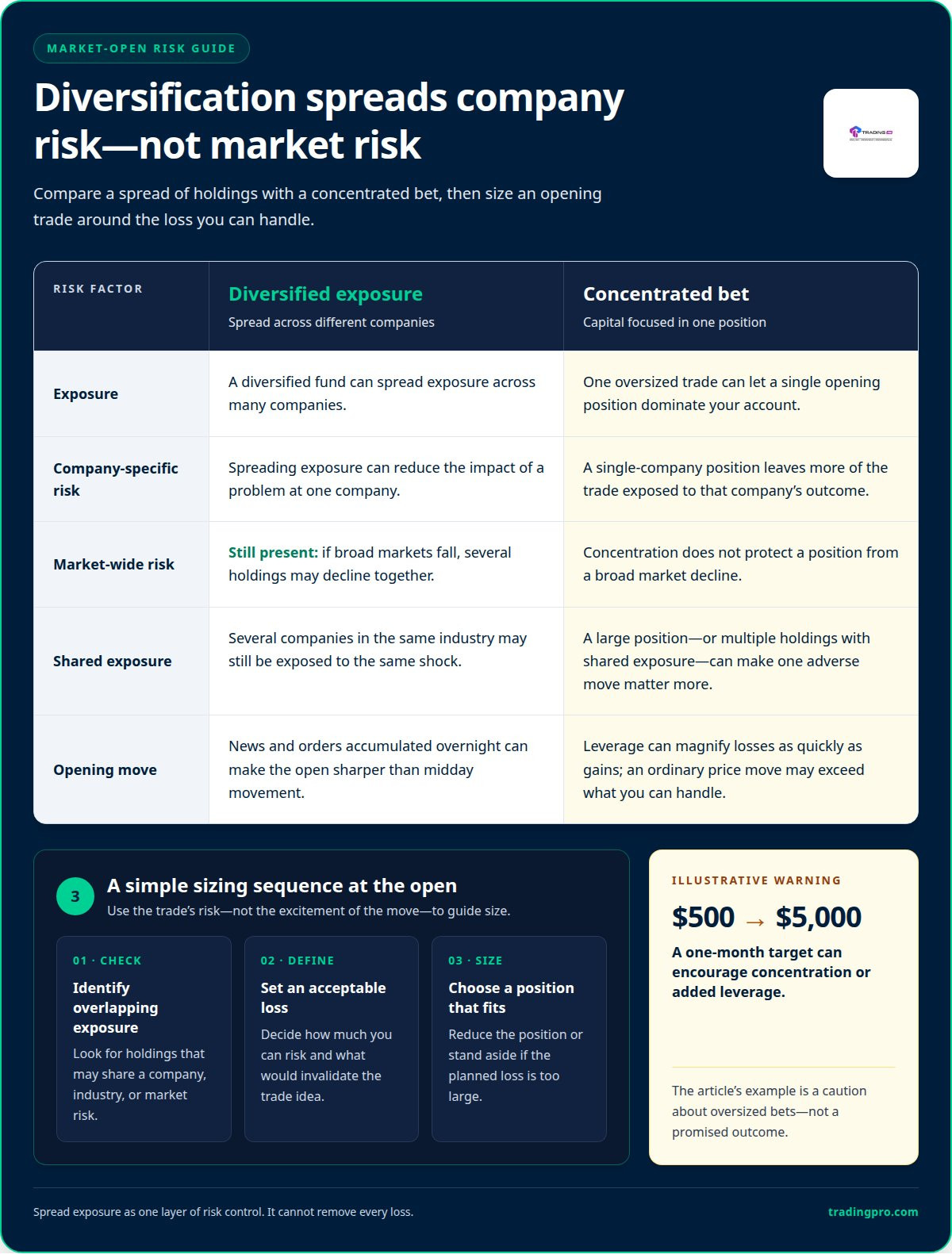
Diversification spreads exposure across different companies instead of concentrating it in one position. A diversified fund can reduce company-specific risk, but it cannot eliminate market risk. If broad markets fall, several holdings may decline together. Treat diversification as one layer of risk control, not protection against every loss. Pair it with a position size that won’t let one opening trade dominate your account.
Market-open volatility is often sharper than midday movement because prices respond to news and orders accumulated overnight. Midday trading can be calmer, but fresh news can still trigger abrupt moves. For example, a stock may open far from its previous close, then move again as trading develops. Don’t assume a calmer-looking chart means a position is safe.
An oversized bet can turn a reasonable market idea into an account-level risk. Imagine trying to turn $500 into $5,000 in one month. That target can encourage a trader to concentrate capital or add leverage instead of following a measured plan. Before entering, define the trade’s purpose, the loss you can accept, and the conditions that would invalidate your idea.
Opening trades can also magnify simple execution errors. A beginner who accidentally opens a short sale could lose $100, even without intending to make a large directional bet. Keep order direction, position size, and exit conditions clear before submitting an order. If the trade would strain your plan after a small adverse move, reduce its size or skip it.
Avoid the pattern of selling winners quickly while holding losers until they break even. That can leave a portfolio increasingly weighted toward losing positions. Instead, review each holding against its original thesis and current role in your portfolio. A breakout already 10% into its move can tempt a late entry; pause and assess whether the remaining opportunity justifies the risk.
Use a simple sizing sequence at the open: identify overlapping exposure, set an acceptable loss, then choose a position size that respects both. Keep money needed within the next few years in a safer, more accessible place than stocks, such as a high-yield savings or money market account. A beginner account overview can also help connect account choice with a deliberate approach to trading size.
2. Risk management
A risk plan turns a market idea into defined actions before emotions take over. Write down what you’re buying, why it fits your goals, how much risk you can handle, and when you’ll review the decision. At the market open, this plan helps distinguish a deliberate entry from a reaction to a fast price move. If the trade no longer fits your reason for entering, don’t increase your exposure just to defend it.
In the US, broker margin requirements specify how borrowed funds are supported by account equity and when a broker may require more collateral. Pattern day trading rules govern repeated same-day trades in margin accounts and can affect trading access and required account equity. Understand the applicable conditions before relying on borrowed funds or planning frequent same-day trades.
Margin lets a trader borrow funds to take a position larger than the cash they commit. Leverage describes how much market exposure borrowed funds create relative to the trader’s capital. A small price move can therefore create a larger gain or loss relative to the funds invested. Maximum leverage magnifies that effect, leaving less room to absorb an adverse move at the open.
A stop-loss order instructs the platform to close a position when the market reaches a specified price. It can help enforce an exit plan, but it doesn’t guarantee execution at that exact price. If the market gaps past the trigger, the order may fill at a worse available price, creating slippage. Set the stop where your trade idea is invalidated, then size the position around the potential loss.
Use a pre-trade sequence to make risk limits practical:
- Check at least the daily timeframe before entering, so an opening move isn’t judged in isolation.
- Define the trade’s thesis, entry, stop, target, and review point in a trading journal.
- Estimate how a move against the position affects your account, including the effect of leverage.
- Reduce the position or stand aside if the planned loss exceeds what you can handle.
Selling after a decline locks in a loss, while an unrealized loss may recover if the position remains open. That possibility isn’t a reason to ignore a broken trade thesis. During downturns, wait 24 hours before making trades rather than reacting immediately. Use the pause to review your daily timeframe, risk limit, and exit conditions.
Keep the plan visible before placing an order. If you want to put your risk rules into practice through an account, you can create a trading account and make position limits part of your process from the start.
3. Why is overleveraging at market open a common rookie mistake?
A rookie mistake of overleveraging at the market open often starts with urgency. The opening move looks decisive, so a new trader may treat it as confirmation. But the first price action doesn’t prove a trade thesis. Entering with 100% of available capital on margin can leave little room for a move against the position. A plan needs to come before the order, not after it.
New traders can also confuse a bold target with a sound strategy. Trying to turn $500 into $5,000 in one month creates pressure to chase outsized returns. That pressure can encourage a trader to raise leverage, add to a losing position, or ignore an exit condition. Replace the target with a process: define the setup, decide what would invalidate it, and set a maximum acceptable loss.
The open can expose unfamiliar order mechanics, too. A beginner might accidentally open a short sale and lose $100 without intending to take that risk. Before submitting an order, identify whether it buys or sells, confirm the position size, and review the exit plan. These checks are simple, but they address errors that confidence alone can’t prevent.
Fast price changes can trigger emotional decisions after entry. A trader may sell a winner quickly, then hold a loser while hoping it returns to breakeven. That can leave the account concentrated in losing positions. Another common reaction is revenge trading: doubling down five minutes after a loss to recover it immediately. Pause instead. Review your original thesis before making another trade.
Chasing a breakout creates a different trap. Buying after a move is already 10% underway can mean entering late, with less room before the idea fails. The move may continue, but excitement isn’t evidence of a favorable entry. Record the thesis, entry, stop, target, and outcome in a trading journal. Reviewing those details helps identify whether a decision followed the plan.
Trading more often doesn’t automatically improve results. Frequent trades can cause fees and transaction costs to compound over time. Even professional management doesn’t ensure outperformance: about 93% of actively managed large-cap U.S. funds trailed the S&P 500 over the 20 years ending in 2025. Treat every opening trade as a decision with a defined risk, not a race to participate.
Build discipline through repeatable limits. Before entering, write down the reason for the trade and the condition that would make you exit. If the setup isn’t clear, wait rather than increasing leverage to force an opportunity. The strongest opening decision may be choosing not to trade.
4. How does volatility at the market open affect leveraged trades?
The opening price can react to company announcements, economic news, and orders placed overnight. That can create a fast move before a trader has time to reassess an entry. With leverage, a position’s exposure is larger than the capital committed. A small adverse price change can therefore have a greater effect on the trader’s account than the same move on an unleveraged position.
Increasing leverage from about 15 to 1 to 30 leaves less capital available to absorb losses, according to the U.S. Government Publishing Office. The practical lesson is direct: higher exposure leaves less room for an unfavorable move before losses weigh heavily on available account equity. Leverage doesn’t make the market move; it magnifies the effect of that move on the position.
Consider a trader who enters immediately after a sharp opening jump. If the price reverses, a leveraged position can lose value quickly, even if the trader’s broader market view remains unchanged. The first move may reflect overnight developments, while subsequent orders shift the price again. Don’t treat an opening surge as proof that the trend will continue.
Volatility also complicates execution. A price can move between the moment an order is submitted and when it reaches the market. During a fast opening move, the fill may differ from the price the trader had in mind. This matters especially when the position is large relative to available capital. Don’t treat a planned entry price as a guaranteed fill.
Use the daily timeframe to put the opening action in context. A quick move on a short-term chart may look dramatic, while the daily chart shows whether it changes the broader setup. Before entering, identify the price level that would weaken your thesis. Then calculate whether the potential loss at that exit fits your risk limit. If it doesn’t, reduce exposure or wait.
Separate market direction from position size. A trader can be right about a stock’s direction and still take too much risk through excessive leverage. For example, an entry that moves favorably at first may reverse before the trader can adjust. A smaller position gives the plan more room to work without relying on perfect timing. Set the size before the opening move accelerates.
Build an opening routine around observation, not urgency. Review relevant news, check the daily chart, and note whether the opening price changes the trade’s premise. If price action is erratic, wait for a clearer setup instead of increasing leverage to force an entry. Record why you acted or stood aside. That record can show whether your decisions follow a consistent process.
At the open, volatility is a condition to account for, not an invitation to maximize exposure. Match leverage to your ability to withstand an adverse move, and keep the trade’s exit logic clear. When price action becomes difficult to interpret, preserving your risk limit is a decision, too.
5. What is a safe position size for a beginner day trader?
A safe position size is one that keeps a planned loss within your own risk limit. There isn’t one share count that fits every beginner. The right size depends on your account, entry price, exit level, and the loss you’re prepared to accept. Decide those limits before placing an order, especially during the market open.
Start with the exit, not the number of shares you want to buy. Set a stop where your trade idea no longer holds. Then measure the price distance between entry and stop. Divide your maximum acceptable loss by that distance to estimate the position size. For a stock, the result represents shares, before accounting for execution differences or other trading costs.
For example, if the stop is close to the entry, each share carries less planned risk than a share with a much wider stop. That doesn’t automatically make the closer stop better. Choose the exit based on the trade setup, then adjust the share count to fit your risk limit. Don’t move the stop farther away just to justify a larger position.
Separate position value from potential loss. A trader may commit only part of their account’s buying power, yet still take excessive risk if the stop is distant or leverage is high. Before entering, work through these checks:
- Write down the entry price and the price that invalidates the trade.
- Choose the maximum loss you can accept for this specific trade.
- Calculate the size from that loss and the entry-to-stop distance.
- Reduce the size if the opening price changes the planned entry.
Recalculate when the setup changes. If a stock opens far from your planned entry, the original share count may no longer fit the new stop distance. A wider gap between entry and exit can raise the potential loss per share. Don’t keep the old size simply because it was part of yesterday’s plan. Update the calculation or skip the trade.
Keep a journal to compare planned size with actual outcomes. Record the entry, stop, position size, and whether you followed your exit rule. After several trades, review which setups create losses larger than intended. Use that evidence to refine your process, not to raise your risk after one successful trade. Consistency matters more than taking the largest possible opening position.
Build your approach around deliberate sizing, then create a trading account to put your plan into practice.
Position sizing works best within a wider trading strategy. That strategy should specify what you are buying, why it fits your goals, how much risk you can handle, and when you will review the decision. These points provide context for judging whether a trade’s planned loss fits your overall approach, rather than setting a limit simply because a position seems attractive.
Before every trade, check at least the daily timeframe. Consider that review alongside your entry, exit, and risk limits, and confirm that the proposed size still reflects your plan. If the setup or your assessment changes, revisit the decision instead of treating the original share count as fixed.
TradingPRO: Rookie Account
TradingPRO’s Rookie Account is an option for traders beginning to apply a deliberate approach to market-open positions. It offers new traders an account choice to consider alongside the risk limits, entry rules, and exit plan they’ve developed. An account type doesn’t remove market risk or determine a safe position size, so keep your leverage and trade size aligned with your own plan.
As your experience and trading style develop, TradingPRO also offers Micro, Pro, and Scalp Accounts. Consider which account fits the way you intend to trade, without treating greater exposure as a goal. For beginners, disciplined sizing and consistent risk decisions remain the priority, especially during volatile openings.
Contact TradingPRO to discuss the Rookie Account and your trading approach.
Make your next opening decision deliberate
Use your next market open to practise a repeatable decision process, not to prove how quickly you can act. Before trading, set a clear condition for entering and a separate one for stepping aside. Afterward, compare your actions with that plan. This turns each session into useful feedback and helps keep the rookie mistake of overleveraging at the market open from becoming a habit.
Progress comes from applying your limits consistently, including on days when a fast move feels hard to ignore. Keep refining your approach as you learn which decisions suit your experience and trading style. TradingPRO offers account options for different trading approaches, so choose your next step with risk discipline in view.
Take the next step with TradingPRO and keep building a more deliberate trading routine.
Frequently Asked Questions
How can beginners manage risk before placing a trade at the open?
Beginners can reduce avoidable mistakes by reviewing the order ticket before submitting it. Confirm the asset, direction, order type, and quantity, then check that no earlier order remains active for the same idea. If the price has moved beyond your planned entry, pause rather than chase it. This final review catches execution mismatches and helps keep a fast opening move from changing your decision process.
What alternatives to high leverage can help limit trading losses?
Use less exposure instead of borrowing to enlarge a position. You can trade a smaller quantity, avoid margin, or skip a setup that requires more risk than you can accept. You can also wait for opening price action to settle before deciding whether an entry still makes sense. These choices can limit how much capital is exposed, although they can’t eliminate the possibility of a loss.


