




- Published on: 2026-11-11 18:01:27
How to tell whether a rookie trader losing streak reflects chance or rule-breaking

Three to six losses in a row aren’t necessarily a major problem. The psychology of a rookie trader after a first losing streak is easier to steady when you separate an unlucky run of outcomes from a change in how you trade. The streak alone doesn’t tell you which one you’re facing.
A run of losses can shake your confidence and make every next decision feel urgent. That reaction is understandable, but changing your strategy or taking bigger risks to win back losses can make it harder to see what’s really happening.
This guide shows you how to reframe losses, review each trade against your dated plan, and spot changes in process or exposure. You’ll also learn how to assess a streak with a clear model, decide whether you followed your rules, and choose a measured next step based on evidence rather than pressure.
Key Takeaways
- Don’t treat a losing streak as proof that your strategy has failed; assess each outcome in the context of probabilities.
- Compare your recent trades with your dated plan to spot changes in execution, position size, or exposure.
- Pause before reacting emotionally. A calm review can help turn a loss into useful information without self-blame.
- Separate ordinary losing outcomes from rule-breaking by checking what you did, not just how the trades ended.
- Use a clear risk model to understand how consecutive losses may occur and decide what evidence should guide your next move.
Loss and gain framing in prospect theory
Respond to a losing streak with a process review, not an immediate strategy change. Loss aversion can make losses feel stronger than equal-sized gains, while fear and frustration can prompt revenge trading, higher risk, or abandoning a working strategy.
-
Frame Outcomes as Losses or Gains
Separate the trade’s outcome from the decision that produced it. Prospect theory describes how people can experience a loss more intensely than a gain of the same size, so a losing trade may feel more significant than an equivalent win feels rewarding. Record the result and whether you followed your plan as separate facts. For example, mark a planned trade that lost as a rule-following loss, not automatic proof that the strategy failed.
-
Identify Bias-Driven Strategy Changes
Before changing your approach, name the emotion driving the change. Frustration after losses can push you toward revenge trades, higher risk, or abandoning a strategy before you’ve assessed it. A recent loss can also loom large in your judgment, making the next setup look worse or more urgent than your plan suggests. Ask whether you want to change your rules because of evidence or because you want to erase the last result.
- Write down the trade sequence before deciding what it means. Include the setup, entry, exit, planned risk, actual risk, and whether you followed each rule. Then review the record in order, rather than judging the strategy by its final loss alone. A three-to-six-trade losing run isn’t automatically a major problem; what matters is whether the trades fit the plan and its assumptions.
- Pause when a loss creates an urge to act immediately. Use a 15-minute break to let the first reaction settle, then reread your notes and state the next decision in plain language. If the decision is “increase size to recover,” identify the rule that supports it. If no rule supports it, don’t disguise an emotional reaction as a strategy adjustment.
- Keep account context separate from trade evidence. Reviewing rookie account information can orient you to the account context, but it can’t establish why a particular trade lost. Use your records to evaluate execution and exposure. Treat a planned loss, a rule breach, and a strategy question as distinct findings, each requiring its own evidence before you act.
That distinction matters because a loss can be painful without proving that your process is broken. Review the decision, measure exposure against your plan, and change your approach only when the evidence points to a specific problem.
Separating outcome streaks from process and exposure changes
Compare each trade’s result with its execution and exposure, rather than treating a sequence of losses as a diagnosis of your process. Keep position size fixed or reduce it during review; increase it only after consistently following your system.
-
Separate Outcome Streaks from Process Changes
Record each trade’s result and execution separately. Check whether the setup, entry, exit, and planned exposure matched your rules, even when the trade lost. For example, a loss at the planned size is different evidence from a loss after doubling your size. Also review whether your stop or exit changed. This comparison shows whether the streak reflects outcomes, altered execution, or both.
-
Estimate Typical Losing-Streak Length
Use your system’s win rate to understand the chance of a loss on each trade, not to predict the next result. A lower win probability makes individual losses more likely, but it doesn’t mean every sequence will match the average. Review a representative sample of your own trades and note the longest runs. Treat that record as context, not permission to change rules after a single cluster.
-
Calculate Risk of Ruin After Consecutive Losses
Define “ruin” first, such as reaching the account threshold where you can no longer follow your plan. Then model consecutive losses using your chosen risk per trade. If you risk a fixed fraction of your remaining balance, estimate the balance after each loss by multiplying the previous balance by one minus that fraction. Streak probability also depends on win rate and trade count. Keep the model’s assumptions explicit, especially the assumption that trades are independent.
-
Apply Position-Size Limits
Set a fixed risk rule before entering, and don’t raise position size to recover a loss. Use automatic stops and a daily loss limit to constrain decisions when pressure rises. If your process needs review, reduce size as you return to live trading, then increase it only after consistently following your system. Also assess combined exposure: two correlated trades, such as AUD/USD and NZD/USD, can lose together.
Once your limits and review criteria are clear, put your trading plan into practice with a measured approach.
Review winning runs as well as losing ones. After a losing streak, traders may revenge trade, take higher risks, or abandon a working strategy. Check your records for these possible changes in behavior rather than treating them as evidence that the underlying method has failed. Note any departure from planned size or entry and exit criteria, then return to the limits you set before trading.
Don’t assume a run of wins is harmless. A winning streak can trigger overconfidence, leading traders to increase position sizes, loosen rules, or believe the market owes them more. Keep the same review discipline: compare each decision with your plan, and adjust only through a deliberate review, not an impulse to extend gains or recover losses. This separates outcomes from the choices you made and gives you a consistent basis for deciding whether execution or exposure needs attention.
Cognitive reframing and self-compassion
Use a short review routine to respond to losses deliberately, not with self-blame or urgency. Separate what you feel from your next trading decision.
-
Reframe Losses Without Self-Criticism
Write one neutral sentence about the loss, then one about the decision. For example, “The trade closed at a loss” describes the result, while “I’m incapable of trading” turns one outcome into a judgment about yourself. Replace that judgment with a specific observation, such as “I followed my entry rule, but the trade did not work.”
Writing about performance failures may help you treat a loss as information and reduce its mental weight. Note one lesson and one action to review later. Don’t demand a lesson from every losing trade; a valid decision can still produce an unfavorable outcome.
-
Pause Revenge Trading and Impulsive Decisions
Step away for 15 minutes when you feel an urge to recover a loss immediately. During that pause, don’t open another position or increase risk. Name the trigger, such as frustration after a stopped trade, and wait until you can describe your next decision without using “win it back” as the reason.
If stress or worsening results keep influencing your choices, consider taking a day or two away from trading. Return with a clear routine, not a recovery target. The break puts time between the emotional trigger and your next action, interrupting revenge trading and impulsive decisions after losses.
-
Rebuild Confidence Without Raising Risk
Rebuild confidence by measuring consistency, not by increasing position size. Short-term traders can use simulated paper trading to practise entries and exits before risking real money. Track whether you followed your routine, then return to live trading gradually with a reduced position size. Increase it only after consistently following your system.
-
Use Routines or Mental-Health Resources
Build a repeatable reset: pause, note the trigger, then review the trade when calm. Mindfulness meditation may help you manage stress, recognize market triggers, and control emotional reactions. Keep the routine brief and consistent, and record whether it helped you return to planned decisions.
If trading stress begins affecting your wellbeing beyond the screen, consider speaking with a qualified mental-health professional. A trading routine can support decision-making, but it isn’t a substitute for mental-health care. Use both practical reflection and appropriate support to address the strain.
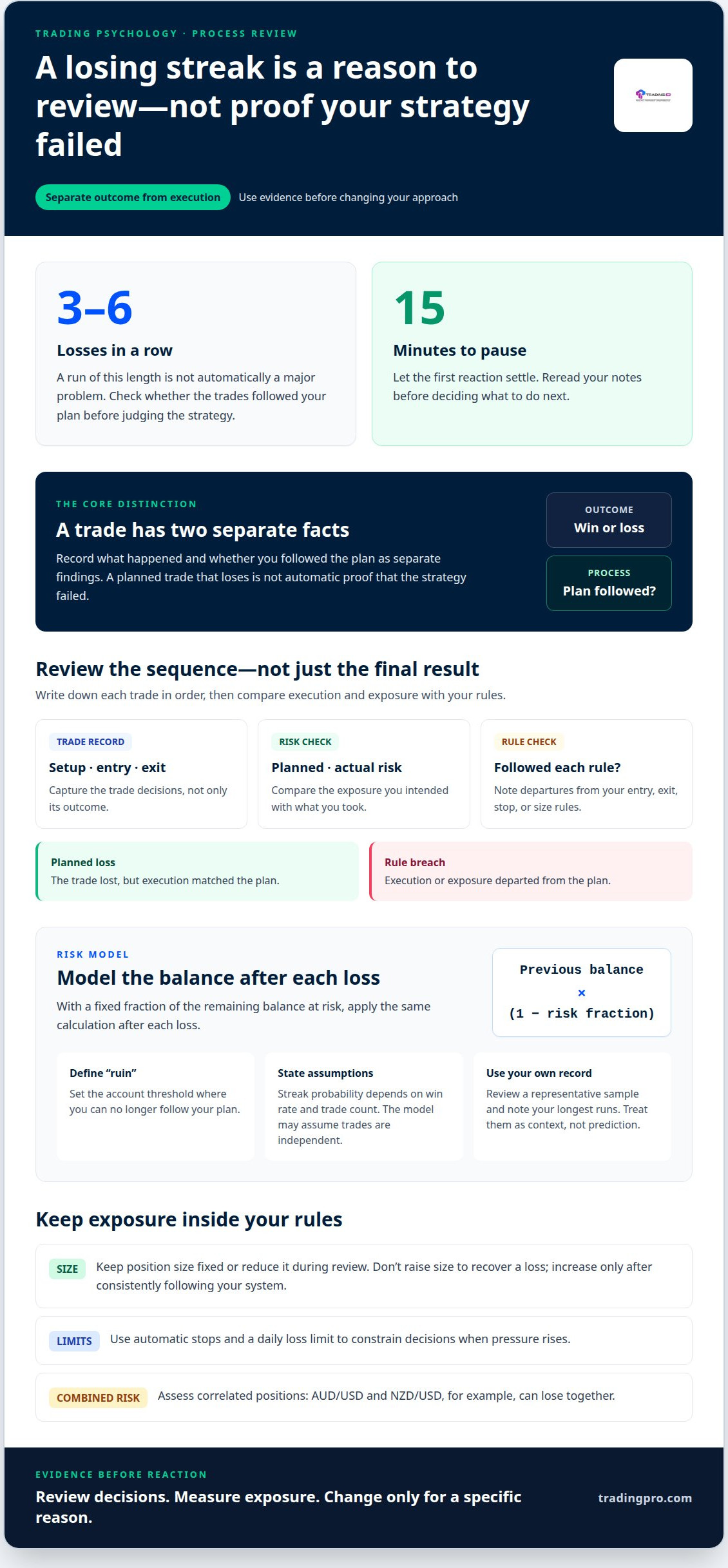
Distinguishing a genuine losing streak from rule-breaking
Three to six losses in a row don’t automatically show that your process failed. Use a fixed review sequence to distinguish ordinary outcomes from changes in execution or exposure.
- Freeze risk decisions before reviewing the streak. Don’t increase position size, loosen a stop, or add trades to recover losses. Keep your existing risk rules in force while you examine the evidence. This prevents the review itself from becoming an excuse to take on new exposure. If your plan includes a daily loss limit, treat reaching it as a stop signal, not a reason to override the plan.
- Verify the sequence using your trade records. List each trade in order, including its setup, entry, exit, size, and result. Confirm that the trades belong to the same strategy and review period. A sequence of four losses can look different if a winning trade was omitted or trades from separate strategies were mixed. Use timestamps and completed trade records, not memories shaped by the latest result.
- Compare each trade with the dated plan that existed before it. Check whether the setup qualified, the entry and exit followed the rules, and exposure stayed within planned limits. Mark each item as followed or changed; don’t treat a losing result alone as evidence of a breach. For example, a planned entry at the prescribed size remains a rule-following trade even if its stop is hit.
- Test the streak against an explicit model, and keep the model’s assumptions fixed during review. State its win probability, trade-independence assumption, strategy, and sequence length before interpreting the result. Don’t change the assumed win rate because this particular run ended in losses. If consecutive trades share risk or depend on similar market conditions, note that the independence assumption may not fit the sequence.
- Act only on evidence that your model and plan can assess. A rule breach is a documented deviation, such as doubling size or entering without the required setup. A losing streak with plan-compliant trades is an outcome sequence, not proof of misconduct. If you find a deviation, identify the exact rule and the trade where it occurred. If you find none, preserve the process and review future trades against the same criteria.
How should traders calculate risk of ruin after consecutive losses?
Separate the probability of a losing run from the probability of exhausting your trading capital. A fixed-probability model estimates streaks; your risk rules and account constraints determine what those losses mean for your plan.
- Define the outcome you’re measuring before calculating anything. A run of losses isn’t automatically account ruin. Specify whether you’re estimating the chance of a streak, reaching a loss limit, or losing the capacity to continue trading as planned. Keep these outcomes separate. A model that estimates five consecutive losses doesn’t, by itself, say whether your account can withstand them.
- Set the model’s assumptions and hold them steady. The examples here use fixed win probabilities, independent trades, and a window of 100 trades. Under those assumptions, a 40% win probability means a 60% loss probability on each trade. Independence means one result doesn’t change the next trade’s probability. Real trades may not fit that assumption, especially when positions share market exposure.
- Estimate how often a run may occur within the chosen window. In this fixed-probability independent-trade model, a 40% win probability gives a 97.6% chance of at least one five-loss run within 100 trades. The chance of at least one eight-loss run is 49.0%. These are probabilities of encountering runs, not direct estimates of account ruin.
- Compare the same loss-run lengths across win probabilities. With a 50% win probability, the model gives an 81.0% chance of at least one five-loss run, and a 17.0% chance of an eight-loss run within 100 trades. At a 60% win probability, those chances are 45.9% and 3.6%, respectively. A stronger win rate lowers the modeled chances, but doesn’t eliminate losing sequences.
- Translate a streak into account impact using your actual risk rule. Track how each consecutive loss changes the remaining balance, then compare that balance with your defined loss limit. Fixed-fraction risk compounds against the reduced balance; fixed-amount risk subtracts the same amount each time. Don’t treat a streak probability as a forecast of your personal balance without applying your exposure.
- Use the result to test resilience, not to predict the next trade. Consecutive losses occur even in profitable systems, and each trade should follow fixed risk rules regardless of recent outcomes. If you’re ready to put a measured plan into practice, register and start trading with defined risk limits.
TradingPRO: Rookie Account
TradingPRO’s Rookie Account is an option for beginners who want an account suited to their stage of trading. Use the process checks in this guide first: identify whether the streak involved rule-breaking, review your exposure, and set clear limits before deciding how to proceed. An account choice can support your trading journey, but it can’t determine whether a strategy is sound or guarantee a particular result.
If you’re comparing account options, explore the Rookie Account details and consider whether they fit your current approach. Contact TradingPRO if you’d like to discuss the Rookie Account.
Make your next decision from a position of control
A losing streak can test your discipline, but it doesn’t have to define your next move. Let the record guide your decisions, and give yourself room to distinguish a difficult outcome from a process that needs adjustment. The psychology of a rookie trader after a first losing streak can shift when progress means consistent execution, not immediate recovery.
As you decide how to continue, choose an account option that fits your current trading approach. TradingPRO offers the Rookie Account, Micro Account, and Pro Account. Treat the account decision as one part of a broader plan, alongside clear risk limits and a routine you can follow under pressure.
Take your next step deliberately. Contact TradingPRO to discuss your next steps, and keep building your process trade by trade.
Frequently Asked Questions
Step 2: How to proceed?
Choose your next action only after identifying what the losses changed, if anything. If your records show an execution mistake, address that specific behavior before trading again. If you followed your plan, avoid changing your strategy just to feel in control. Set a clear condition for your next session, such as stopping when you notice rushed entries, and decide beforehand what would prompt another review.
What emotional reactions do beginner traders commonly experience after a losing streak?
Beginners may feel frustration, anxiety, embarrassment, self-doubt, or an urgent need to recover losses. These reactions can show up as repeatedly checking prices, hesitating on planned entries, or entering trades without a clear setup. Notice the behavior as well as the feeling. For example, if you start changing a stop because you’re afraid of another loss, step away from the screen before making another decision.
How can a new trader tell whether losses are normal variance or a flawed strategy?
Look for a repeated weakness in your decisions, not just a run of negative results. A strategy deserves closer review when its setups repeatedly fail under similar conditions or its rules prove difficult to apply consistently. Compare current trades with the conditions the strategy was designed for. A single cluster of losses can’t establish that pattern; changing the method before finding one risks confusing discomfort with evidence.
When should a beginner pause trading after repeated losses?
Pause when emotions are driving decisions, you’re struggling to follow your written limits, or results are worsening alongside rushed execution. A pause is useful when it prevents another reactive trade, not when it becomes a promise to return only after recovering losses. Use the time to sleep, reset your routine, and decide what observable behavior would show you’re ready to resume. Persistent distress is a reason to seek appropriate support.
What steps should a trader take to review and journal a losing streak?
Give every entry a consistent structure: record the market condition, the reason for entering, what you expected, and what you felt before and after the trade. Tag observations as facts or interpretations. For instance, “closed before planned exit” is a fact; “the market targeted me” is an interpretation. At review, look for recurring conditions or behaviors, then write one question to investigate rather than rewriting your rules immediately.


