




- Published on: 2026-10-02 18:32:00
Small Account, Big Decisions
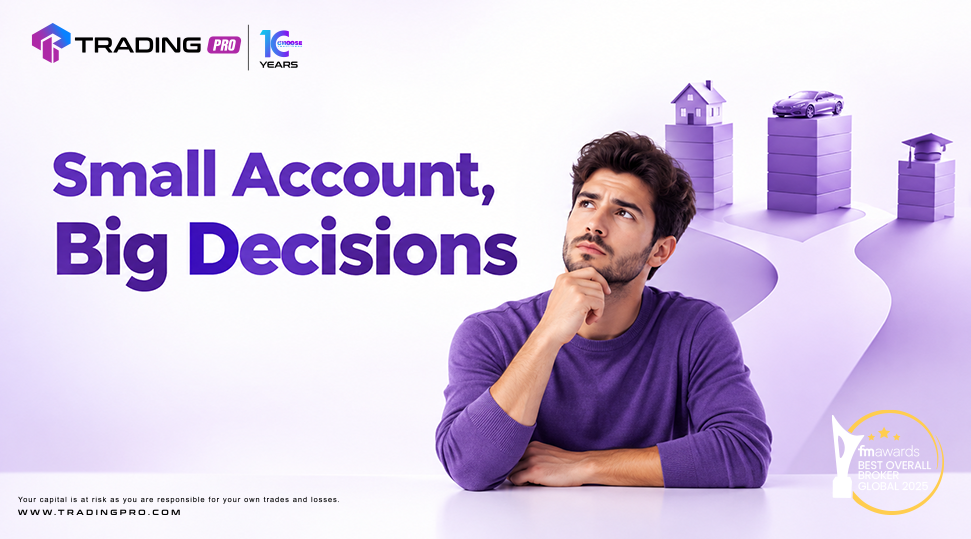
A small trading account can make every decision feel significant.
When available capital is limited, traders may feel pressure to generate meaningful returns quickly. A single winning trade can seem like a major opportunity, while a loss may feel disproportionately large.
This pressure can encourage decisions that are not part of a well-defined trading strategy.
For individual traders across the MENA region, where people enter financial markets with different levels of experience and available capital, understanding how to approach a smaller account is an important part of financial and trading education.
The challenge is not simply finding trades. It is learning how to manage limited capital without allowing the account balance to dictate every decision.
The Pressure to Grow an Account Quickly
One of the most common challenges for traders with smaller accounts is the desire to grow their balance as quickly as possible.
A trader may set an ambitious target and then feel that ordinary market movements are not enough to reach it.
This can lead to taking larger positions, increasing leverage, or entering trades that do not meet the original strategy’s requirements.
The problem is that trying to accelerate account growth also increases the potential for losses.
A trading account does not become more secure simply because the trader wants faster results. The market remains uncertain regardless of the size of the account or the target being pursued.
Position Sizing Starts With Risk
Position sizing is the process of determining how large a trade should be.
For traders with smaller accounts, this decision can have a particularly important effect on overall performance.
Instead of choosing a position size based on the profit they hope to make, traders can begin by deciding how much of their available capital they are prepared to risk.
For example, a trader with a small account may decide to limit the amount risked on any individual trade to a predefined percentage of the balance.
The appropriate amount depends on the trader’s circumstances, strategy, and risk tolerance. There is no single percentage that is suitable for everyone.
The important principle is that position size should reflect the risk the trader can afford to take, rather than the return they hope to achieve.
Why Leverage Can Change Everything
Leverage allows traders to control a position larger than the capital they commit as margin.
While this can increase market exposure, it also magnifies the effect of price movements on the trader’s available capital.
A relatively small movement in the market can therefore produce a significant gain or loss relative to the margin used.
This can make leverage particularly tempting for traders who believe their account is too small to generate meaningful returns without taking additional exposure.
However, increasing leverage does not improve the quality of a trading strategy or make a market prediction more accurate.
Traders should understand the leverage available on their account, the margin requirements, and the possibility of rapid losses before using it.
The Difference Between a Small Account and a Small Risk
A smaller account does not automatically mean that every trade has to involve a large percentage of capital.
The amount of risk depends on several factors, including position size, entry price, the distance to the stop-loss, and the characteristics of the instrument.
Traders can use position-sizing calculations to determine whether a proposed trade fits within their risk limits.
If the minimum trade size available on a platform creates more risk than the trader is comfortable taking, the setup may not be suitable for that account.
In such cases, waiting or choosing an instrument with different trading conditions may be more consistent with the trader’s plan.
The Psychology of Every Loss
A loss can feel different when the account balance is small.
Traders may become concerned about how much of their capital remains and feel pressure to recover the amount as quickly as possible.
This can lead to revenge trading, where a trader opens another position mainly to recover a previous loss.
The next trade may then be based on frustration rather than market analysis.
A more structured approach is to evaluate the trade according to the original plan. If the position followed the strategy and stayed within the predefined risk limit, a loss does not automatically mean the decision was poor.
Markets involve uncertainty, and even a carefully planned trade can result in a loss.
Avoid Comparing Your Account to Others
Online trading communities and social media can create unrealistic expectations about account growth.
Traders may see screenshots of large profits or claims about rapid returns without knowing the capital involved, the risk taken, or the full history of the account.
Comparing a personal account with an isolated result from someone else can encourage unnecessary risk-taking.
A trader’s circumstances, experience, available capital, and financial obligations are different from those of other market participants.
For traders in the MENA region, as in other markets, focusing on personal financial limits and a consistent process can be more useful than trying to match someone else’s results.
Build Consistency Before Expanding
A smaller account can provide an opportunity to focus on developing trading habits.
Rather than concentrating only on the balance, traders can track whether they follow their entry criteria, respect their risk limits, and record their decisions.
A trading journal can help identify recurring mistakes and evaluate how the strategy performs across different market conditions.
Demo trading can also be useful when testing a new approach or learning how a platform works.
The purpose is to develop a process that can be reviewed and improved over time, without assuming that a larger account or more aggressive position size will automatically produce better results.
Protecting Capital Is Part of the Strategy
Capital management is not separate from trading strategy.
A strategy that identifies potential entries but ignores the size of possible losses is incomplete.
Traders can establish clear limits around the amount they are prepared to risk on an individual trade and the total exposure they are willing to maintain.
They can also define conditions under which they will stop trading for a session, particularly after repeated losses or when emotions begin affecting their decisions.
These rules can help prevent a difficult trading session from turning into a series of increasingly risky decisions.
Trading Capital Is Not Everyday Money
Before entering financial markets, traders should distinguish between money available for trading and money needed for everyday expenses.
Funds required for rent, bills, debt payments, emergency savings, or other essential commitments should not be treated as trading capital.
Trading involves the possibility of losing money, and no strategy can guarantee a profit.
For people who are still learning about financial markets, understanding this distinction is an important part of making informed decisions about whether and how to participate.
A trading account should reflect what an individual can afford to risk, not what they need to earn.
Conclusion
Trading with a small account involves more than finding opportunities to increase the balance. It requires careful decisions about position sizing, leverage, risk limits, and emotional discipline.
For traders across the MENA region, developing a structured approach can help keep trading decisions connected to personal financial circumstances rather than unrealistic expectations or pressure to generate quick returns.
A smaller account does not remove market risk, and no trading approach can guarantee consistent profits. Understanding those limitations is part of building a more informed relationship with financial markets.
TradingPRO provides educational resources to help traders strengthen their knowledge of position sizing, risk management, and disciplined trading decisions.
Start Your Trading Journey with TradingPRO
Ready to take the next step in your trading journey? Register your TradingPRO account and explore the available trading options.
Want to keep learning about the markets? Follow TradingPRO across our social media channels for market insights, trading education, and updates.


