




- Published on: 2026-08-26 22:51:00
Support and Resistance: A Practical Guide for MENA Traders
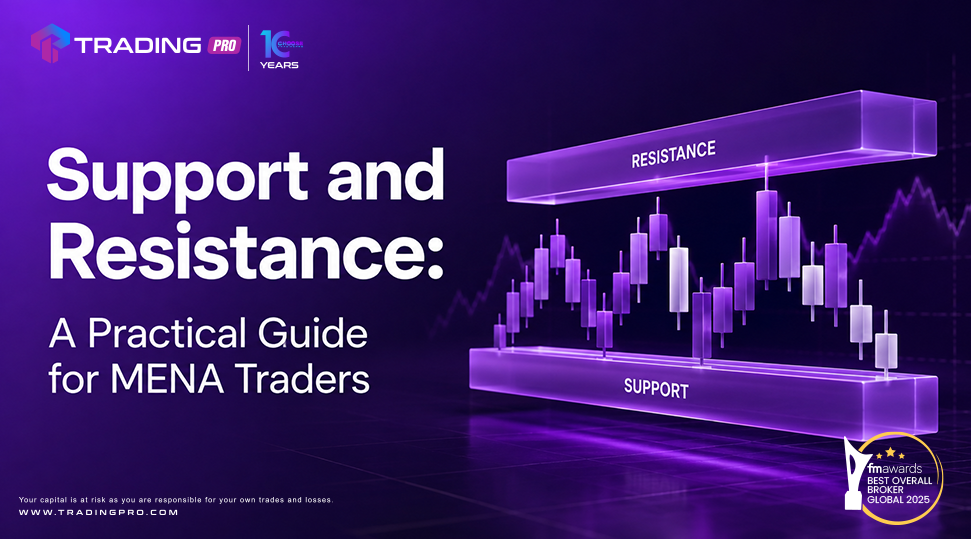
Understanding how prices move is one of the foundations of technical trading. While financial markets can be influenced by economic data, geopolitical developments, and investor sentiment, traders can also use historical price behavior to identify areas where buying or selling pressure may increase.
Two of the most widely used concepts in technical analysis are support and resistance.
These levels can help traders understand where prices have previously struggled to move lower or higher. For MENA traders following forex, commodities, indices, or other financial markets, learning how to identify these areas can provide useful context when analyzing a chart.
What Are Support and Resistance?
Support and resistance are price areas where the market has historically shown a stronger reaction.
What Is a Support Level?
A support level is an area where selling pressure has previously weakened and buying interest has appeared.
When the price approaches this area again, traders may watch for signs that buyers are becoming more active.
However, support does not guarantee that the price will stop falling. If selling pressure becomes strong enough, the level can eventually break.
What Is a Resistance Level?
Resistance is the opposite.
It is an area where upward price movement has previously faced stronger selling pressure.
When the price approaches resistance, traders may watch for signs that the upward movement is losing momentum.
As with support, resistance is not an impenetrable barrier. A strong market move can push the price through it.
How Traders Identify These Levels
Support and resistance can appear in different forms on a chart.
Previous Highs and Lows
One of the simplest ways to identify potential levels is by looking at previous price highs and lows.
If the market repeatedly reacts around a similar price area, traders may consider it a level worth monitoring.
The more consistently the market reacts around an area, the more attention it may receive from traders.
Psychological Price Levels
Some price levels attract attention simply because they are easy to remember.
For example, round numbers can sometimes become psychologically important to market participants.
These levels should not automatically be treated as support or resistance, but they can be useful areas to monitor alongside other forms of analysis.
Support Can Become Resistance
One important concept for traders to understand is that support and resistance can change roles.
If a support level breaks decisively, traders may later watch that same area as potential resistance.
The opposite can also happen.
A resistance level that is broken may later act as support if buyers continue to show strength.
Why Does This Happen?
Market participants may remember previous price levels and adjust their decisions when the market returns to them.
This can create a change in the balance between buying and selling pressure.
Understanding this concept can help traders interpret price action instead of viewing every level as permanently fixed.
Using Support and Resistance With Other Tools
Support and resistance are most useful when they are part of a broader technical analysis process.
Combine Levels With Price Action
Rather than entering a trade simply because the price reaches a support or resistance area, traders can look for additional confirmation.
This could include changes in price structure, momentum, or other technical signals.
The objective is to build a stronger trading setup instead of relying on a single factor.
Use Multiple Timeframes
A level visible on a short-term chart may not have the same significance on a longer-term chart.
Looking at multiple timeframes can help traders understand the broader market structure before focusing on a specific entry.
For example, a trader might examine a longer-term chart to identify the broader trend before using a shorter timeframe to study potential entry areas.
Support and Resistance in MENA Markets
MENA traders may follow a variety of instruments influenced by both regional and global developments.
Oil prices, currency movements, interest rate decisions, and international economic data can all affect market conditions.
Technical levels can provide one way to analyze how prices are responding to these developments.
For example, if a major economic announcement causes a sharp market movement toward a previously identified resistance area, traders can monitor how price behaves around that level rather than automatically assuming that resistance will hold.
Common Mistakes to Avoid
Treating Levels as Exact Prices
Support and resistance are often better understood as areas rather than exact prices.
Markets can move slightly above or below a level before reversing, so expecting a precise reaction at one specific price can create unrealistic expectations.
Ignoring the Broader Market Context
A technical level should not be analyzed in isolation.
Major economic announcements, unexpected geopolitical developments, or significant changes in market sentiment can cause prices to move through previously established levels.
Entering Without a Risk Management Plan
Identifying a strong technical level does not eliminate trading risk.
Before entering a position, traders should understand how much they are willing to risk and consider how the trade fits into their overall strategy.
Building a Simple Technical Analysis Routine
For traders who are still developing their technical skills, support and resistance can be a useful starting point.
A simple routine could involve:
-
Identify the broader market trend.
-
Mark important previous highs and lows.
-
Identify potential support and resistance areas.
-
Observe how price behaves when approaching those areas.
-
Look for confirmation from other technical factors.
-
Define the potential risk before entering a trade.
-
Review the result and record what was learned.
This process can help traders develop consistency without relying on complicated strategies.
How TradingPRO Can Support Technical Analysis
TradingPRO provides trading tools and educational resources that can help traders develop their understanding of financial markets and technical analysis.
For MENA traders, combining chart-based analysis with market knowledge, risk management, and continuous education can provide a more structured approach to analyzing potential trading opportunities.
Technical tools should support a trader’s decision-making process rather than replace it.
Conclusion
Support and resistance are fundamental concepts in technical analysis and can help traders better understand how price has behaved around important market areas.
For MENA traders, these levels can be used alongside broader market analysis to study price movements across different financial instruments.
The key is not to treat support or resistance as a guaranteed prediction of what will happen next. Instead, traders can use these areas as part of a structured process that combines technical analysis, confirmation, and responsible risk management.
Start Your Trading Journey with TradingPRO Global
Ready to take the next step in your trading journey? Visit TradingPRO Global to register your account and connect with TradingPRO across our social media channels.


