





Stop Loss
Learn what a stop loss is, how to place it at structural levels, how it connects to position sizing, and why moving it against you is the costliest mistake.
Authorship
Written by

Forex Market Analyst , an ICT Chartered Graduate with 18 years of live trading experience in forex, gold, and crypto.
Reviewed by

Forex market analyst and educator with a strong focus on technical analysis and trader psychology.
Key Takeaways
- A stop loss is an order placed with the broker that automatically closes a trade when price reaches a specified level in the losing direction. It defines the maximum loss before any further decision is required. Without it, the maximum loss on any trade is unlimited.
- Stop losses must be placed at structural levels that invalidate the trade's logic, not at arbitrary pip distances from entry. A stop at the wrong level either gets triggered by normal market noise or sits so far away that the loss when it triggers is too large.
- The stop loss distance determines position size. The two are calculated together before the trade opens. A wider structural stop requires a smaller position. A tighter structural stop allows a larger position. The account risk percentage stays constant regardless of which trade is being placed.
What Is a Stop Loss?
Every trader enters the market hoping to make a profit. Yet no trader wins every trade. Even the most experienced traders encounter losing trades because the market is uncertain: news events, unexpected economic data, and shifts in sentiment can all cause a trade to fail. The difference between traders who last and those who do not is not that the former avoid losses. It is that they control them. A stop loss is the primary tool for that control.
If you have not yet read Risk Management, start there before continuing.
A stop loss is a predetermined price level where a trade is automatically closed if the market moves against you. Before entering a trade, the trader decides: if the market reaches this level, the trade idea is no longer valid. The stop loss is placed at that level. If triggered, the trade closes automatically and the loss is contained. If price moves in the expected direction, the stop remains untouched and the trade continues toward its target. This simple process removes the emotional decision from the moment a loss is growing.
Why every trade needs a stop loss
Without a stop loss, traders hold losing trades hoping for recovery, increase losses unnecessarily, allow emotion to override analysis, and risk large portions of their account on what started as a small adverse move. A stop loss protects both the capital and the discipline. It tells the market: this trade has a defined limit and will not be held indefinitely if the conditions change.
How Does It Work?
Structural placement: the core principle
A stop loss should never be placed randomly. It must be based on market structure: the level where, if reached, the original trade idea is invalidated. For a long trade, that means below the most recent swing low that the setup depends on. For a short trade, it means above the most recent swing high. The stop is not placed at those exact levels but 10 to 15 pips beyond them.
The buffer matters. Obvious price levels attract institutional order flow that temporarily pushes price through them to trigger retail stops before reversing. This is called stop hunting. Placing the stop 10 to 15 pips beyond the obvious structural level accounts for this without placing it so far away that a genuine structural break is required to trigger it.
Long trade example: stop below support
Imagine EUR/USD pulling back to a key support zone in an established uptrend and forming a bullish engulfing candle. The trader buys at 1.1672. The recent swing low sits at 1.1660. A logical stop goes at 1.1645, roughly 15 pips below the swing low. If price closes below 1.1645, the support that justified the buy is broken and the bullish setup has failed.
Short trade example: stop above resistance
Imagine GBP/USD rallying into a known resistance zone in a downtrend and forming a bearish engulfing candle. The trader sells at 1.3260. The recent swing high sits at 1.3280. A logical stop goes at 1.3295, roughly 15 pips above the swing high. If price closes above 1.3295, the resistance that justified the short is broken and the bearish setup has failed.
ATR-based placement
The Average True Range measures how much a pair typically moves over a given period. Placing a stop at 1.5 to 2 times the ATR from the entry gives the trade room to breathe within the pair's normal daily movement. ATR-based stops are especially useful when the nearest structural level is further away than the ATR suggests is necessary, as they prevent stops from being placed so wide that the required position size becomes impractically small.
The position size calculation
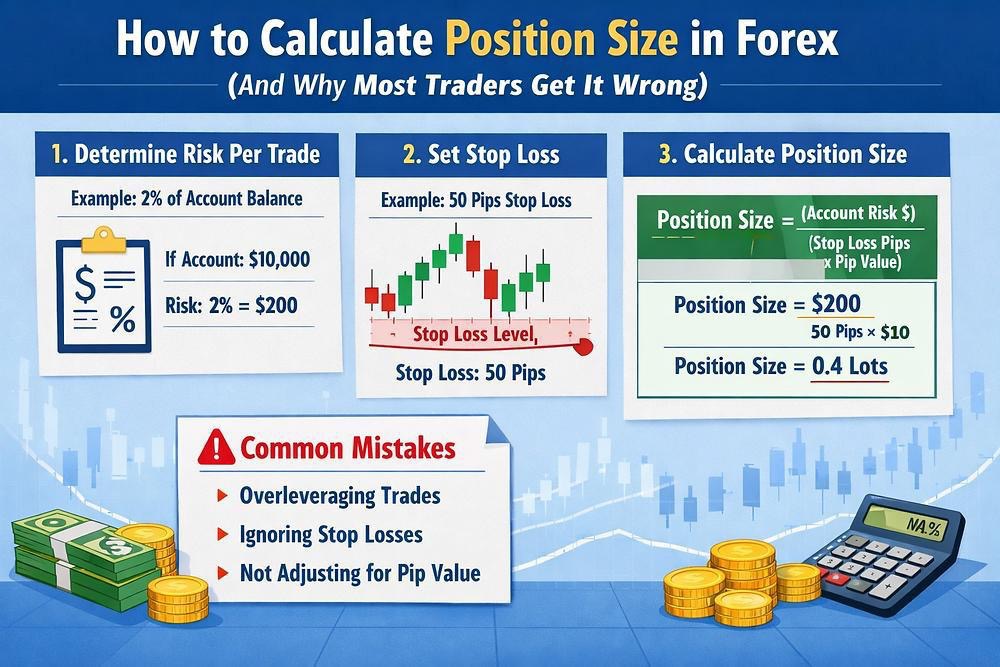
The stop loss distance and the account risk percentage determine position size. This is the most important formula in trade construction:
Position size = risk amount divided by (stop loss in pips multiplied by pip value)
Risk amount = account balance multiplied by risk percentage (typically 1 to 2%)
For a $10,000 account risking 1%, the risk amount is $100. If the stop is 20 pips and the pip value on EUR/USD is $10 per standard lot, the position size is $100 divided by $200, which is 0.5 lots. If the stop is 40 pips, the position halves to 0.25 lots. The account risk stays constant at $100. The position adjusts to the structural stop distance. Never work in the opposite direction by deciding position size first and then looking for a stop to fit. That produces stops at arbitrary levels that ignore the structure.
Stop loss is not a sign of failure
Many beginners view being stopped out as losing. Professional traders see it differently. A stop loss is the cost of doing business. Small controlled losses are normal and already accounted for in the strategy's expectancy calculation. Large uncontrolled losses are optional. Successful traders protect capital first. A stopped-out trade that followed the rules is not a failure. It is the strategy working exactly as designed.
Should you ever remove a stop loss?
This is one of the most common and most expensive errors in trading. A losing trade becomes uncomfortable. Instead of accepting the planned loss, the trader removes the stop and hopes for a reversal. Sometimes the market does reverse. More often it does not. One uncontrolled trade can erase weeks of steady progress. The stop loss should only be adjusted according to the written trading plan: moved to breakeven once a defined profit threshold is reached, or trailed behind structural levels as the trade progresses. It is never removed because of hope.
Breakeven stops
Once a trade has moved at least 1:1 in profit relative to the initial risk, moving the stop to the entry price eliminates the possibility of a losing outcome on a trade that was ahead. The rule for when to move to breakeven should be defined before the trade opens. Moving it too early, before the trade has established enough distance from the entry, risks being stopped on a normal pullback before the move has developed. Moving it at a defined structural milestone removes the subjectivity from the decision.
Example
The EUR/USD ascending trendline documented in the Trendlines article in this series provides a complete stop loss placement and position sizing illustration. All trendline contact point data is confirmed in that article.
| Stop Loss Component | EUR/USD Trendline Trade: May 2026 |
| Entry | Long at 1.1672, trendline third contact (5 May 2026) |
| Trendline structure | Rising lows: 1.1411 (9 Apr), 1.1616 (22 Apr), 1.1672 (5 May) |
| Stop placement | 1.1655, below the 5 May trendline contact low |
| Buffer applied | 17 pips below entry, accounting for wick noise at the trendline |
| Structural justification | Close below 1.1655 breaks the ascending trendline; the three-point structure is invalidated |
| Account balance | $10,000 |
| Risk percentage | 1% ($100 per trade) |
| Pip value (EUR/USD, standard lot) | $10 per pip |
| Position size calculation | $100 divided by (17 pips multiplied by $10) = 0.59 lots |
| Rounded position size | 0.6 lots (60,000 units) |
| Actual outcome | EUR/USD traded above 1.17 by second week of May 2026 (stop not triggered) |
The stop at 1.1655 was placed because it sits below the third trendline contact low at 1.1672 with a 17-pip buffer. A close below 1.1655 would have broken the trendline connecting all three rising lows, removing the structural basis for the long position. The stop was not placed at exactly 1.1672 because that exposes it to a brief wick through the level. It was not placed at 1.1640 because that would be further away than the structural invalidation requires, producing a larger loss if wrong and a smaller position size than the setup justifies.
The position size of 0.59 lots was calculated directly from the stop distance. The same $100 account risk applied regardless. If the trendline contact had required a 30-pip stop instead, the position would have been $100 divided by $300, which is 0.33 lots. The risk stays constant. The position adjusts.
Why It Matters
The stop loss is the single mechanism that keeps a strategy's losing trades within the size that the expectancy calculation assumes. Every strategy is tested on the assumption that losing trades produce a loss of approximately 1R, one times the initial risk. If losing trades run beyond their initial stop, the actual losses are larger than the model assumes and the tested expectancy no longer applies to the real results.
The mathematics of losing streaks makes this concrete. A $10,000 account risking 1% per trade and hitting ten consecutive losses reduces to approximately $9,050. That is recoverable. The same account without stops, where each losing trade runs until it closes at a larger loss, can lose 30 to 50% on the same sequence of bad setups. That is not recoverable without a very long period of profitable trading just to return to the starting point.
The stop loss also changes the psychology of losing trades. A trade stopped out at its defined structural level is a trade that followed the rules. The loss was planned for and the position size was calculated with it in mind. There is no reason to feel surprised. A trade held past its stop out of hope produces a larger loss and a compromised decision-making process for the next trade. For the complete framework of how stop losses connect to position sizing, account risk, and long-term capital preservation, read Risk Management alongside this topic.
Common Mistakes
| Mistake | Why It Matters | |
| Mistake 1 | Moving the stop further from entry as price approaches it | Every time a stop is moved away from entry in the losing direction, the original structural justification is overridden by the hope that the trade will recover. The structural level either invalidates the trade when broken or it does not. Moving the stop does not change the structure. It only increases the eventual loss if the structure genuinely fails. |
| Mistake 2 | Placing the stop at round numbers or exact swing lows without a buffer | Obvious price levels attract institutional order flow that temporarily pushes price through them before reversing. A stop placed at exactly the swing low is exposed to a brief wick that does not represent a genuine structural break. A buffer of 10 to 15 pips beyond the obvious level accounts for this without placing the stop so far away that a genuine structural break is required to trigger it. |
| Mistake 3 | Trading without a stop loss at all | Without a stop, the maximum loss on any trade is the entire account balance minus the broker's margin call level. No strategy has an expectancy model that assumes unlimited downside on individual trades. Removing the stop removes the mechanism that keeps the strategy's model connected to the actual results. One uncontrolled trade can erase weeks of steady progress. |
Quick Summary
- A stop loss is an order that automatically closes a trade when price reaches a structural level that invalidates the trade's original logic. It defines the maximum loss before any further decision is required and must be placed before the trade is opened.
- Structural placement puts the stop below the most recent swing low for long trades and above the most recent swing high for short trades, with a 10 to 15 pip buffer beyond the obvious level. The stop distance then determines position size: risk amount divided by stop distance multiplied by pip value.
- The stop loss must not be moved in the losing direction after the trade opens. Small controlled losses are the normal cost of trading. Large uncontrolled losses are optional and avoidable. Protecting capital is the first responsibility of any trader.
Next Steps
You now understand how to place the protective exit with structural precision and how to calculate position size to match it. The next step is the planned exit when the trade works.
Take Profit - Learn how to set profit targets at structural levels, how to evaluate reward to risk before the trade opens, and how to use scale-out exits to balance securing profit with letting winners run.
Risk Management - Revisit the full framework for protecting capital and see how stop loss placement connects to the broader system of position sizing and account risk control.
Take Action
Open a demo chart on EUR/USD at the daily timeframe. Identify the three most recent significant swing lows. For each one, practise placing a stop loss 10 to 15 pips below the swing low, not at the level itself. Then calculate the position size required to risk exactly 1% of a $10,000 account at each stop distance. Notice how the position size changes as the stop distance changes. Then open a recent chart and identify three completed setups. For each, ask where a logical structural stop would have been placed, whether it was based on structure, and whether it would have protected the trade idea without being unnecessarily tight. Run this across five different setups before placing any stop losses on a live account. Your first responsibility as a trader is not to make money. It is to protect the capital that allows you to keep trading. Apply structural stop loss placement across at least 20 demo trades before using it in live trading.


